ULTRA-effective labeling of tandem repeats in genomic sequence
Student9:02CCAI
paperi.ai
0:00 / 0:00
Daniel R. Olson, Travis J. Wheeler
Long-read sequencing reveals repetitive DNA that used to look unmappable—but mutations, insertions, and deletions can hide its repeating structure. ULTRA tackles that problem by modeling the sequence and its errors together.
In the age of long read sequencing, genomics researchers now have access to accurate repetitive DNA sequence (including satellites) that, due to the limitations of short read-sequencing, could previously be observed only as unmappable fragments. Tools that annotate repetitive sequence are now more important than ever, so that we can better understand newly uncovered repetitive sequences, and also so that we can mitigate errors in bioinformatic software caused by those repetitive sequences. To that end, we introduce the 1.0 release of our tool for identifying and annotating locally repetitive sequence, ULTRA Locates Tandemly Repetitive Areas (ULTRA). ULTRA is fast enough to use as part of an efficient annotation pipeline, produces state-of-the-art reliable coverage of repetitive regions containing many mutations, and provides interpretable statistics and labels for repetitive regions. Availability and implementation: ULTRA is released under an open source license, and is available for download at https://github.com/TravisWheelerLab/ULTRA.
Transcript
Long-read sequencing reveals repetitive DNA that used to look unmappable—but mutations, insertions, and deletions can hide its repeating structure. ULTRA tackles that problem by modeling the sequence and its errors together.
In the age of long read sequencing, genomics researchers now have access to accurate repetitive DNA sequence, including satellites, that short read-sequencing limitations previously left as unmappable fragments. Tools that annotate repetitive sequence are now more important than ever, both to understand newly uncovered repetitive sequences and to mitigate errors in bioinformatic software caused by those repetitive sequences.
ULTRA is introduced as a tool for identifying and annotating locally repetitive sequence. It is fast enough for an efficient annotation pipeline, produces reliable coverage of repetitive regions containing many mutations, and provides interpretable statistics and labels.
Tandem repeats of all sorts have long been studied for scientific intrigue and because of their effects on human health. They contribute to protein and RNA function, are involved in gene regulation, influence the evolution and maintenance of centromeres and telomeres, and play a role in genetic diseases.
Both hard-masking and soft-masking require a threshold of repetitiveness to decide what should be masked and what should not be masked. Low thresholds mask too much and reduce annotation sensitivity, while high thresholds mask too little and allow low-scoring decayed repeats to cause false positive hits.
A potential strategy is not to mask at all, but instead to incorporate models of repetitiveness directly into the annotation process. ULTRA began as a prototype HMM-based repeat annotation tool described in an earlier conference paper. Its goals include improving sensitivity and specificity, particularly with high levels of mutation, while providing statistically meaningful annotation scores and consistent, interpretable characterization of repetitive patterns.
The user-ready 1.0 release demonstrates repeat labeling and scoring output, compares performance with TRF and tantan, and shows high genome coverage with a low false labeling rate. ULTRA models tandem repeats using a hidden Markov model, or HMM. The HMM uses a single state for nonrepetitive sequence and a collection of repetitive states that model different repetitive periodicities.
The nonrepetitive state is blind to context and represents expected letter frequencies in background sequence, while each repetitive state is context-sensitive and depends on prior observations. Figure one shows ULTRA’s hidden Markov model: a nonrepetitive state connects through a start state to repetitive states for periods one, two, three, and up to k, with cloud-shaped groups also representing insertion and deletion events.
The emission tables show that nonrepetitive sequence uses background letter probabilities, while a repetitive state favors repeating the letter observed one period earlier. This matters because the model can tolerate substitutions while explicitly accounting for temporary pattern offsets caused by indels, supporting more robust tandem-repeat annotation.
ULTRA’s HMM models indel events with period-specific indel states that account for inserted and deleted letters and for the temporary offset in repetitive pattern caused by indels. ULTRA uses three types of states to model indels: I-states represent insertion events, D-states omit a letter in the repeat pattern, and J-states model the offset that occurs for the p letters following an indel.
I-states emit a letter without regard for the current repeat pattern, while D-states are silent states modeled as omitting a letter in the repeat pattern. A tandem repeat can change from an AC pattern to a GC pattern, yet ULTRA’s repetitive states only compare the letter at position t with the letter p positions earlier and therefore observe only a single mismatch.
Because of that, ULTRA’s repeat model is unaware of the change in pattern, so ULTRA performs a post processing repeat splitting step to annotate such changes. Locations where a change in pattern occurs are called repeat splits, and the repetitive sequence segments isolated by repeat splits are called subrepeats.
Figure three illustrates how ULTRA detects a change within a period-four repeat made of the subrepeats “AAAC” and “GGTT.” It compares adjacent window profiles using Jensen–Shannon divergence: the first and last pairs have similar nucleotide-content profiles and JSD values of zero point four zero, while the middle pair differs substantially, with a JSD of eight point six five and a split marked as passing the threshold.
The result preserves both the full repeat and its two subrepeats in the annotation. For both default and optimized settings, ULTRA produces greater coverage than TRF and tantan. For most genomes, ULTRA also has the smallest false discovery rate, with the notable exception of Plasmodium falciparum, whose highly biased eighty-point-seven percent AT-rich composition is far from ULTRA’s default composition expectation.
For many genomes, ULTRA with tune produces a larger false discovery rate than ULTRA with default settings, especially in the period five hundred coverage experiments. The increased false discovery rate while tuning is primarily caused by tune disabling indel states; for best results, users are suggested to use tune indel.
Figure four compares annotation coverage across five genomes for ULTRA, tantan, and TRF, under maximum repeat periods of ten and five hundred. Plain bars show default settings, textured bars show grid-search optimization, and the additional blue bars show ULTRA with automated tuning.
The false discovery rate appears beneath each bar, making the figure useful for judging coverage alongside the constraint that some parameter choices cannot achieve less than ten percent false discovery rate. Repeat splitting allows ULTRA to find and annotate changes in repetitive pattern.
Figure 6 shows ULTRA’s repeat splitting accuracy for repetitive periods one through ten under substitution rates between zero and zero-point-five. The accuracy test uses artificial repetitive sequences containing two subrepeats, with repeat periods between one and ten and two repeat units sharing no more than fifty percent similarity.
Figure six measures ULTRA’s repeat-splitting accuracy as sequence substitution rate increases from zero to zero point five, across repeat periods one through ten. The authors generated sequences containing two different tandem subrepeats, mutated them at controlled rates, and evaluated five thousand sequences for each combination.
The curves show how accurately ULTRA identifies the boundary between the subrepeats as mutations accumulate, directly testing its ability to detect changes within repetitive patterns. Table 3 shows memory usage and runtime while processing the T2T genome, which is three-point-two gigabytes, with ULTRA, TRF, and tantan.
TRF with a maximum detectable repeat period of ten failed to process all T2T chromosomes without crashing, despite efforts to adjust the dash-l option and increase allocated memory. ULTRA is the only tool capable of multithreading, and all ULTRA analysis was performed using sixteen threads.
Its memory footprint can be decreased linearly by reducing the number of threads. Table three reports user time, wall time, and peak memory while annotating the three-point-two-gigabyte T2T genome with ULTRA, tantan, and TRF.
The authors ran ULTRA with sixteen threads on CPUs with ninety-four cores and five hundred twelve gigabytes of RAM, while TRF could not process all T2T chromosomes with a maximum repeat period of ten without crashing. The table matters because it makes the computational costs and scalability of these annotation approaches directly comparable across repeat periods of ten and five hundred.
ULTRA combines context-sensitive repeat modeling, indel-aware states, and repeat splitting to label difficult repetitive DNA. In the reported comparisons, it achieves greater coverage than TRF and tantan, while generally maintaining the smallest false discovery rate.
A derivative work by Paperi · AI-generated script, voice and captions
· pages and figures unaltered
Made with Paperi.
Drop in a research PDF — get a narrated video walkthrough like this one,
with highlights that follow the narration. Free to start.
Sara Spaziani, Alessandro Esposito, Giovannina Barisciano, Giuseppe Quero, Elumalai Satheeshkumar, M. Di Leo, Vittorio Colantuoni, Maria Mangini, Marco Pisco, Lina Sabatino, Anna Chiara De Luca, Andrea Cusano
Breast cancers that look alike can behave very differently. This study uses light to find a key cancer marker on individual cells—and then reveals a surprising change that remains even after that marker is silenced.What if one optical workflow could both map HER2 on an individual cancer cell and read the cell’s broader metabolic state—and then test what changes when HER2 is silenced?
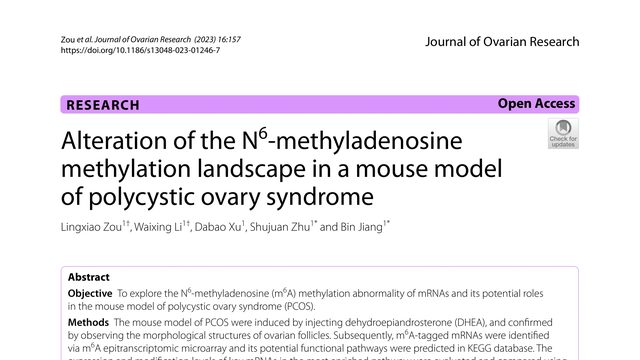
Lingxiao Zou, Waixing Li, Dabao Xu, Shujuan Zhu, Bin Jiang
Polycystic ovary syndrome can affect periods, fertility, and long-term health, yet there is no single treatment for its underlying cause. This study points to a tiny chemical mark on genetic messages as one possible piece of the puzzle.In a mouse model of polycystic ovary syndrome, hundreds of messenger RNAs carried altered m6A methylation—and the strongest pathway signal pointed toward insulin signaling. But correlation is not causation.
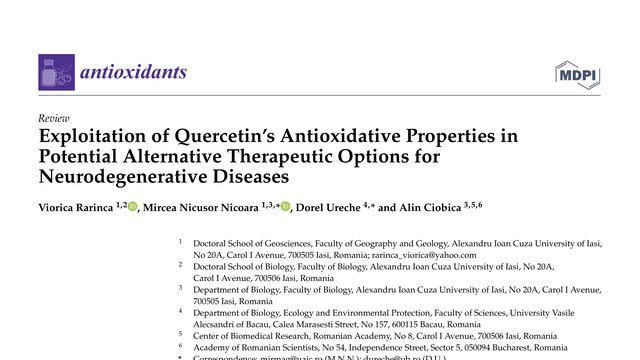
Viorica Rarinca, Mircea Nicoară, Dorel Ureche, Alin Ciobîcă
A compound found in fruits and vegetables may help protect nerve cells from damage linked to aging brain diseases. But the evidence is promising, uneven, and not yet a treatment people can rely on.A plant flavonoid found in ordinary foods may counter oxidative stress, amyloid formation, inflammation, and mitochondrial problems across several brain disorders—but the evidence also includes toxicity and failures.
 4:31
4:31