For some children, staying alive can mean lying under special blue lights for ten to twelve hours every day. This review asks whether future treatments could repair the problem instead of managing it for life.
Crigler–Najjar Syndrome (CNS) is a rare genetic disorder caused by mutations in the UGT1A1 gene, leading to impaired bilirubin conjugation and severe unconjugated hyperbilirubinemia. CNS presents in the following forms: CNS type 1 (CNS1), the more severe form with the complete absence of UGT1A1 activity, and CNS type 2 (CNS2), with partial enzyme activity. This narrative review aims to provide a detailed overview of CNS, highlighting its clinical significance and the need for new, more effective treatments. By summarizing current knowledge and discussing future treatments, this article seeks to encourage further research and advancements that can improve outcomes for CNS patients. The literature analysis showed that CNS1 requires aggressive management, including phototherapy and plasmapheresis, but liver transplantation (LT) remains the only definitive cure. The timing of LT is critical, as it must be performed before the onset of irreversible brain damage (kernicterus), making early intervention essential. However, LT poses risks such as graft rejection and lifelong immunosuppression. CNS2 is milder, with patients responding well to phenobarbital and having a lower risk of kernicterus. Recent advancements in gene therapy and autologous hepatocyte transplantation offer promising alternatives to LT. Gene therapy using adeno-associated virus (AAV) vectors has shown potential in preclinical studies, though challenges remain in pediatric applications due to liver growth and pre-existing immunity. Autologous hepatocyte transplantation avoids the risk of rejection but requires further research. These emerging therapies provide hope for more effective and less invasive treatment options, aiming to improve the quality of life for CNS patients and reduce reliance on lifelong interventions.
Transcript
For some children, staying alive can mean lying under special blue lights for ten to twelve hours every day. This review asks whether future treatments could repair the problem instead of managing it for life. Crigler–Najjar syndrome is a rare inherited disorder characterized by dangerously high levels of unconjugated bilirubin, a condition known as severe unconjugated hyperbilirubinemia.
The condition causes jaundice without the usual breakdown of blood cells. Its most serious danger begins when bilirubin crosses the blood–brain barrier and binds to brain tissue, causing damage to the nervous system.
For the most severe form, blue-light treatment requires whole-body exposure for ten to twelve hours each day, starting from birth. That makes ordinary family life difficult for both patients and caregivers. The treatment does not appear to disrupt daily sleep rhythms, but it significantly restricts travel and social activities.
A liver transplant is definitive, yet it brings donor shortages, possible graft failure, and lifelong immune-suppressing drugs. So the central problem is a trade-off. Liver transplantation is currently the only definitive treatment for the most severe form, and when it happens early, it can greatly improve quality of life and prevent severe complications.
Replacing the factory with a liver transplant can solve the underlying problem, because transplantation is currently the only definitive treatment for CNS1. The syndrome has two forms. The more severe form has no working activity from the affected liver system, causing extreme bilirubin levels and a high risk of irreversible brain damage.
Blue-light treatment and blood-cleansing procedures are temporary. A transplant must happen before neurological damage, while doctors balance early action against surgery and lifelong immune suppression. That is why gene therapy is being tested as another path. Two clinical trials are evaluating gene transfer using modified viruses in patients with the severe form.
In one small study, no serious adverse events were reported. Patients who received the higher dose had lower bilirubin levels and did not need blue-light treatment for at least seventy-eight weeks afterward. The harvested liver cells are genetically corrected outside the body with a lentiviral vector and then transplanted back into the patient.
Because these transplanted hepatocytes are autologous to the patient, this strategy could offer an alternative to undergoing a full liver transplant. Transplanted liver cells offer a less invasive way to improve quality of life and extend the time before a liver transplant is needed.
This approach remains mainly a temporary bridge to eventual liver transplantation for patients with CNS1, rather than a definitive treatment for the disease. More research is needed to help the transplanted liver cells survive long term and to evaluate this treatment’s full potential.
For people with this rare liver disorder, transplanted liver cells often lowered the harmful pigment in the blood, but usually only bought time: many later needed a liver transplant, while a few avoided it during the reported follow-up. The review finds that a transplant can cure the most severe form, but gene-based treatments and transplanted liver cells may eventually reduce the need for major surgery and lifelong immune-suppressing drugs.
A derivative work by Paperi · AI-generated script, voice and captions
· pages and figures unaltered
Made with Paperi.
Drop in a research PDF — get a narrated video walkthrough like this one,
with highlights that follow the narration. Free to start.
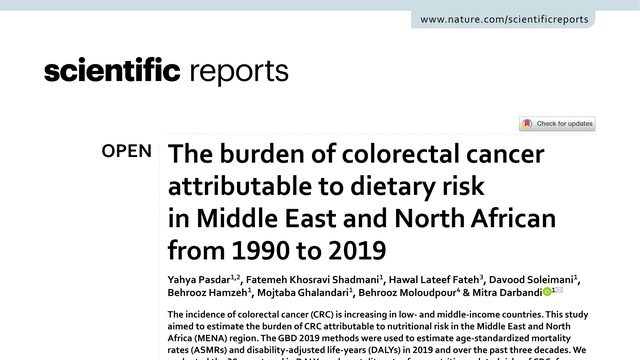
Bowel cancer is rising in lower- and middle-income countries, and this study finds that the share linked with diet increased across all 21 countries examined. What we eat may be part of a changing regional health story.Across the Middle East and North Africa, the burden of colorectal cancer linked to dietary risk increased from 1990 to 2019. The pattern was especially pronounced among men, older adults, and several countries in the region.
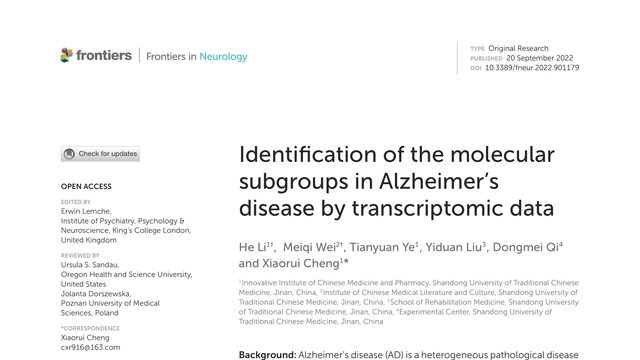
He Li, Meiqi Wei, Tianyuan Ye, Yiduan Liu, Dongmei Qi, Xiaorui Cheng
What if Alzheimer’s disease is not one illness following one path, but several different biological problems hiding under the same diagnosis? This study found three distinct patterns in affected brains.What if Alzheimer’s disease is not one molecular disease at all? By reading gene-expression patterns in hundreds of brain samples, this study separated Alzheimer’s into three subgroups with sharply different biological and clinical profiles.
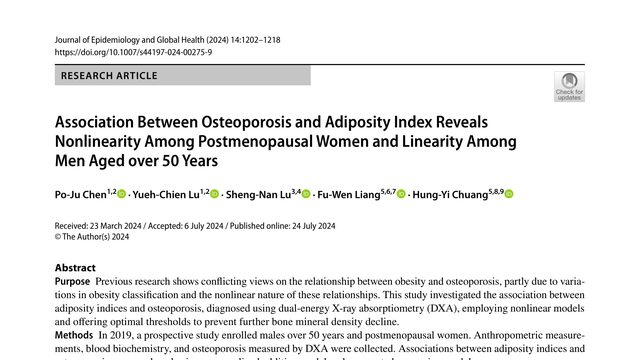
Could carrying more body fat sometimes protect bones, but only up to a point, and differently for women and men? This study finds that the answer is not a simple “more” or “less.”Can body fat be both protective and harmful to bone? This study finds a U-shaped relationship in postmenopausal women, but a linear pattern in men over fifty.
 3:16
3:16