The effects of a firm’s internationalization, age, and environmental turbulence on the capabilities that comprise strategic agility
Overview3:55CCAI
paperi.ai
0:00 / 0:00
Enrique de Diego Ruiz, Paloma Almodóvar, Julian Birkinshaw
When the business world becomes more chaotic, companies do not always become less capable. This study finds that turbulence can actually make them more alert, more responsive, and better able to adapt.
This study investigates a largely unexplored area by examining how internationalization, firm age, and environmental turbulence influence the key components of strategic agility, namely strategic sensitivity, leadership unity, and resource fluidity. Although these factors have been identified as potential catalysts for strategic agility, their specific impacts on strategic agility’s core capabilities have yet to be thoroughly explored. Our research aims to bridge this gap, providing a nuanced understanding of how each of these variables shapes the strategic agility of a firm. The study uses the empirical research of 220 Spanish firms in the service sector and then adopts partial least squares structural equation modeling to analyze the data. Our findings indicate that internationalization has a dual effect on strategic agility: internationalization enhances strategic sensitivity, reflecting improved environmental awareness, but it diminishes leadership unity, illustrating the complexities of global leadership alignment. Additionally, an increase in firm age is associated with a decrease in all the aspects of strategic agility. By contrast, environmental turbulence positively impacts each dimension of strategic agility, suggesting that turbulent conditions can indeed promote the adaptability and responsiveness of a firm.
Transcript
When the business world becomes more chaotic, companies do not always become less capable. This study finds that turbulence can actually make them more alert, more responsive, and better able to adapt. Strategic agility is generally believed to encompass three core capabilities: actively sensing and anticipating changes in the environment, making bold and fast decisions as a leadership team, and quickly reallocating resources as needed.
Think of a company like a rescue crew: it must notice a changing situation, agree quickly on what to do, and move its people and equipment where they are needed. The study examines internationalization, firm age, and environmental turbulence, and their impact on the components of strategic agility.
It analyzes how these factors influence each dimension separately: sensing change, keeping leadership aligned, and moving resources quickly. The study is supported by a survey of Spanish firms in the service sector and uses structural equation modelling to identify the role of these three variables in the three capabilities of strategic agility.
This approach offers practical insights for strategic management and international business. Internationalization has a dual effect on strategic agility: it enhances strategic sensitivity, reflecting improved environmental awareness, but diminishes leadership unity.
An increase in firm age is associated with a decrease in all aspects of strategic agility. By contrast, environmental turbulence positively impacts each dimension of strategic agility, suggesting that turbulent conditions can promote adaptability and responsiveness.
The positive relationship between internationalization and strategic sensitivity suggests that global operations enhance a firm’s ability to adapt to diverse market conditions. But internationalization has a negative relationship with leadership unity, highlighting the challenge of aligning leadership.
The maturity of a firm has a negative relationship with each dimension of strategic agility: strategic sensitivity, leadership unity, and resource fluidity. Older firms may struggle to maintain the awareness and responsiveness needed to navigate a rapidly evolving market, leading to slower adaptation to new demands and technological shifts.
Established routines and ingrained organizational practices may become barriers to the flexible reallocation of resources needed for agile responses to new opportunities and market threats. Environmental turbulence has a positive relationship with strategic sensitivity.
Rapidly shifting conditions elicit adaptive responses from firms. As turbulence intensifies, firms need to enhance their foresight and insight so they are not only reactive but also proactive in the face of market disruptions and trends. This model links international reach, market turbulence, and firm age to three parts of strategic agility: sensing change, staying united as leaders, and moving resources quickly.
It accounts for 30.4% of differences in strategic sensitivity, making clear how these forces may shape a firm’s ability to respond. The study advances understanding of strategic agility within internationalization, firm age, and environmental turbulence. The study advances understanding of strategic agility in relation to internationalization, firm age, and environmental turbulence, while acknowledging limitations that can guide future research.
A company’s flexibility depends on more than size or international reach: age can slow every part of it, while difficult conditions can sharpen its awareness, decisions, and ability to move resources.
A derivative work by Paperi · AI-generated script, voice and captions
· pages and figures unaltered
Made with Paperi.
Drop in a research PDF — get a narrated video walkthrough like this one,
with highlights that follow the narration. Free to start.
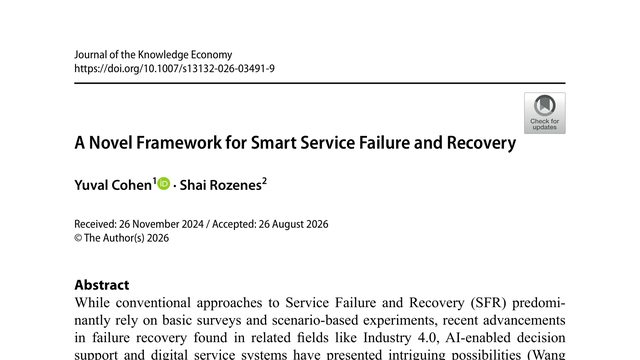
Most services wait for you to complain before they try to help. This framework imagines something different: a service that notices trouble forming, works out why, and starts recovery sooner.What if service recovery did not begin with a complaint? This framework shifts the focus toward continuous monitoring, prediction, diagnosis, and healing before a service failure fully unfolds.
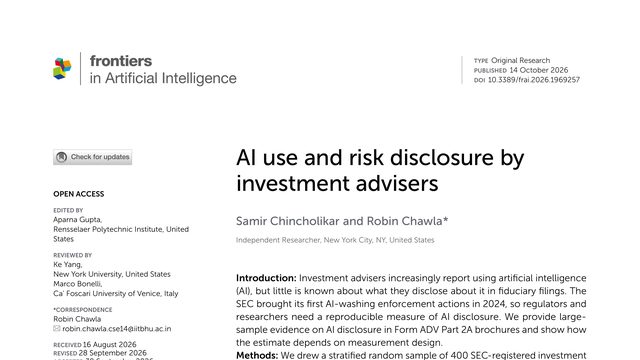
When an investment adviser mentions artificial intelligence, it is slightly more likely to be warning clients about it than boasting about using it. But even that headline depends on how the words are counted.Investment advisers mention AI in nearly a quarter of their fiduciary brochures, but they mention AI-related risks even more often. The surprising part is that the headline percentage changes substantially depending on how disclosure is measured.
Tania Daiana Tobares, Margarita Miguelina Mieras, Fabricio Orlando Sanchez Varretti, José Luis Iguain, Antonio Jose Ramirez-Pastor
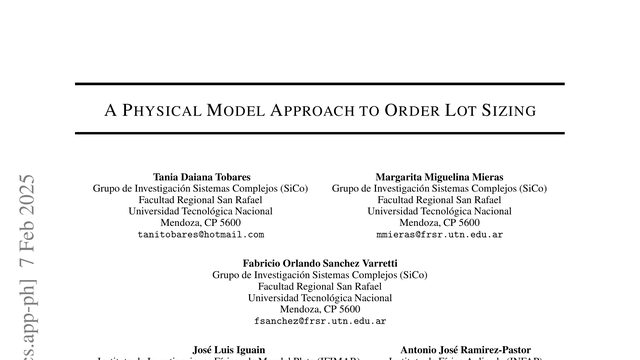
Every company has to choose between ordering often and paying for each order, or ordering in bulk and paying to store the extra. This paper turns that balancing act into the behavior of a simple mechanical system.What if choosing inventory order sizes could be treated like arranging particles connected by springs? This paper turns that physical analogy into an exact lot-sizing solution, avoiding heuristic methods.
 3:17