When an investment adviser mentions artificial intelligence, it is slightly more likely to be warning clients about it than boasting about using it. But even that headline depends on how the words are counted.
Introduction: Investment advisers increasingly report using artificial intelligence (AI), but little is known about what they disclose about it in fiduciary filings. The SEC brought its first AI-washing enforcement actions in 2024, so regulators and researchers need a reproducible measure of AI disclosure. We provide largesample evidence on AI disclosure in Form ADV Part 2A brochures and show how the estimate depends on measurement design. Methods: We drew a stratified random sample of 400 SEC-registered investment advisers from a population of 16,223 firms, crossing adviser type (private-fund vs. wealth/retail) with 2024 assets-under-management (AUM) quartile. A large language model (LLM) classified the 388 available brochures under a prespecified five-label typology: investment-process use, operational or client-service use, AI-related risk, explicit non-use, and named AI vendors. We treated the LLM as a measurement instrument and validated it three ways: same-family reproducibility, blinded cross-family recoding of 180 brochures, and human verification of 158 cases. Secondary analyses compared brochures with 283 matched firm websites and applied a screen derived from SEC enforcement orders. Results: AI use is disclosed in 23.7% of brochures (22.7% survey-weighted), while 27.6% contain AI-related risk language. The within-brochure difference is signifi cant (McNemar p = 0.036). Disclosure rises from 10.4% in the smallest AUM quartile to 43.8% in the largest, and is higher among private-fund advisers. Against human coding, the composite any-use measure achieves precision of 0.76 and sensitivity of 0.81. The same corpus yields estimates of 9.9%, 13.1%, and 23.7% under alternative constructs, adviser universes, and weighting schemes. A literal keyword rule misses or mislabels roughly a quarter of cases. A raw 17.3-percentage-point brochure–website gap disappears after conditioning on document length. None of the five enforce ment-screen matches was adjudicated as an unsubstantiated promotional claim. Discussion: Advisers present AI at least as often as a risk as a capability, and dis closure is concentrated among larger and private-fund advisers. AI-disclosure prevalence reflects measurement design as much as adviser behavior, so esti mates should be reported with their construct, universe, weighting, and valida tion. The validated framework and an open reproducibility capsule provide a baseline for monitoring AI claims and AI-washing in investment management.
Transcript
When an investment adviser mentions artificial intelligence, it is slightly more likely to be warning clients about it than boasting about using it. But even that headline depends on how the words are counted. Investment advisers increasingly report using artificial intelligence, but little is known about what they disclose about it in fiduciary filings.
After the SEC brought its first AI-washing enforcement actions in 2024, regulators and researchers needed a reproducible measure of AI disclosure. The study asks how often advisers disclose AI use, whether disclosure changes with assets under management or adviser type, and whether AI appears more often as a capability or a risk.
The central problem is that an estimate depends on what counts as AI use, which documents and advisers are observed, and how reliably the text is classified. So the study created and locked in a five-label classification framework before looking at the outcomes, with categories designed to distinguish different forms of AI disclosure.
Think of it like sorting mail before opening the envelopes: the result depends on the sorting rules, not only on what is inside. Disclosures related to risks associated with AI occurred more often than affirmative disclosures about AI use. AI appears in investment-adviser brochures as a disclosed technological capability, but more often it is something to be warned about.
A risk reference does not imply that the adviser itself uses AI, so risk disclosure is reported separately from disclosed use. Disclosed use of AI increased substantially across the assets-under-management groups. Among private-fund advisers, disclosure rose from twelve percent in the lowest group to fifty-six percent in the highest; wealth and retail advisers showed the same pattern, rising to thirty point four percent.
The picture makes the widening gap unmistakable: private-fund advisers pull steadily away from wealth and retail advisers as assets under management grow. The independent validation found substantial agreement with the blinded recoding, and the main classifier identified most of the independently identified positive cases.
But the study measures disclosed AI use rather than underlying adoption. The estimates are properties of documents, not of the technologies firms deploy. AI disclosure is not a simple window into what firms actually use.
It is a document-based signal shaped by what advisers choose to say and by how carefully those statements are measured.
A derivative work by Paperi · AI-generated script, voice and captions
· pages and figures unaltered
Made with Paperi.
Drop in a research PDF — get a narrated video walkthrough like this one,
with highlights that follow the narration. Free to start.
Tania Daiana Tobares, Margarita Miguelina Mieras, Fabricio Orlando Sanchez Varretti, José Luis Iguain, Antonio Jose Ramirez-Pastor
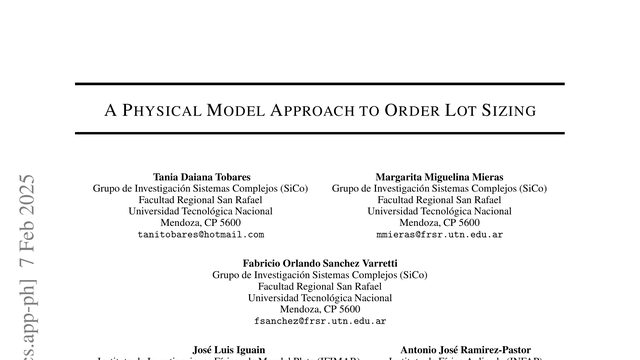
Every company has to choose between ordering often and paying for each order, or ordering in bulk and paying to store the extra. This paper turns that balancing act into the behavior of a simple mechanical system.What if choosing inventory order sizes could be treated like arranging particles connected by springs? This paper turns that physical analogy into an exact lot-sizing solution, avoiding heuristic methods.
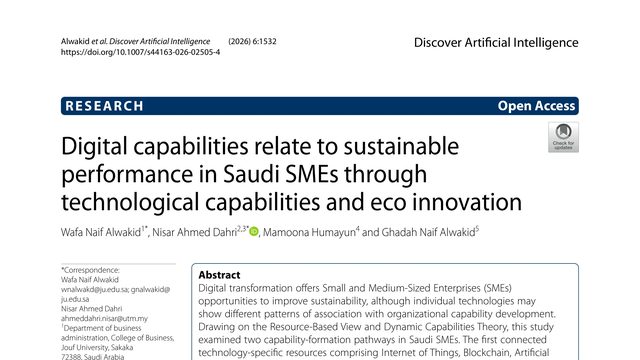
For a small business trying to become more efficient and sustainable, buying the latest digital tool may not be enough. In this study, some tools strengthened a company’s technological ability, but others showed no independent link at all.What if the most famous digital technologies do not all help SMEs in the same way? In Saudi SMEs, artificial intelligence and big-data analytics were linked to stronger technological capabilities, while internet of things and blockchain were not.
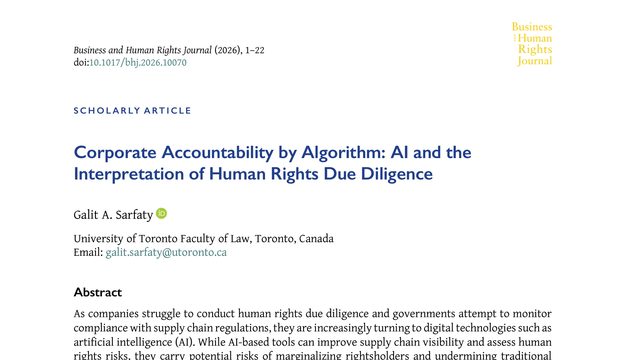
A company may use artificial intelligence to find hidden human-rights risks in its supply chain. But the same system can quietly decide what counts as a risk, and place that judgment in the hands of a private technology firm.AI can make global supply chains more visible and help flag forced-labour risks. But this paper asks a sharper question: when software interprets human rights duties, who is really deciding what counts as a risk?
 3:46