A Novel Framework for Smart Service Failure and Recovery
Overview3:17CCAI
paperi.ai
0:00 / 0:00
Yuval Cohen, Shai Rozenes
Most services wait for you to complain before they try to help. This framework imagines something different: a service that notices trouble forming, works out why, and starts recovery sooner.
Most services wait for you to complain before they try to help. This framework imagines something different: a service that notices trouble forming, works out why, and starts recovery sooner. Service recovery has usually been studied in two separate ways: one asks how people feel and behave after a failure, while the other measures the failure and its effects.
The need is for one framework that brings these two ways of understanding service failure and recovery together. The framework draws on newer work in failure recovery, smart maintenance, decision support, and digital service systems to create a connected way to handle service problems.
It is organized into seven modules, covering watching for trouble, predicting and preventing it, detecting a failure, recording the report, finding the cause, forecasting what may happen next, and supporting recovery. Here is the catch: existing service recovery systems usually begin only after a customer files a complaint.
This framework instead keeps watching the customer, the employee serving them, and the surrounding service situation. Think of it like a careful mechanic who listens to a car before it breaks down, rather than waiting for the driver to return with a dead engine.
The framework forecasts emerging failures, looks for their root causes, and recommends a recovery pathway. The modules are designed to connect with one another, and also with service providers, customers, suppliers, and clients. Together, they provide a broad description of how the framework could organize service failure and recovery.
The framework brings artificial intelligence and other smart techniques into service provision, with a focus on service failure and recovery. The central idea is a novel methodological framework that integrates artificial intelligence and smart techniques into service provision, focusing on service failure and recovery.
In telemedicine, continuous monitoring can detect declining patient satisfaction and trigger a diagnostic analysis while keeping the intervention aware of privacy. The framework also describes monitoring negative sentiment in guest reviews as part of an operational flow.
But the framework cannot simply be switched on. It needs high-quality, well-structured data, while many organizations have data stored in separate places, inconsistent formats, and too little history. Connecting the framework to older systems may require expensive upgrades and shared interfaces, and employee resistance or scepticism can hinder deployment.
The proposed framework combines ideas from smart maintenance and connected industrial systems to address critical challenges in service failure and recovery. For someone using a service, its promise is a robust, innovative, knowledge-based approach that integrates Industry Four Point Zero and smart maintenance to address critical service-failure and recovery challenges.
The framework turns service recovery from a reaction into a connected process that can spot warning signs, investigate causes, and guide a response. In real life, that could mean help arrives before frustration becomes a formal complaint.
A derivative work by Paperi · AI-generated script, voice and captions
· pages and figures unaltered
Made with Paperi.
Drop in a research PDF — get a narrated video walkthrough like this one,
with highlights that follow the narration. Free to start.
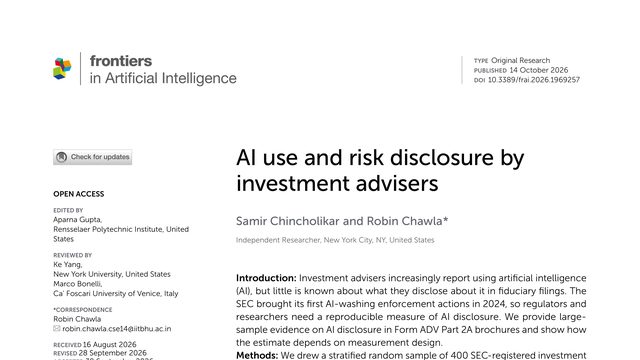
When an investment adviser mentions artificial intelligence, it is slightly more likely to be warning clients about it than boasting about using it. But even that headline depends on how the words are counted.Investment advisers mention AI in nearly a quarter of their fiduciary brochures, but they mention AI-related risks even more often. The surprising part is that the headline percentage changes substantially depending on how disclosure is measured.
Tania Daiana Tobares, Margarita Miguelina Mieras, Fabricio Orlando Sanchez Varretti, José Luis Iguain, Antonio Jose Ramirez-Pastor
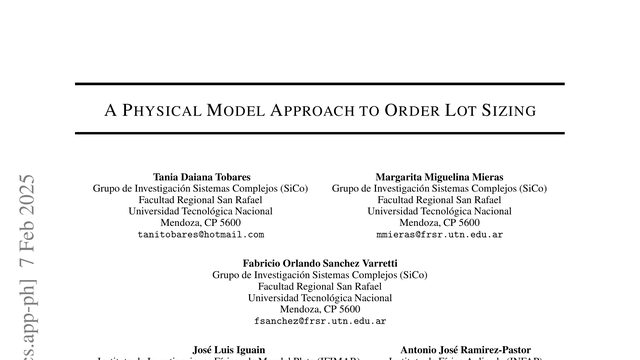
Every company has to choose between ordering often and paying for each order, or ordering in bulk and paying to store the extra. This paper turns that balancing act into the behavior of a simple mechanical system.What if choosing inventory order sizes could be treated like arranging particles connected by springs? This paper turns that physical analogy into an exact lot-sizing solution, avoiding heuristic methods.
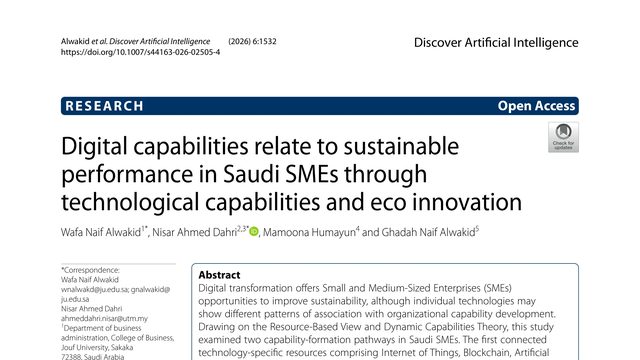
For a small business trying to become more efficient and sustainable, buying the latest digital tool may not be enough. In this study, some tools strengthened a company’s technological ability, but others showed no independent link at all.What if the most famous digital technologies do not all help SMEs in the same way? In Saudi SMEs, artificial intelligence and big-data analytics were linked to stronger technological capabilities, while internet of things and blockchain were not.
 2:41