IoT platforms assessment methodology for COVID-19 vaccine logistics and transportation: a multi-methods decision making model
In depth13:44CCAI
paperi.ai
0:00 / 0:00
Yasir Khalif Ali, Habib Ullah Khan
Keeping a COVID-19 vaccine cold is only part of the challenge. This study asks which Internet of Things platform can manage the wider logistics problem, and its model selects Microsoft Azure IoT.
The supply chain management (SCM) of COVID-19 vaccine is the most daunting task for logistics and supply managers due to temperature sensitivity and complex logistics process. Therefore, several technologies have been applied but the complexity of COVID-19 vaccine makes the Internet of Things (IoT) a strong use case due to its multiple features support like excursion notification, data sharing, connectivity management, secure shipping, real-time tracking and monitoring etc. All these features can only feasible through choosing and deploying the right IoT platform. However, selection of right IoT platform is also a major concern due to lack of experience and technical knowledge of supply chain managers and diversified landscape of IoT platforms. Therefore, we introduce a decision making model for evaluation and decision making of IoT platforms that fits for logistics and transportation (L&T) process of COVID-19 vaccine. This study initially identifies the major challenges addressed during the SCM of COVID-19 vaccine and then provides reasonable solution by presenting the assessment model for selection of rational IoT platform. The proposed model applies hybrid Multi Criteria Decision Making (MCDM) approach for evaluation. It also adopts Estimation-Talk-Estimation (ETE) approach for response collection during the survey. As, this is first kind of model so the proposed model is validated and tested by conducting a survey with experts. The results of the proposed decision making model are also verified by Simple Additive Weighting (SAW) technique which indicates higher results accuracy and reliability of the proposed model. Similarly, the proposed model yields the best possible results and it can be judged by the precision, accuracy and recall values i.e. 93%, 93% and 94% respectively. The survey-based testing also suggests that this model can be adopted in practical scenarios to deal with complexities which may arise during the decision making of IoT platform for COVID-19 SCM process.
Transcript
Keeping a COVID-19 vaccine cold is only part of the challenge. This study asks which Internet of Things platform can manage the wider logistics problem—and its model selects Microsoft Azure IoT. COVID-19 vaccine supply chain management is a daunting task because of temperature sensitivity and a complex logistics process.
The Internet of Things is a strong use case because it supports excursion notification, data sharing, connectivity management, secure shipping, real-time tracking and monitoring. Choosing and deploying the right IoT platform is necessary for these features, but selection is difficult because supply chain managers may lack experience and technical knowledge, and IoT platforms are diverse.
The proposed model uses hybrid Multi Criteria Decision Making and Estimation-Talk-Estimation for survey responses, then checks the results with Simple Additive Weighting. COVID-19 vaccine logistics and transportation involve many factors, including the number of entities, ultra-cooling freezing, delivery testing, materials and organizations.
Those factors create bottlenecks involving integrity, traceability, cold chain management, personnel, tracking information, theft, tampering, coordination, supplies and manufacturing delays. Vaccine integrity means transporting the vaccine from manufacturing to administration while maintaining its original shape, including required temperature thresholds.
mRNA vaccines can lose efficiency at variable temperatures and therefore require a cold chain for storage and transportation. Because conventional development, logistics and administration are not the right solution, the study calls for a digital solution that can reach more people in less time.
The COVID-19 vaccine supply chain is not one activity; it is a series of steps and procedures moving the vaccine from the manufacturing spot to the final delivery location. Figure 1 presents the different phases and entities involved in that COVID-19 vaccine supply chain model.
Figure one maps the COVID-19 vaccine supply-chain procedure from suppliers providing raw materials, to manufacturers receiving orders, and then wholesalers distributing vaccines to pharmacies and hospitals. These facilities receive the vaccine before it is administered to patients, making the figure a clear overview of the entities and sequential stages involved in moving vaccines from production to final delivery.
The study identifies issues through a literature study and highlights them during the COVID-19 vaccine supply chain process. The entire process is affected by hiccups and bottlenecks, so different issues need to be addressed for smooth operation. These challenges occur across manufacturing, distribution and transportation, cold chain management and vaccine administration.
During the pandemic, the main challenge was preserving vaccine integrity, because COVID-19 vaccines are temperature sensitive and require ultra-careful monitoring during shipping. Vaccine integrity is solely dependent on cold chain management, and the success of the supply chain hinges on correct cold chain implementation.
A WHO report estimated that two point eight million vaccine doses were lost in 2011 in five countries because of cold chain failure. Common vaccine storage temperatures range from two to eight degrees, while some coronavirus vaccines may require temperatures as low as minus seventy degrees centigrade.
Table one maps COVID-19 vaccine supply-chain challenges across four phases: manufacturing, logistics and transportation, cold chain management, and administration. It highlights issues ranging from quality control, production inputs, and regulatory approval to routing, tracking, dry ice, temperature monitoring, public reluctance, misinformation, and protecting healthcare staff.
By organizing these bottlenecks by phase, the table shows why vaccine delivery requires coordinated attention from production through final administration. A full-fledged technological solution is described as indispensable for handling vaccine logistics and transportation problems.
After identifying supply chain issues, the study focuses on IoT-based solutions and on selecting the most viable IoT platform. After identifying the challenges, the next step was to select IoT platform alternatives, with the study choosing popular platforms for evaluation.
The study evaluates twenty IoT platforms, including Carriots, AWS IoT, Azure IoT, IBM Watson, Bosh IoT suit, Particle, DeviceHive, Xively, Kaa and Google cloud. The selected platforms are based on expert opinion and industry applications for logistics and transportation.
After selecting alternatives, the framework sets benchmarks or criteria for choosing IoT platforms. The criteria are designed from IoT platform features, with feature analysis used to include the most relevant features covering IoT business needs.
The parameters come from the literature and were consulted with an expert panel in IoT. Table 2 defines the nine evaluation parameters used to assess and rank IoT platforms, from scalability and availability to security, cost, device management, deployment, protocol support, usability, and interoperability.
For each criterion, the authors provide a description and cite the literature sources supporting its inclusion. This matters because these parameters establish the benchmark for the platform-selection framework and reflect the features identified as relevant to IoT business needs.
After finalizing the platform alternatives, the study conducted a survey and a case study to collect platform data and verify the criteria features. IoT platform vendors and supply chain management experts were consulted when finalizing the important features.
The case study followed the Estimate-Talk-Estimate technique, also known as the Delphi method. Experts in the IoT field provided responses about the features selected for the study, and the expert panel's opinions were collected through the technique.
The first round produced intermediate results, while the second round completed data collection about the IoT platforms with respect to the criteria. The focus was to collect the most relevant data for selecting IoT platforms in response to the identified issues.
Figure five outlines the Estimate-Talk-Estimate process used to collect expert responses about IoT platform features and criteria. It begins with questionnaire preparation and a first round using a Delphi method, producing intermediate results; a second Delphi round then leads to the final collected responses.
The figure also shows re-examining the first-round responses and sending feedback to experts, making the iterative structure of the data-collection process explicit. Values assigned by the expert panel could contain bias and subjectivity, so the study aimed to avoid bias in its judgment.
For that purpose, the study applied CRITIC, a Multi Criteria Decision Making method using mathematical and statistical procedures. The first CRITIC step is to build a decision matrix, with its data derived from Table 4. CRITIC assigns the highest weight to scalability, followed by cost, deployment and protocol, which have equal numeric weights.
Figure 6 provides the complete detail of the weights assigned to the features. Figure six shows the feature weights produced by the CRITIC method for evaluating IoT platforms. The horizontal bar chart covers interoperability, usability, protocol support, deployment, device management, cost, security, availability, and scalability, with weights read against the horizontal scale.
The authors use these weights to represent each feature’s contribution before applying TOPSIS to evaluate and rank the platform alternatives. CRITIC assigns weights to the IoT platform criteria features, and the next step is to evaluate and rank the platforms using those features. TOPSIS is applied to evaluate the platform alternatives based on the criteria.
Based on the proposed criteria, Microsoft Azure, identified as platform P3, is the best choice among the IoT platforms in the study. Figure 9 provides the comparison of all the selected IoT platforms. Figure nine reports the platforms consistency index values for the IoT platforms compared in this study.
The horizontal bar chart lists each platform with its corresponding index, including Microsoft Azure IoT at zero point seven two one zero seven two zero nine one, alongside AWS IoT, Carriots, and other platforms. This visual supports the authors’ selection of Microsoft Azure as the preferred choice under the proposed criteria and makes the cross-platform comparison explicit.
The study suggests that Microsoft Azure IoT is the right candidate for shipping COVID-19 vaccine and can support multiple supply chain and logistics features. The platform uses Azure cloud, Azure IoT hub, Azure machine learning and Azure maps to provide smart delivery in logistics and transportation.
Microsoft Azure IoT provides smart transportation infrastructure, assesses road conditions, and manages both real-time and historic traffic through its platform. It uses real-time data to support fleet operations and smart logistics, sending alerts, monitoring performance, and optimizing delivery routes.
The framework was evaluated by consulting an expert group because of its theoretical nature. The evaluation used accuracy, precision and recall, while the features were checked as relevant, irrelevant, recommended or not recommended. The framework used four variables: features recommended by both the experts and framework, features suggested only by the framework, features suggested only by the expert panel, and features suggested by neither.
The expert groups' mean values were all more than four after responses were collected. That result means all expert groups were satisfied with the proposed IoT decision making model. All group members gave positive feedback and favored recommending the framework for selecting an IoT platform for vaccine logistics and transportation.
Table nine reports questionnaire responses from three expert groups across security, usability, information and knowledge, and effectiveness. The table includes item-level ratings and category averages; for example, the security averages are four point one, three point nine, and three point nine, while the cumulative averages are four point zero seven, four point zero two, and four point one zero.
These responses provide the empirical basis for assessing the proposed IoT evaluation framework. The Simple Additive Weighting results also give platform P3 the highest ranking score among the selected IoT platforms. The study concludes from this empirical data that the quantitative results are accurate and consistent, and that the proposed decision making model is validated.
According to Simple Additive Weighting, Microsoft Azure IoT stands at the top of all selected platforms. Figure eleven compares the ranking scores of the selected IoT platforms using the Simple Additive Weighting, or SAW, method. The chart places platforms such as Carriots, AWS IoT, Azure IoT, and IBM Watson alongside the other alternatives on a common ranking-score axis.
The authors use this comparison to support their decision-making model for choosing IoT platforms in vaccine logistics and transportation, identifying P3 as the platform associated with the highest ranking score. The proposed model was validated in two ways: selected criteria features were verified through an expert survey, and the results were confirmed by Simple Additive Weighting and expert groups.
The feature-validation values were ninety-three percent for precision, ninety-three percent for accuracy and ninety-four percent for recall. The results indicate that the selected features cover the most essential aspects of IoT platforms. Survey-based testing suggests that the assessment methodology can evaluate and prioritize IoT offerings intended for COVID-19 vaccine logistics and transportation.
The proposed methodology produces promising results, covers all features and enhances the decision making process, but limitations may affect its practicability and stability. The study's hybrid decision model ranks Microsoft Azure IoT highest, while expert testing and Simple Additive Weighting produce consistent results.
Its value is a structured way to choose platforms for vaccine logistics.
A derivative work by Paperi · AI-generated script, voice and captions
· pages and figures unaltered
Made with Paperi.
Drop in a research PDF — get a narrated video walkthrough like this one,
with highlights that follow the narration. Free to start.
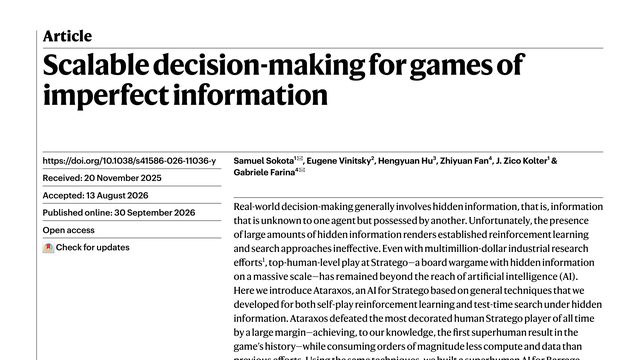
Samuel Sokota, Eugene Vinitsky, Hengyuan Hu, Zhiyuan Fan, J. Zico Kolter, Gabriele Farina
For years, computers could master games where everything was visible, but hidden information stopped them cold. Then one system beat Stratego’s most decorated human player by a margin never seen at the highest level.Stratego has enormous hidden information, and years of expensive AI research still could not beat its best humans. This paper introduces an approach that wins decisively, and does so with only a few thousand dollars of training.
Imagine living with a threat that feels frightening, yet still seems unlikely to happen to you. Among Chinese university students, fear of cyber fraud was common, while expecting to be defrauded was not.Here’s the paper’s central tension: only ten percent of students thought cyber fraud was likely to happen to them, but about half said they felt afraid of it. Fear and perceived risk are not the same thing.
Finding a new medicine can demand enormous effort and resources. This paper explores whether a machine that reads molecular strings can create promising new drug structures instead of searching only through existing ones.What if designing a drug molecule could look less like searching a massive catalog and more like generating a new sentence? This paper explores how AI models use SMILES strings to create and optimize candidate molecules.
 4:10