Scalable decision-making for games of imperfect information
In depth10:39CCAI
paperi.ai
0:00 / 0:00
Samuel Sokota, Eugene Vinitsky, Hengyuan Hu, Zhiyuan Fan, J. Zico Kolter, Gabriele Farina
Stratego has enormous hidden information, and years of expensive AI research still could not beat its best humans. This paper introduces an approach that wins decisively, and does so with only a few thousand dollars of training.
Real-world decision-making generally involves hidden information, that is, information that is unknown to one agent but possessed by another. Unfortunately, the presence of large amounts of hidden information renders established reinforcement learning and search approaches ineffective. Even with multimillion-dollar industrial research efforts1, top-human-level play at Stratego—a board wargame with hidden information on a massive scale—has remained beyond the reach of artificial intelligence (AI). Here we introduce Ataraxos, an AI for Stratego based on general techniques that we developed for both self-play reinforcement learning and test-time search under hidden information. Ataraxos defeated the most decorated human Stratego player of all time by a large margin—achieving, to our knowledge, the first superhuman result in the game’s history—while consuming orders of magnitude less compute and data than previous efforts. Using the same techniques, we built a superhuman AI for Barrage Stratego and state-of-the-art AIs for Hanabi and dou dizhu, all with low cost and high sample efficiency. The success of this approach across adversarial, cooperative and team games establishes a design pattern for reinforcement learning and search that is effective under large amounts of hidden information, a longstanding desideratum of the field of strategic decision-making.
Transcript
Stratego has enormous hidden information, and years of expensive AI research still could not beat its best humans. This paper introduces an approach that wins decisively—and does so with only a few thousand dollars of training. Imperfect information describes interactions in which some agents may possess information that others do not.
It is a characterizing feature of real-world settings, including financial markets, military conflict, and negotiations. In chess and Go, the conceptual right thing to do is simple: select a move that maximizes the value of the resulting position. In imperfect information, the value of a decision is subtle.
The value depends on the policies agents employ thereafter, as well as those they used and counterfactually would have used before and at the time of the decision, because these affect the posterior distribution over hidden information. Even reasoning about the dependencies among contemporaneous counterfactuals in isolation is complex.
These dependencies have made artificial intelligence for imperfect-information settings challenging, while the most successful approaches use sophisticated problem transformations based on public information. The cost of these transformations scales with the amount of hidden information, so they apply only when that amount is small, as in Texas hold’em with 1,326 possible hands.
Because of this limitation and the absence of an alternative foundation, strategic decision-making with large amounts of hidden information has remained an open problem. Stratego epitomizes this unresolved problem: it is a board wargame resembling military chess, with over ten to the thirty-third possible piece configurations.
Stratego has been studied through industrial research efforts spanning multiple years, involving dozens of researchers and computation costing millions of dollars. Yet human players have remained superior, potentially making Stratego the only classical game where such well-resourced efforts failed to produce superhuman performance.
Figure two introduces Stratego through two board states. Panel A shows the initial setup from the red player’s perspective: red pieces are visible, while the blue pieces remain concealed, illustrating the game’s hidden information. Panel B shows a blue move into a square occupied by a red piece, triggering a battle in which both piece types are revealed and at least one is captured.
This concealed setup and battle-based information reveal help explain why Stratego is such a demanding challenge for artificial intelligence. Sandbagging shows why decisions can depend on counterfactual behavior. Increasing timid play in strong positions makes rational opponents more cautious against timid behaviour.
That decreases the value of sandbagging itself because opponents are less likely to bite, but increases the value of timid play from weak positions because opponents are less likely to challenge it. Ataraxos is based on tabula rasa self-play reinforcement learning and test-time search, a design pattern that is general across imperfect-information games.
The pattern combines a policy–value network trained through self-play to propose decisions and predict game outcomes, a belief network trained on self-play data to model hidden information, and a search procedure that refines the policy at test time. In self-play reinforcement learning, the policy–value network improves by playing games against itself and shifting probability towards decisions that lead to wins.
The core innovation is coordination between regularization strength and policy update size. Ataraxos uses stronger regularization and more aggressive updates early, then weaker regularization and smaller policy updates late in self-play.
Keeping update sizes commensurate with regularization strength damps cyclical, divergent, or chaotic learning dynamics, leading to stable progress. Adapting both quantities facilitates rapid improvements early and continued improvement later, avoiding updates that are too small and regularization that is too large.
Ataraxos trains a belief network on the self-play games of its final policy–value network. Given the information available to the player at a position, the network models the hidden information whose ground truth is available in self-play.
The trained belief network serves as a generative model, allowing Ataraxos to sample realizations of hidden information based on their likelihoods. At test time, Ataraxos selects its actions by search, starting by generating realizations of hidden information with its belief network.
With its policy–value network, it plays out candidate actions under each realization and estimates their values from the positions reached. Ataraxos then treats these estimates as if they came from self-play, performs one additional update step only for the current decision, and selects the action from the updated policy.
Because this step mimics self-play reinforcement learning, the search inherits its improvement properties. For Stratego, Ataraxos uses two interdependent self-play processes for the two phases of the game: a set-up network learns to arrange the forty pieces, and a move network learns to move them.
The processes are coupled through the games themselves: the set-up process supplies initial boards, and the resulting game outcomes drive updates of both processes. The belief network predicts the types of the opponent’s hidden pieces, while set-ups are sampled directly from the set-up network and moves are selected using search.
The evaluation consisted of a twenty-game series, with performance measured by effective win rate, counting draws as half wins. The large number of games was chosen to reduce variance and to give Pim an opportunity to find and exploit weaknesses in Ataraxos’s strategy, which would not adapt to his play.
The evaluation was spread over three weeks to prevent fatigue and allow time for tactical preparation between games. Pim was paid one thousand US dollars for participating, plus one hundred dollars for each win and fifty dollars for each draw, aligning monetary incentives with performance.
Figure three tracks the network’s effective win probability throughout twenty games against Pim Niemeijer, with each panel showing probability against the percentage of the game played. The blue win panels generally finish near one, while the purple draw panels remain closer to one-half and the orange loss panel falls toward zero.
This visual supports the reported series result: fifteen wins, one loss, and four draws, corresponding to an eighty-five percent effective win rate. Ataraxos is an AI for Stratego built with self-play reinforcement learning and test-time search under massive amounts of hidden information.
In a twenty-game series, Ataraxos defeated Pim Niemeijer, the most decorated Stratego player of all time, with fifteen wins, one loss, and four draws. Ataraxos achieved this result while costing only a few thousand dollars to train.
Ataraxos won the series with fifteen wins, one loss, and four draws. That margin was an eighty-five percent effective win rate and was described as without precedent at the highest level of human play, where margins are razor thin. At the 2025 Stratego World Championship, attendees were given the opportunity to play against Ataraxos across a demonstration from the first to the third of August.
Across forty games, Ataraxos recorded a ninety-five percent effective win rate: thirty-eight wins, two losses, and zero draws, providing additional evidence against a range of players and playing styles. The same techniques were applied to Barrage Stratego, Hanabi, and dou dizhu, spanning a Stratego variant, a cooperative imperfect-information benchmark, and a popular Chinese card game.
The resulting AIs defeated three multi-time world champions in Barrage Stratego, achieved a new state of the art for Hanabi, and beat the state-of-the-art bots for dou dizhu. Ataraxos won each of the four Barrage Stratego series. An exact one-sided binomial test of its aggregate record would have yielded a P value less than one point three times ten to the power of negative five, under the same caveats and assumptions as the evaluation.
These results were, to the authors’ knowledge, the first in which AIs outperformed top humans at Barrage Stratego. Ataraxos was implemented for each of the two- to five-player variants of Hanabi, and it set a new state of the art with statistical significance for all variants.
For the two-player variant, the result required two orders of magnitude less compute than the previous state of the art. For dou dizhu, the evaluation compared Ataraxos with PerfectDou, the previous state of the art, and its predecessor DouZero. The evaluation used a player-versus-team setting, with one agent controlling the landlord and the other controlling both peasants in a decentralized fashion.
Ataraxos defeated PerfectDou and DouZero with statistical significance, establishing a new state of the art. Across Barrage Stratego, Hanabi, and dou dizhu, the techniques spanned two-player zero-sum, fully cooperative, and two-team zero-sum games. State-of-the-art results across this diverse collection illustrate the effectiveness of the techniques across imperfect-information settings.
Reinforcement learning combined with search has been a powerful recipe for strategic decision-making, but it previously had limited applicability to imperfect-information settings. The success of these AIs shows that large amounts of hidden information are no longer prohibitive.
That puts practical AI within reach for strategic decision-making problems for which fast, accurate simulators can be constructed. Ataraxos combines self-play, belief modeling, and test-time search to handle massive hidden information. Its results across Stratego, Hanabi, and dou dizhu suggest that hidden information is no longer automatically prohibitive for practical AI.
A derivative work by Paperi · AI-generated script, voice and captions
· pages and figures unaltered
Made with Paperi.
Drop in a research PDF — get a narrated video walkthrough like this one,
with highlights that follow the narration. Free to start.
Imagine living with a threat that feels frightening, yet still seems unlikely to happen to you. Among Chinese university students, fear of cyber fraud was common, while expecting to be defrauded was not.Here’s the paper’s central tension: only ten percent of students thought cyber fraud was likely to happen to them, but about half said they felt afraid of it. Fear and perceived risk are not the same thing.
Finding a new medicine can demand enormous effort and resources. This paper explores whether a machine that reads molecular strings can create promising new drug structures instead of searching only through existing ones.What if designing a drug molecule could look less like searching a massive catalog and more like generating a new sentence? This paper explores how AI models use SMILES strings to create and optimize candidate molecules.
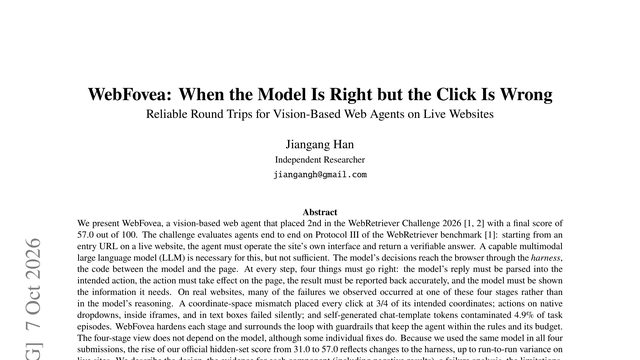
An AI can understand exactly what button to press and still fail, because the click lands somewhere else. This paper finds that the invisible machinery between the AI and the website can be as important as the AI’s reasoning.A web agent can reason correctly and still fail because its click lands in the wrong place. WebFovea argues that reliable browsing is less about smarter thoughts alone and more about making the model-to-browser round trip dependable.
 3:54