Fear and perceived risk of cyber fraud victimization among Chinese University students
Overview3:54CCAI
paperi.ai
0:00 / 0:00
Jia Qu, Kai Lin, Yuning Wu, Ivan Y. Sun
Imagine living with a threat that feels frightening, yet still seems unlikely to happen to you. Among Chinese university students, fear of cyber fraud was common, while expecting to be defrauded was not.
Cyber fraud has surfaced as a serious social problem in China, resulting in billions of Chinese yuan worth of financial losses in recent years. The high prevalence and large quantity financial losses from cyber fraud have sparked widespread public concerns about online safety. Based on survey data from over 1000 university students in China, this study explores the prevalence of fear and perceived risk of cyber fraud and its correlates among university students. The results showed that although only 10% of the respondents believed they would likely experience cyber fraud victimization in the next 12 months, approximately 50% reported feeling fearful of cyber fraud in the past 3 months. The logistic regression results show that both fear and perceived risk are influenced by different domains of risk factors, with higher selfcontrol and deviant online behaviors explaining greater odds of fear. In contrast, the perceived risk of crime is linked to vicarious victimization experiences, perceived crime seriousness, and satisfaction with the police. Implications for future research and policy are discussed.
Transcript
Imagine living with a threat that feels frightening, yet still seems unlikely to happen to you. Among Chinese university students, fear of cyber fraud was common, while expecting to be defrauded was not. Cyber fraud has surfaced as a serious social problem in China, resulting in billions of Chinese yuan worth of financial losses in recent years.
Those losses have sparked widespread public concerns about online safety. The study explores the prevalence of fear and perceived risk of cyber fraud among university students. The results showed that about half reported feeling fearful, although only ten percent believed they would likely experience cyber fraud victimization in the next twelve months.
Public perceptions of cyber fraud remain under-researched, even though cyber fraud is widespread and serious. Studying fear of cyber fraud can assist in developing more effective policies and practices to enhance public alert and defensiveness, as well as encourage help-seeking.
The study tests explanations for fear and perceived risk using university students from China. That means the study moves from the literature review to testing its hypotheses, using a sample of one thousand sixty-five university students from China.
The contrast is sharp: fifty percent reported feeling fearful of being a victim of cyber fraud during the past three months, whereas ten percent expressed that they were likely to experience cyber fraud victimization in the next twelve months. The pattern is striking: half of respondents felt fearful of becoming victims of cyber fraud in the past three months, but only ten percent thought victimization likely in the next twelve months.
Fear of cyber fraud was linked to three factors: self-control, downloading and using Wi-Fi cracking apps, and being male. Lower levels of self-control were associated with a lower likelihood of reporting fear, while downloading and using Wi-Fi cracking software was connected to higher odds of fear.
Compared with male respondents, female respondents were more likely to report greater fear of cyber fraud. Fear and perceived risk of online fraud were shaped by different experiences: using Wi-Fi cracking apps was linked to fear, while seeing others victimized and viewing fraud as serious were linked to perceived risk.
Gender also pointed in opposite directions for the two feelings. About half of the Chinese university students surveyed reported fear of cyber fraud over the last three months. However, only ten percent envisioned the possibility of being defrauded in the next twelve months.
The study suggests that cyber fraud’s pervasive occurrence and significant financial repercussions may have created apprehension, while other factors may have explained students’ perceived invulnerability to victimization. The findings need caution because the study was not designed for rigorous causal inference.
The relationships should not be treated as proof that one factor directly caused another. The results also came from university students in China, so future research should consider more universities in different regions. Other important variables may not have been included, such as prior personal victimization experience with cyber fraud and routine online or telecommunication activities.
Future studies should explore these variables as potential explanatory factors. For people outside research, the practical lesson is to take fear seriously without assuming that fear alone reveals who is most at risk.
Fear and perceived personal risk are not the same thing: people can worry about cyber fraud without believing it will happen to them. That gap matters for warnings, support, and prevention.
A derivative work by Paperi · AI-generated script, voice and captions
· pages and figures unaltered
Made with Paperi.
Drop in a research PDF — get a narrated video walkthrough like this one,
with highlights that follow the narration. Free to start.
Finding a new medicine can demand enormous effort and resources. This paper explores whether a machine that reads molecular strings can create promising new drug structures instead of searching only through existing ones.What if designing a drug molecule could look less like searching a massive catalog and more like generating a new sentence? This paper explores how AI models use SMILES strings to create and optimize candidate molecules.
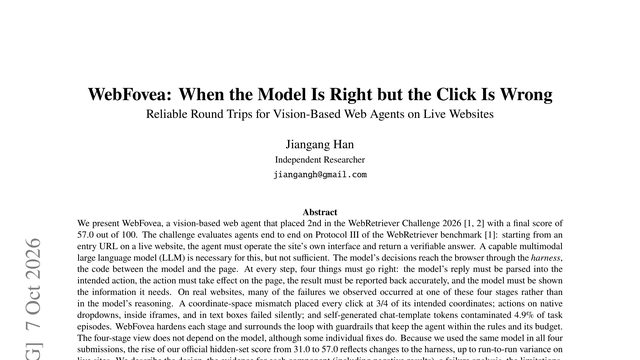
An AI can understand exactly what button to press and still fail, because the click lands somewhere else. This paper finds that the invisible machinery between the AI and the website can be as important as the AI’s reasoning.A web agent can reason correctly and still fail because its click lands in the wrong place. WebFovea argues that reliable browsing is less about smarter thoughts alone and more about making the model-to-browser round trip dependable.
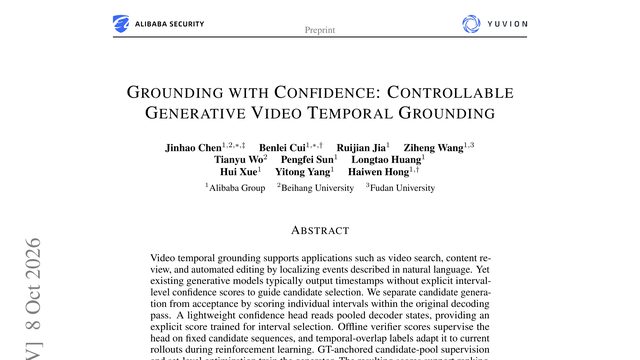
A video search system can find a clip that sounds right, but still has no idea whether it should trust that answer. This paper gives each proposed clip a separate confidence score, including permission to return nothing.What if a video model could generate several possible moments once, then decide afterward which ones deserve to be returned? This paper adds confidence without regenerating the timestamps.
 4:39