How does consumer quality preference impact blockchain adoption in supply chains?
In depth14:34CCAI
paperi.ai
0:00 / 0:00
Benedict Jun, Shuai Liu, George Q. Huang, C.T. Ng
Blockchain can make supply chains more transparent, but this paper shows that transparency does not automatically make everyone better off. The payoff depends heavily on how much consumers care about product quality.
Blockchain can make supply chains more transparent—but this paper shows that transparency does not automatically make everyone better off. The payoff depends heavily on how much consumers care about product quality.
Blockchain technology is increasingly used to ensure the authenticity of product information in supply chains, making the evaluation of blockchain’s value important as digital transparency becomes a key factor in modern commerce. The model studies a supply chain with a manufacturer and an online retailer, comparing the marketplace and wholesale price models while examining how consumer quality preference affects blockchain adoption.
Blockchain ensures the authenticity of quality information shared between the manufacturer and retailer and improves consumers’ perceived product value. The findings indicate that blockchain enhances information transparency and reduces the impact of commissions on pricing in the wholesale price model, benefiting both the manufacturer and the retailer.
The paper recommends assessing consumer preferences for product quality and carefully weighing implementation costs, because blockchain reduces constraints from commission-driven pricing but makes transparency improvements crucial in the marketplace model. Trust in product quality affects cooperation among supply chain members and consumer purchasing decisions, but traditional quality inspection methods such as process control and survey sampling often struggle to thoroughly ensure product quality.
Consumers sometimes find it difficult to understand the true quality of products, especially products sourced globally, so blockchain has become a solution for increasing information transparency in supply chains. Retailers positioned between upstream manufacturers and downstream consumers have become the most active adopters of this technology.
Walmart partners with IBM Food Trust to trace food origins and monitor supply chains, while JD dot com offers blockchain services to manufacturers for product quality certification. The paper asks whether the benefits blockchain brings to supply chain operations are truly significant and how blockchain can be leveraged to create intrinsic value and improve supply chain profitability.
Surveys show that consumer perceptions of blockchain’s value are diverse, while previous studies mainly model consumer heterogeneity as binary: consumers either opt for blockchain-enhanced products or they do not. The model extends this view by recognizing that even among consumers who purchase blockchain-enhanced products, attitudes toward blockchain differ.
The analysis also considers consumer privacy concerns as a potential downside of blockchain to validate the robustness of the findings. The model contains a manufacturer, an online retailer, and a benchmark case without blockchain before blockchain is introduced. The analysis considers both wholesale price and marketplace models.
In the wholesale price model, the retailer buys products from the manufacturer at a wholesale price and sells them at a retail price. In the marketplace model, the retailer connects the manufacturer with customers and earns a commission from the manufacturer. After analyzing optimal pricing decisions and profits, the model examines blockchain’s value under each business model and the optimal strategy for business model selection.
Under the wholesale price model, blockchain enhances manufacturer profitability by targeting quality-conscious consumers. Under the marketplace model, both the manufacturer and retailer can benefit when quality-conscious consumers dominate the market, despite adoption costs.
As the perceived benefits of blockchain improve, the required proportion of quality-conscious consumers for achieving profitability decreases. Without blockchain, prices are higher under the wholesale price model if commissions are high.
Blockchain reduces the influence of commissions, keeping prices high regardless of commission levels and allowing both parties to eliminate the impact of commissions on pricing. The wholesale price model offers greater product transparency than the marketplace model, although the gap narrows with higher commissions and production costs.
Results from extended models confirm the robustness of these findings. The first research gap is that previous studies predominantly assume the manufacturer leads blockchain implementation, overlooking situations where the retailer provides blockchain services. The analysis therefore investigates retailer-led blockchain implementation and its implications for the manufacturer-retailer relationship and the product-consumer interaction.
A second gap is that prior research often ignores diversity among consumer segments, which may overestimate blockchain’s overall value because not all consumers are sensitive to product quality. The model considers both quality-conscious and quality-indifferent consumers for a more nuanced assessment of blockchain’s impact.
A third gap is heterogeneity among quality-conscious consumers in how they value blockchain’s additional benefits, which the model incorporates when exploring consumer behavior and the overall effectiveness of adoption. The supply chain contains a manufacturer, an online retailer, and consumers; the manufacturer produces the product, and the retailer sells it.
The retailer determines whether the business model is wholesale price or marketplace because it has significantly stronger market power than the manufacturer. The retailer provides blockchain for product quality certification, such as tracing product authenticity, and blockchain makes product information transparent and trustworthy.
Blockchain records production information, giving consumers more knowledge about the product and increasing their perceived value, while retailers develop greater trust in manufacturer product quality. A direct consumer benefit of blockchain adoption is the level of information disclosure, denoted by b, because blockchain addresses concerns about counterfeit goods and substandard quality.
Heterogeneous consumers have various attitudes toward blockchain: some enjoy its added benefits by confirming quality when they buy the product. Consumers can scan the QR code attached to a product and learn about authentic product information.
Other consumers may overlook blockchain’s effectiveness and view a blockchain-enhanced product as a regular one; for consumers indifferent to product quality, blockchain is useless. The model considers two consumer segments: quality-conscious consumers and quality-indifferent consumers.
The proportion of quality-conscious consumers is denoted by alpha, and the proportion of quality-indifferent consumers is one minus alpha; quality-conscious consumers recognize product quality confirmed by blockchain, while quality-indifferent consumers ignore blockchain’s benefits.
Blockchain enhances perceived product value for quality-sensitive consumers but has little significance for consumers who are not quality-sensitive. Consumer attitudes toward using blockchain are private information, so the retailer cannot identify consumer type and charges a flat price to all consumers.
In the wholesale price model, the retailer determines the final price for consumers, and the manufacturer has no control over the retail price. In contrast, the marketplace model allows the manufacturer to sell directly to consumers through the retailer’s platform, with the retailer taking a commission.
Under the wholesale price model, the manufacturer announces product quality at the beginning, and the retailer sets the penalty for quality fraud. When blockchain is adopted, the retailer determines the unit cost of using blockchain.
The manufacturer sells to the retailer at the wholesale price, while the retailer resells to consumers at the retail price, provides blockchain, and decides on production information disclosure. The benchmark is the case where blockchain is not adopted. Consumers purchase the product if their net utility is non-negative.
Market demand in this benchmark is one minus price divided by quality. The retailer implements a quality inspection mechanism to prevent potential quality fraud from the manufacturer. Under the wholesale price model, the supply chain adopts blockchain only when product quality is high, meaning quality is greater than cost.
Under the marketplace model, the supply chain inevitably adopts blockchain. The utility of blockchain technology differs across business models. The wholesale price model benefits the supply chain with blockchain technology, whereas blockchain is not an effective tool for making the supply chain more profitable under the marketplace model.
Under the marketplace model, blockchain yields greater benefits for the manufacturer and retailer in specific conditions. If the cost of blockchain is high, the manufacturer increases the price; when the cost of adopting blockchain is low, its benefits offset the expenses and the manufacturer decreases the price.
When blockchain cost is low, the manufacturer can enhance transparency and efficiency, reduce transaction costs with the platform, and lower the price. Blockchain-recorded information ensures authenticity, allowing the retailer and consumers to trust actual product quality, while without blockchain the manufacturer may use limited consumer understanding of product quality to adopt high-pricing strategies.
The increased consumer value of purchasing the product driven by blockchain is therefore likely to reduce the price. The analysis compares wholesale price and marketplace results to determine the optimal supply chain structure. It also compares scenarios without and with blockchain to show blockchain’s impact on the choice of supply chain structure.
Figure two maps the equilibrium blockchain-adoption strategy under Model T across h on the horizontal axis and beta on the vertical axis. The shaded regions identify areas labeled I, II, III, and IV, alongside regions marked infeasible, showing that adoption depends jointly on these conditions rather than being universally beneficial.
This matters because, as the authors emphasize, perceived utility gains can be offset by privacy concerns, while heterogeneous consumer valuations make the adoption boundary more realistic. Figure three maps the equilibrium blockchain adoption strategy under Model H across s on the horizontal axis and c on the vertical axis.
The chart divides the space into regions labeled I, II, and III, with region II occupying a central upper area, region III appearing on both sides, and region I concentrated near the lower-right corner. These boundaries show how the equilibrium strategy changes with the two variables under the parameter settings listed in the caption.
When the trade-off between increased perceived utility and privacy concerns is included, blockchain adoption does not necessarily benefit the supply chain. The figure examines when the manufacturer and retailer adopt blockchain under the wholesale price model and marketplace model, when both models are profitable with blockchain, and what the optimal supply chain structure is.
When both h and beta are relatively moderate, blockchain implementation in either business model is profitable for the manufacturer and retailer. In this case, the feasible range for adopting blockchain under the wholesale price model is larger than under the marketplace model.
Figure four compares consumer surplus across parameter regions, with alpha on the horizontal axis and theta on the vertical axis. In both panels, the shaded region is labeled as having higher consumer surplus with blockchain than without it. The authors distinguish low product quality in panel a from high product quality in panel b: the shaded area is broader when quality is high, indicating that blockchain’s consumer benefit is more pronounced in that setting.
The higher-consumer-surplus pattern occurs when alpha is relatively low to moderate and theta is also moderate, suggesting that blockchain enhances consumer surplus when there are fewer quality-sensitive consumers and the blockchain benefit is moderate. As theta increases, the blue region shrinks, implying that more blockchain benefits do not expand the surplus advantage further.
Blockchain can deliver added value to consumers while driving prices up, and the added benefit can offset the influence of price increases to some extent. Figure five compares consumer surplus in the marketplace and wholesale price models across blockchain benefit and another parameter, shown separately for low and high product quality.
The labeled regions indicate where marketplace consumer surplus exceeds wholesale consumer surplus, with the comparison changing across parameter ranges. This matters because, alongside the nearby discussion of blockchain’s stronger consumer value for higher-quality products, the figure shows that adoption’s consumer consequences depend on both product quality and the model structure.
A limitation is that the paper does not consider multiple manufacturers on the platform, which may influence price competition. Future research should investigate competitive dynamics among multiple manufacturers operating within a single online retail platform that uses blockchain technology.
Future research could also consider price discrimination based on product features and explore blockchain benefits when blockchain products and regular products have inconsistent prices. The central lesson is that blockchain adoption should match consumer quality preferences and implementation costs: it can improve profitability and consumer value, but privacy concerns and business-model differences limit its benefits.
A derivative work by Paperi · AI-generated script, voice and captions
· pages and figures unaltered
Made with Paperi.
Drop in a research PDF — get a narrated video walkthrough like this one,
with highlights that follow the narration. Free to start.
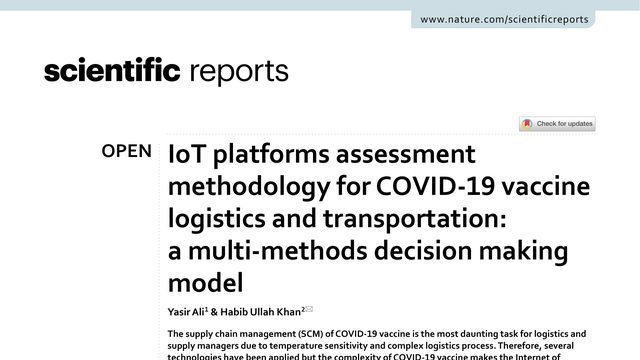
A vaccine can be perfectly made and still fail before reaching a patient. Its safety may depend on an invisible journey: keeping it cold, watched, and accounted for every step of the way.Keeping a COVID-19 vaccine cold is only part of the challenge. This study asks which Internet of Things platform can manage the wider logistics problem, and its model selects Microsoft Azure IoT.
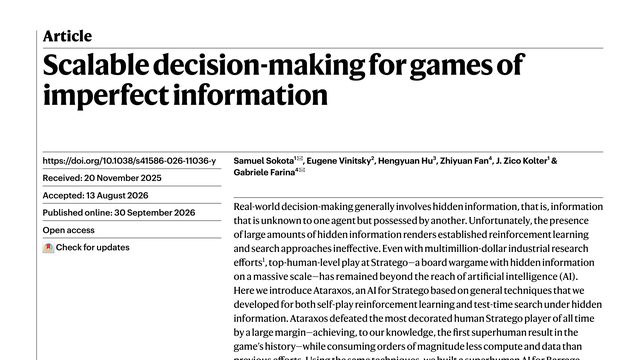
Samuel Sokota, Eugene Vinitsky, Hengyuan Hu, Zhiyuan Fan, J. Zico Kolter, Gabriele Farina
For years, computers could master games where everything was visible, but hidden information stopped them cold. Then one system beat Stratego’s most decorated human player by a margin never seen at the highest level.Stratego has enormous hidden information, and years of expensive AI research still could not beat its best humans. This paper introduces an approach that wins decisively, and does so with only a few thousand dollars of training.
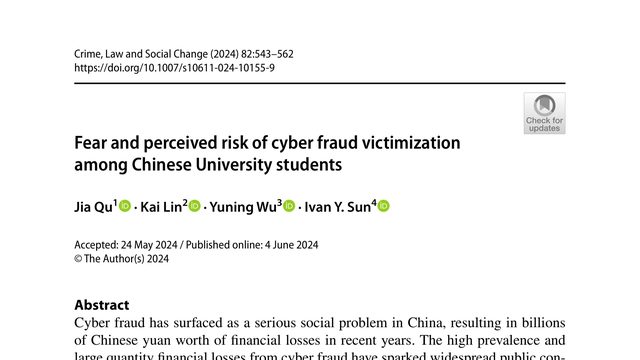
Imagine living with a threat that feels frightening, yet still seems unlikely to happen to you. Among Chinese university students, fear of cyber fraud was common, while expecting to be defrauded was not.Here’s the paper’s central tension: only ten percent of students thought cyber fraud was likely to happen to them, but about half said they felt afraid of it. Fear and perceived risk are not the same thing.
 3:58