High-throughput study of electrical conductivity in ordered metals
In depth8:13CCAI
paperi.ai
0:00 / 0:00
Thalis H. B. da Silva, Hai-Chen Wang, Tiago F. T. Cerqueira, Simone Di Cataldo, Silvana Botti, Miguel A.L. Marques
What if a computer could search millions of metallic compounds and narrow them to a few promising conductors before anyone synthesized them? This study combines machine learning with first-principles physics to do exactly that.
We present a computational framework that integrates machine learning with high-throughput ab initio calculations to screen over 2.8 million compounds for metallic transport. We identify several metallic candidates with predicted high conductivities comparable to that of aluminum (36.59 × 10⁶ S/m). We perform full electron–phonon coupling calculations for the top-performing materials, yielding results in good agreement with available experimental data. Our analysis reveals that while the noble metals (Ag, Au, Cu) possess a conductivity that remains difficult to surpass due to their unique electronic structure and low scattering, compounds like LiBePt2 can achieve good performance by utilizing valence electrons from light elements to shift high-scattering d-states beneath the Fermi level. This study not only identifies novel high-performance conductors but also demonstrates the predictive power of combining statistical learning with detailed ab initio calculations.
Transcript
What if a computer could search millions of metallic compounds and narrow them to a few promising conductors before anyone synthesized them? This study combines machine learning with first-principles physics to do exactly that.
Electrical conductivity is one of the most fundamental and technologically important properties of metallic materials, governing applications across microelectronics, power transmission, energy storage, and quantum technologies. Predicting and optimizing electrical transport properties from first principles enables the rational design of materials with tailored electronic properties without extensive experimental synthesis and characterization.
Traditional calculations rely on density functional theory, or DFT, combined with Boltzmann transport theory as a quantum mechanical framework for understanding electron transport. That semiclassical description assumes well-defined quasiparticles, and the assumption breaks down beyond the weak electron-phonon coupling limit.
More rigorous Kubo-formula approaches include electronic spectral functions and vertex corrections, but they come at substantially higher computational cost. Even at the semiclassical level, detailed electronic band structures, scattering rates, and transport integrals limit conventional calculations to small material sets, making vast chemical-space exploration prohibitively expensive.
The study presents a comprehensive high-throughput investigation of electrical conductivity in metallic systems, screening approximately 2.8 million inorganic ordered compounds. Its multi-stage workflow incorporates the Eliashberg parameter lambda, previously computed for conventional superconductivity studies, as an additional descriptor.
Reliable transport properties from first-principles theory require computationally demanding calculations, so the workflow uses machine-learning acceleration to address that bottleneck. The first descriptor is electrical conductivity computed using BoltzTraP2 within the constant relaxation-time approximation.
The second is the electron-phonon coupling constant lambda from Eliashberg theory, which encodes the strength of the dominant scattering mechanism limiting conductivity in crystalline metals. Machine-learning surrogate models predict both descriptors, and symbolic regression combines them through an empirical formula to screen candidate high-conductivity metals.
All training data and screened compounds come from the Alexandria database. The central flow narrows visibly from the large Alexandria database to approximately twelve hundred selected metals, then to fifty-two unique systems.
The lower box shows that these finalists receive more accurate transport calculations with EPW by solving the iterative Boltzmann transport equation. First-principles validation calculations were performed for compounds whose machine-learning-predicted conductivity exceeded the screening threshold of fifteen times ten to the sixth siemens per meter.
For those compounds, full electronic-structure and BoltzTraP2 calculations produced sigma B T, while electron-phonon calculations evaluated the Eliashberg coupling constant lambda. The validation set also included compounds from Alexandria with previously computed sigma B T and lambda, producing a dataset of approximately fourteen thousand compounds.
In the upper-left region, the blue points identify compounds combining comparatively large predicted conductivity with smaller predicted electron–phonon coupling. The labeled metals span a broad range: aluminum reaches above thirty-five times ten to the sixth siemens per meter, while niobium tin lies near one times ten to the sixth and a coupling of about one point five.
The procedure yields the compact relation sigma S R equals zero point four times sigma B T divided by lambda, with a dimensionless prefactor. This simple analytical expression gives a good description of electrical conductivity across chemically diverse metals, including noble metals, alkali metals, and transition metals.
The most noticeable relative-error outliers are strontium and calcium, whose anomalous behavior is discussed in more detail below. The blue data points broadly follow the red diagonal across the plot, from low-conductivity metals near the origin to copper and silver at the far right.
Calcium sits conspicuously above this trend, while strontium lies near the low-conductivity cluster; several intermediate points also show visible scatter around the fitted line. The results reproduce experimental reference values with good overall accuracy, with most computed values falling within thirty percent of measured data.
Agreement is relatively strong for copper, gold, and molybdenum, where calculated and experimental conductivities are in close quantitative agreement. Table one compares calculated EPW and experimental electrical conductivities for elemental metals at three hundred kelvin, with values reported in millions of siemens per metre.
Across the listed systems, the table reports a mean absolute error of two point nine seven times ten to the power of six siemens per metre. The largest deviations are associated with calcium and strontium, consistent with the authors’ discussion of their more complex band structures and nearby empty d-states.
The calculations confirm that the selected materials exhibit high electrical conductivity, with several candidates showing predicted conductivities comparable to aluminum at room temperature. Aluminum's reference conductivity is thirty-six point fifty-nine times ten to the sixth siemens per meter.
Modern ab initio methods, coupled with semiclassical Boltzmann transport theory as implemented in BoltzTraP2, E P W, and density-functional perturbation theory for electron-phonon interaction, provide a good description of metallic transport. Agreement between calculated values and experimental benchmarks across chemically diverse elemental metals shows the predictive power of this approach.
That quantitative alignment suggests first-principles methods can predict transport properties in novel material phases where experimental data is unavailable. A significant finding is the surprising robustness of the constant relaxation-time approximation.
Although it omits the energy and momentum dependence of scattering, electronic density of states and Fermi velocity can play a more dominant role in conductivity ranking than fine scattering details. Using this approximation within the machine-learning pipeline made it possible to screen 2.8 million compounds.
The success of the machine-learning models confirms that electronic-structure descriptors are sufficient to navigate the vast chemical space of potential conductors. Figure five plots electrical conductivity against the average squared Fermi velocity for elemental metals.
The red line is a linear regression, showing how these two quantities are compared across the metals, while labels identify examples such as copper, silver, aluminum, sodium, and lead. This matters because the surrounding discussion links high Fermi velocity to intrinsic charge-transport capacity, while also emphasizing that scattering and electron–phonon coupling influence the resulting conductivity.
The central result is that machine-learning proxies can screen approximately 2.8 million ordered compounds, while detailed calculations reproduce experiments well enough to identify candidates with conductivity comparable to aluminum.
A derivative work by Paperi · AI-generated script, voice and captions
· pages and figures unaltered
Made with Paperi.
Drop in a research PDF — get a narrated video walkthrough like this one,
with highlights that follow the narration. Free to start.
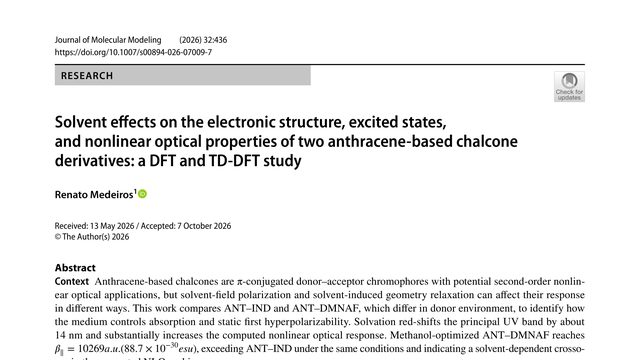
What if the liquid around a molecule could change not just how it absorbs light, but which of two molecules appears more powerful? This study finds that the answer can switch with the solvent.What happens when the same light-responsive molecule is placed in different solvents? In these anthracene-based chalcones, the solvent does more than shift an absorption peak, it can reverse which molecule has the stronger computed nonlinear optical response.
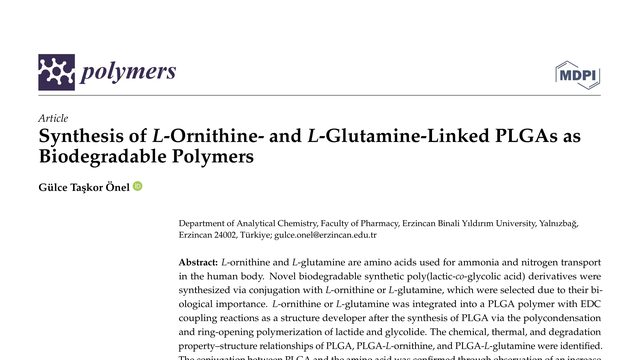
A familiar medical plastic can be redesigned with parts borrowed from the human body, and that small change makes it become friendlier to water and break down faster. The surprising part is how useful that controlled breakdown could be.What happens when a standard biodegradable polymer is linked to amino acids that help transport nitrogen in the human body? This study shows how L-ornithine and L-glutamine change PLGA’s chemistry, thermal behavior, surface properties, and degradation.
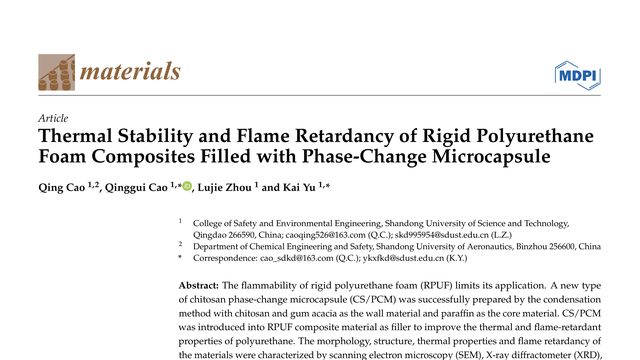
Rigid polyurethane foam is useful in cars, buildings, mining and aerospace, but it burns easily, releases toxic gases, and can trap enough heat to help start a fire. This study asks whether the same material can be made to absorb heat and slow flames.What if a material added to polyurethane foam for heat storage could also slow a fire? This study puts paraffin inside chitosan-based microcapsules and tests whether the capsules make rigid foam both thermally functional and more flame resistant.
 4:50