Synthesis of L-Ornithine- and L-Glutamine-Linked PLGAs as Biodegradable Polymers
Student12:49CCAI
paperi.ai
0:00 / 0:00
Gülce Taşkor Önel
What happens when a standard biodegradable polymer is linked to amino acids that help transport nitrogen in the human body? This study shows how L-ornithine and L-glutamine change PLGA’s chemistry, thermal behavior, surface properties, and degradation.
L-ornithine and L-glutamine are amino acids used for ammonia and nitrogen transport in the human body. Novel biodegradable synthetic poly(lactic-co-glycolic acid) derivatives were synthesized via conjugation with L-ornithine or L-glutamine, which were selected due to their biological importance. L-ornithine or L-glutamine was integrated into a PLGA polymer with EDC coupling reactions as a structure developer after the synthesis of PLGA via the polycondensation and ring-opening polymerization of lactide and glycolide. The chemical, thermal, and degradation property–structure relationships of PLGA, PLGA-L-ornithine, and PLGA-L-glutamine were identified. The conjugation between PLGA and the amino acid was confirmed through observation of an increase in the number of carbonyl carbons in the range of 170–160 ppm in the 13C NMR spectrum and the signal of the amide carbonyl vibration at about 1698 cm−1 in the FTIR spectrum. The developed PLGA-L-ornithine and PLGA-L-glutamine derivatives were thermally stable and energetic materials. In addition, PLGA-L-ornithine and PLGA-L-glutamine, with their unique hydrophilic properties, had faster degradation times than PLGA in terms of surface-type erosion, which covers their requirements. L-ornithine- and L-glutamine-linked PLGAs are potential candidates for development into biodegradable PLGA-derived biopolymers that can be used as raw materials for biomaterials.
Transcript
What happens when a standard biodegradable polymer is linked to amino acids that help transport nitrogen in the human body? This study shows how L-ornithine and L-glutamine change PLGA’s chemistry, thermal behavior, surface properties, and degradation. Biodegradable polymers have many different applications in the medical field, and research on environmentally friendly polymeric designs for biomaterials has become increasingly widespread around the world.
PLA and PGA are biodegradable, nontoxic, and ecofriendly, but their relatively high cost, rapid degradation, and low melting points prevent their widespread use. PLGA is obtained through the ring-opening polymerization of lactide and glycolide, and it is approved by the United States Food and Drug Administration for clinical applications in humans.
Research on PLGA has focused on regulating degradation time through factors including molecular weight, polydispersity, crystallinity, tacticity, pH, biological conditions, hydrophilic and hydrophobic functional groups, and stereo sequence. L-glutamine is a semiessential or conditionally essential amino acid with two nitrogen side chains, and it is used for ammonia and nitrogen transport in the human body.
L-ornithine is an amino acid produced through the separation of urea from L-arginine in the body’s urea cycle, and it is involved in excreting excess nitrogen. PLGA derivatives made by conjugating amino acids and PLGA are expected to have excellent biocompatibility, regulated biodegradable properties, and more hydrophilicity than PLGA.
The research aims to design and synthesize novel amino acid-linked PLGA derivatives as biosimilars. PLGA is first synthesized from lactide and glycolide by ring-opening polymerization, and the synthesis is then completed through an EDC coupling reaction between PLGA and an amino acid.
The derivatives were chemically identified using proton and carbon thirteen NMR spectroscopy and ATR–Fourier transform infrared spectrometry, while molecular weights and thermal transitions were examined using GPC, DSC, and TGA. PLGA was synthesized through ring-opening polymerization from lactide and glycolide monomers in a ratio of seventy-five to twenty-five, respectively.
The seventy-five to twenty-five ratio was chosen to study a polymer with optimized properties such as polymer structure, molecular weight, end group, crystallinity, and glass transition temperature. Stannous octoate served as the catalyst, and one-dodecanol served as the initiator in the synthesis of the block copolymers.
The derivative polymer structures were synthesized from PLGA and amino acids through formation of an amide bond in the presence of EDC. L-ornithine and L-glutamine were selected separately to react with PLGA. PLGA and EDC were added to anhydrous dichloromethane, the amino acid was added, and the mixture was stirred at room temperature for forty-eight hours before purification and drying.
Chemical identification used proton and carbon thirteen NMR spectroscopy, while infrared spectra were acquired in reflectance mode with an ATR accessory over a range from four thousand to four hundred inverse centimeters. Thermal analysis used DSC from twenty-five to four hundred degrees Celsius at a heating rate of ten degrees Celsius per minute under nitrogen, and TGA from one hundred to eight hundred degrees Celsius at twenty degrees Celsius per minute under nitrogen.
Molecular weights were determined using gel permeation chromatography, and surface hydrophilicity was measured through water contact angles. PLGA was conjugated to L-ornithine through the EDC coupling reaction. EDC is described as an ideal reagent for coupling carboxylic acid and amino functional groups because of its high water solubility.
The EDC coupling reaction was completed within forty-eight hours, and the viscous crude product was solidified through vacuum drying and cooling. Figure one compares proton and carbon NMR spectra for PLGA, PLGA-L-Orn, and PLGA-L-Gln.
The PLGA spectra show the expected lactidyl and glycolidyl signals, including the lactidyl proton region around five point two four to five point one four parts per million and glycolidyl protons around four point nine two to four point six one. In the modified polymers, broad amide N-H signals and additional methylene or carbonyl signals appear, supporting incorporation of the ornithine and glutamine units into the PLGA structure.
The proton and carbon thirteen NMR spectra confirmed the chemical structure of synthesized PLGA linked to L-ornithine. Broad singlets near chemical shifts of eight point zero and six point five to six point zero parts per million represented amide NH signals belonging to the L-ornithine units.
The carbonyl peak of L-ornithine appeared at one hundred fifty-nine point ninety parts per million, while lactidyl and glycolidyl chain signals appeared at one hundred seventy-five point seventeen and one hundred seventy-four point zero seven parts per million. Figure two compares FTIR-ATR spectra for PLGA, PLGA-L-Orn, and PLGA-L-Gln across the broad fingerprint region and a magnified N-H and C=O region.
The modified polymers show N-H stretching near three thousand three hundred inverse centimeters and an amide-associated C=O···N-H band at sixteen ninety-eight inverse centimeters, alongside PLGA’s characteristic carbonyl and C–O signals. These spectral features support formation of amide-linked conjugates with L-Orn and L-Gln.
Figure three compares thermal behavior using TGA in panel a and DSC in panel b for PLGA, PLGA-L-Orn, and PLGA-L-Gln. The TGA curves mark five-percent mass-loss decomposition temperatures of 289.7, 277.5, and 269.1 degrees Celsius, while the DSC curves show melting peaks at 256.9, 251.8, and 244.7 degrees Celsius, respectively.
These melting transitions indicate crystalline domains, and the thermal profiles reveal how incorporating the amino-acid-derived chains changes the polymers’ thermal transitions and decomposition behavior. PLGA, PLGA linked to L-ornithine, and PLGA linked to L-glutamine had glass transition temperatures of twenty-six point five, forty-six point one, and forty-three point two degrees Celsius, respectively.
The glass transition results were influenced by molecular weight, monomer ratio, end group, and increased crystallinity in the two amino acid-linked polymers compared with PLGA. Increased hydrogen-bonding capacity, increased molecular weight, and end-group differentiation may have contributed to the higher glass transition temperatures of the derivatives.
Table 2 reports molecular-weight properties measured by gel permeation chromatography for PLGA and its L-ornithine and L-glutamine derivatives. It lists number-average and weight-average molecular weights, along with dispersity: PLGA has three thousand and ten thousand four hundred grams per mole, while the derivatives show distinct values.
These measurements matter because the authors connect the derivatives’ molecular weights and amide bonds with their higher enthalpy of fusion. PLGA linked to L-ornithine had a number average molecular weight of twelve thousand three hundred grams per mole and a weight average molecular weight of twenty-four thousand three hundred grams per mole, with a polydispersity index of one point nine seven five.
PLGA linked to L-glutamine had a number average molecular weight of twenty-one thousand four hundred grams per mole and a weight average molecular weight of fifty-four thousand nine hundred grams per mole, with a polydispersity index of two point five six five. The higher polydispersity values indicate that the chemical structures are far from monodispersity.
Table three compares water contact angles and surface free-energy components for PLGA and its ornithine- and glutamine-modified derivatives. The contact angles are eighty-nine point four plus or minus two point zero degrees for PLGA, fifty-eight point six plus or minus one point four for PLGA-L-Orn, and fifty-two point seven plus or minus two point one for PLGA-L-Gln, while total surface free energy ranges from thirty-eight point two to fifty-eight point zero millinewtons per meter.
The authors use these measurements to assess increased hydrophilicity and relate it to surface erosion and potential cell attachment. The water contact angles were eighty-nine point four degrees for PLGA, fifty-eight point six degrees for PLGA linked to L-ornithine, and fifty-two point seven degrees for PLGA linked to L-glutamine.
The results supported increased hydrophilicity, and PLGA linked to L-ornithine and PLGA linked to L-glutamine showed similar water contact angle results. The wettability of PLGA linked to L-ornithine and PLGA linked to L-glutamine was improved.
Figure four tracks weight loss over one hundred days in PBS at pH seven point four and thirty-seven degrees Celsius for PLGA, PLGA-L-Orn, and PLGA-L-Gln. All three curves rise over time; at one hundred days, the figure reports approximately twenty-six percent loss for PLGA, thirty-eight percent for PLGA-L-Orn, and thirty-four percent for PLGA-L-Gln.
This matters because the authors use these profiles to show that amino-acid functionalization is associated with increased degradation relative to unmodified PLGA. After one hundred days in phosphate-buffered saline, PLGA films had degraded by twenty-five percent by weight.
The one-hundred-day degradation rate was thirty-eight percent by weight for PLGA linked to L-ornithine and thirty-four percent for PLGA linked to L-glutamine. The degradation rates of the amino acid-derived PLGAs increased compared with PLGA, which may be due to hydrophilic groups on L-ornithine and L-glutamine and increased chemical interaction.
Figure Five uses SEM images to compare the surfaces of PLGA-L-Orn and PLGA-L-Gln during in vitro hydrolytic degradation. On the first day, panels a and c show relatively smooth, regular surfaces, whereas by the twenty-fifth day, panels b and d display prominent fractures.
These cracks provide visual evidence that surface erosion had begun under the hydrolytic conditions, helping distinguish the polymers’ changing degradation morphology. The twenty-fifth-day degradation morphologies of PLGA linked to L-ornithine and PLGA linked to L-glutamine can be observed in Figure five.
Smooth and regular surfaces were shown for PLGA linked to L-ornithine and PLGA linked to L-glutamine at the earlier time point, while fractures showed that surface erosion started under hydrolytic degradation conditions. The amino acid-derived PLGAs were prone to surface erosion because hydrophilic groups accelerated degradation, and linear mass loss supported surface erosion.
The results show that surface-type erosion makes PLGA linked to L-ornithine and PLGA linked to L-glutamine suitable for biomaterial applications such as controlled drug release systems, although certain physiological or enzymatic conditions may change the mechanism to bulk erosion.
Linking PLGA to L-ornithine or L-glutamine produced more hydrophilic derivatives that degraded faster than PLGA through surface-type erosion, making them potential raw materials for biodegradable biomaterials.
A derivative work by Paperi · AI-generated script, voice and captions
· pages and figures unaltered
Made with Paperi.
Drop in a research PDF — get a narrated video walkthrough like this one,
with highlights that follow the narration. Free to start.
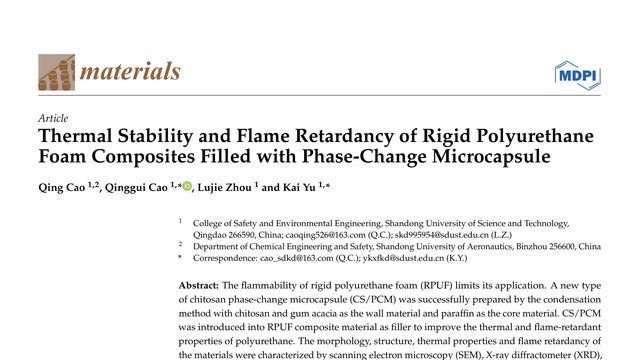
Rigid polyurethane foam is useful in cars, buildings, mining and aerospace—but it burns easily, releases toxic gases, and can trap enough heat to help start a fire. This study asks whether the same material can be made to absorb heat and slow flames.What if a material added to polyurethane foam for heat storage could also slow a fire? This study puts paraffin inside chitosan-based microcapsules and tests whether the capsules make rigid foam both thermally functional and more flame resistant.
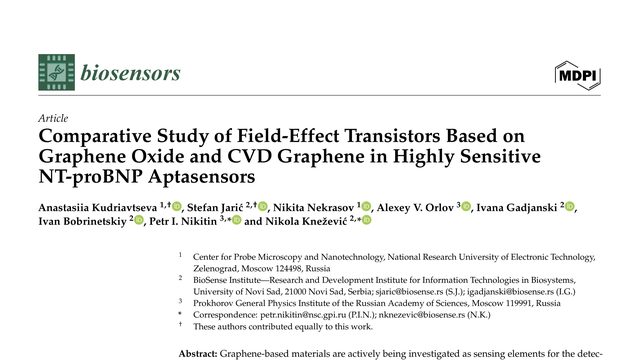
Anastasiia Kudriavtseva, Stefan Jarić, Nikita Nekrasov, А. В. Орлов, Ivana Gadjanski, Ivan Bobrinetskiy, Petr I. Nikitin, Nikola Ž. Knežević
Could a saliva sample reveal signs of heart failure without a blood draw? This study found that a less perfect form of graphene could detect the signal more reliably than the cleaner, more orderly version.Two graphene-based sensors cost about the same, but they do not perform the same: the rougher, more defective material detects NT-proBNP in artificial saliva at a lower concentration than pristine CVD graphene.
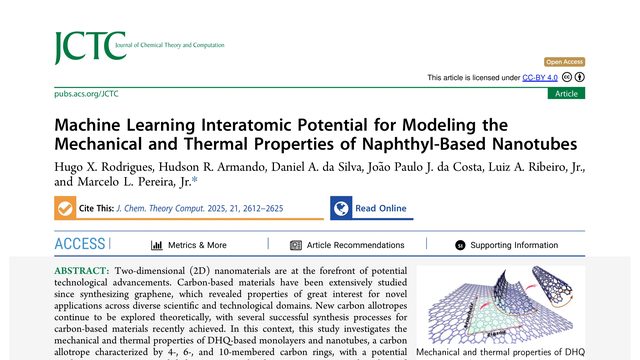
Hugo X. Rodrigues, Hudson R. Armando, Daniel A. da Silva, João Paulo C. L. da Costa, Luiz Antônio Ribeiro, Marcelo Lopes Pereira
A tiny carbon structure can stay intact at temperatures far beyond ordinary industrial heat, yet snap suddenly when stretched. This study builds a faster way to find out exactly where those limits lie.What happens when a carbon nanomaterial is pushed, stretched, and heated far beyond ordinary conditions? This study uses a machine-learned interatomic potential to test DHQ sheets and nanotubes at scales first-principles calculations cannot reach.
 4:54
4:54