Harnessing Backlash: How Leaders Can Benefit from Antagonizing Foreign Actors
Overview3:55CCAI
paperi.ai
0:00 / 0:00
Kelly Matush
What if a leader angers a powerful foreign partner not by accident, but to prove loyalty to voters back home? This paper argues that a diplomatic backlash can sometimes be politically useful.
Leaders nearly always claim that their diplomatic campaigns are intended to attract foreign support. However, many diplomatic campaigns fail spectacularly in this regard. While these events have largely been explained as diplomatic failures, I argue that alienating the apparent target of an international diplomatic campaign can be a deliberate strategy leaders use to win domestic support. Under certain conditions, a costly backlash from a foreign actor can be a credible signal that the leader shares the domestic audience’s preferences. Therefore, by intentionally provoking a backlash from a valuable foreign actor, leaders can exchange foreign condemnation for an increase in domestic support. I support this argument with evidence from Netanyahu’s 2015 speech to the US Congress. I show that, as expected by this theoretical framework, Netanyahu’s efforts resulted in a significant backlash among US Democrats and a corresponding increase of support among right-wing Israelis, a crucial constituency for his upcoming election.
Transcript
What if a leader angers a powerful foreign partner not by accident, but to prove loyalty to voters back home? This paper argues that a diplomatic backlash can sometimes be politically useful. Diplomacy is generally understood as an attempt to increase foreign goodwill and cooperation.
But many diplomatic efforts fail to win foreign support, and some produce the opposite effect: a negative backlash. That pattern appears in several familiar cases: Netanyahu angered the Obama administration while opposing an agreement with Iran, Trump openly antagonized NATO leaders, and Theresa May alienated international partners during Brexit negotiations.
The puzzle becomes clearer in Netanyahu’s 2015 speech to the US Congress. To form a majority coalition, Netanyahu needed support from far-right Israeli voters whose preferences opposed those of the US Democrats his speech alienated.
Because Israel relied on US diplomatic and economic aid, a US backlash could be costly to Netanyahu. That cost could also signal his commitment to the policies his electoral campaign supported. Here is the surprising shift: the domestic audience can be the leader’s primary target in an international diplomatic act, while the foreign actor becomes the tool.
Instead of paying a domestic cost to appear credible abroad, a leader can pay a cost in foreign cooperation to appear credible to domestic supporters. A leader may provoke a costly foreign backlash when domestic voters' preferences differ from the foreign actor's, and when the backlash is costly enough to inform the public but not so costly that it outweighs domestic benefits.
How costly the backlash is depends partly on the foreign actor imposing it. The case predicts a clear cost abroad: the foreign actor should reduce support for the leader. In the United States, the Iran agreement divided people along political lines, while the Obama administration and many Democrats supported it.
So if Netanyahu provoked a backlash, Democrats and Obama supporters should become less supportive of him after the speech. That could increase long-term polarization toward Israel in the United States. That is what the survey data showed: after the speech, favorability toward Netanyahu fell among US Democrats and among Americans who approved of Obama.
The lost Democratic support was not replaced by increased Republican support, which was already very high. Overall, US public opinion moved against Netanyahu. The visual makes the partisan divide unmistakable: the two estimates nearly overlap for Republicans, but are clearly separated for Democrats.
But the story did not end with the backlash in the United States. After Netanyahu’s speech, support for a Likud-led coalition increased among the hawkish, right-wing Israelis he needed to win over. The speech was successful in mobilizing support for his coalition precisely among those right-wing voters.
The broader conclusion is that provoking a foreign backlash can be a deliberate and beneficial strategy, not merely an error in judgment. When a foreign actor’s support matters internationally but its preferences oppose those of a key domestic constituency, the backlash can signal that the leader is committed to the domestic constituency’s preferred policy.
Some backlash is accidental, but actions that are clearly antagonistic and produce predictable responses may be better understood as attempts to benefit politically at home. The key idea is that losing support abroad can signal commitment at home when foreign leaders and a powerful domestic constituency want opposite things.
That trade can reshape public support and elections.
A derivative work by Paperi · AI-generated script, voice and captions
· pages and figures unaltered
Made with Paperi.
Drop in a research PDF — get a narrated video walkthrough like this one,
with highlights that follow the narration. Free to start.
Ashley Cleary, Frannie Kaczor, Maisie Finnegan, John Schimek, Abby Egen-Schimek, Erin O’Donnell, Marlene D Melzer-Lange
When a young person is in suicidal crisis, a safety conversation may not be enough. This emergency department added something families could take home immediately: a lockbox for a firearm.When a teenager arrives at the emergency department after suicidal thoughts or an attempt, this program does more than offer advice: it puts a firearm lockbox into the family’s hands at that moment.
Bowen Zhang, Chen Zhong, Mingfei Ma, James Golding-Graham
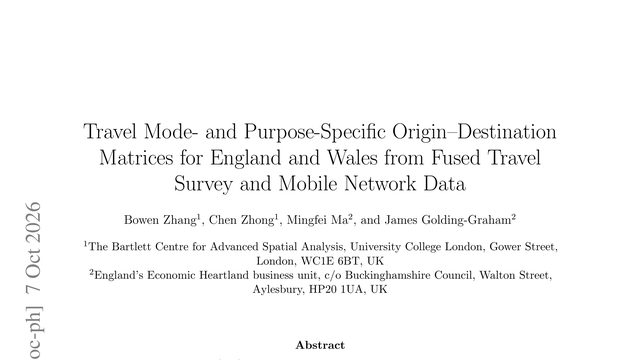
Every transport decision depends on an invisible question: who travels from where to where? This study builds a detailed answer by combining the broad movement picture from mobile phones with the human details surveys can provide.What if the best way to map how a country travels is to combine the reach of mobile networks with the detail of travel surveys? This paper builds that hybrid picture for every small area of England and Wales.
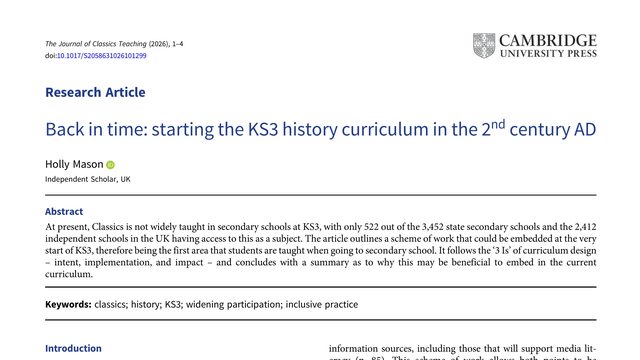
What if a child’s first lesson in secondary-school history began not in 1066, but nearly a thousand years earlier? One proposal says that starting with Roman Britain could make history more accurate, more inclusive, and open to more students.What if the first chapter of a student’s secondary-school history journey began not in 1066, but in Roman Britain? This article proposes a six-lesson scheme designed to make Classics more accessible, inclusive, and historically investigative.
 4:31