Back in time: starting the KS3 history curriculum in the 2 nd century AD
In depth5:26CCAI
paperi.ai
0:00 / 0:00
Holly Mason
What if the first chapter of a student’s secondary-school history journey began not in 1066, but in Roman Britain? This article proposes a six-lesson scheme designed to make Classics more accessible, inclusive, and historically investigative.
What if the first chapter of a student’s secondary-school history journey began not in 1066, but in Roman Britain? This article proposes a six-lesson scheme designed to make Classics more accessible, inclusive, and historically investigative. At present, Classics is not widely taught in secondary schools at KS3: only 522 out of the 3,452 state secondary schools and the 2,412 independent schools in the UK have access to it.
The proposed scheme of work could be embedded at the very start of KS3, making it the first area students are taught when they go to secondary school. Its structure follows the three Is of curriculum design: intent, implementation, and impact, before concluding why it may be beneficial in the current curriculum.
Classics is not widely available in KS3 schools, with only 522 secondary schools teaching a classical subject. Historically, it was reserved for independent schools or students who were excelling academically. Students in state schools and from working and lower-class backgrounds therefore have not had the opportunity to explore this area of history, although ongoing work aims to make these subjects available to all students, particularly in disadvantaged areas.
There is substantial guidance on implementing history, including classical history, in the primary curriculum, but little for the secondary curriculum. The National Curriculum starts pupils’ historical journey in 1066, which limits understanding of British history and of key events and technologies prevalent in later periods.
The article therefore considers how adding this material to the KS3 History curriculum map could be valuable to students. The broad intent is to introduce the Classical World to students as part of their standard KS3 history curriculum. The Curriculum and Assessment Review says that students at KS1 to KS3 need to enhance their knowledge of how the past is studied and how historians make claims, arguments, and construct accounts.
The review also says students should be able to assess a wider range of information sources. The curriculum plan supports decolonisation of the KS3 curriculum by introducing people of Roman Britain, including people of African descent.
Evidence of people from the Middle East living in Roman Britain, such as the Regina tombstone, can also show a multicultural Britain reflecting the society students live in today. This helps students move away from seeing history only from the perspective of wealthy white males and ensures that the history of black individuals in England is not solely associated with the trade of enslaved peoples.
The plan also addresses the risk that black history can appear tokenistic and the untrue idea that the first evidence of black Britons was during the Tudor period. It supports ongoing work to address misconceptions and develop a wider range of historical narrative.
The scheme of work is a series of six lessons: an introduction, four specific areas of Roman Britain, and a final summative assessment to determine students’ learning. The lessons use constructivist approaches, including collaborative group work, inquiry-based projects, and role-playing, so students are engaged rather than passive recipients of knowledge.
They use literary sources such as oracy, historiography, and letters, alongside archaeological sources, arts, and secondary source material. This is intended to help students understand the nuances of studying the Classical World and contribute to building cultural capital. Each lesson ends with an exercise linking the Romans in Britain to today, so students can understand the influence they might have had.
Reading down the left-hand sequence, the figure moves from topic introduction through social life, gender and age, religion, and the military, before ending with assessment. The icons to the right show that different lessons draw on different combinations of literature, maps, graves, letters, remains, secondary sources, temples, archaeological remains, and art, rather than relying on one source type.
Impact is measured using two models: process and progress. Together, these two models define how the scheme’s impact is assessed. The product assessment focuses primarily on assessment scores and takes place in the final lesson through a summative assessment. It includes multiple-choice questions and source analysis, building to a longer written question about the period and its impact on modern-day Britain in a particular area.
The assessment therefore examines general knowledge, historical skills, the ability to construct an argument, and the application of learning to the current day. The article acknowledges that the scheme has some limitations. Those limitations are introduced here, although this block does not specify what they are.
The central proposal is a six-lesson Roman Britain scheme that combines varied sources, active learning, and assessment of historical argument. Its importance lies in bringing Classical history and a more multicultural account of Britain into the standard KS3 curriculum.
A derivative work by Paperi · AI-generated script, voice and captions
· pages and figures unaltered
Made with Paperi.
Drop in a research PDF — get a narrated video walkthrough like this one,
with highlights that follow the narration. Free to start.
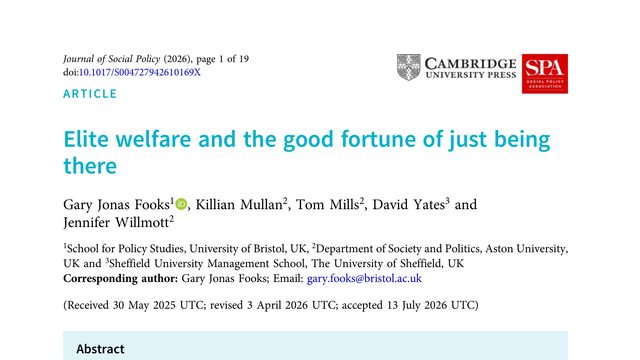
G.J. Fooks, Killian Mullan, T. Mills, David Yates, Jennifer Willmott
During the pandemic, government support was meant to protect jobs and businesses. But companies receiving that support were also linked to a sharp rise in top executives’ pay soon afterward.Pandemic support was presented as protection for jobs and livelihoods. But in the UK’s biggest listed companies, furlough support was associated with higher executive pay soon afterward.
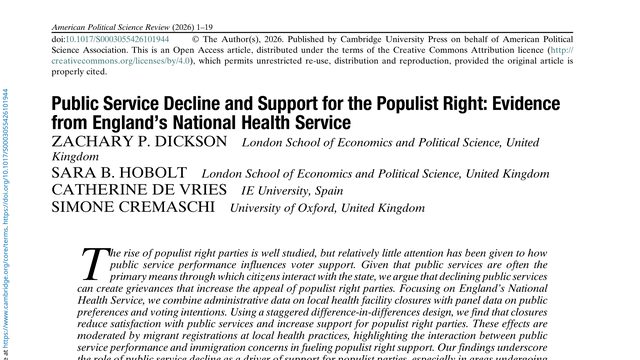
Z. Dickson, SARA BINZER HOBOLT, Catherine E. De Vries, Simone Cremaschi
A local doctor’s surgery closes, and years later, people affected by that closure are more likely to support the populist right. The surprising link is not just healthcare; it is trust in the state.What if support for the populist right is shaped not only by culture or the economy, but by something as concrete as losing a local doctor’s practice? This paper finds that GP closures can change both service satisfaction and political support.
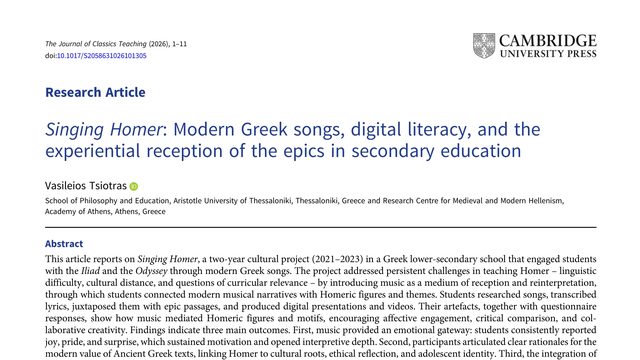
Homer can feel like a locked room: important, famous, and very far away. In one Greek classroom, students found a key in an unexpected place, not another lecture, but modern songs.What if the best way to make Homer feel contemporary is not to simplify the epics, but to let students remake them through songs they already understand? This project turns classical reception into a creative, digital classroom experience.
 5:15