Back in time: starting the KS3 history curriculum in the 2 nd century AD
Overview3:59CCAI
paperi.ai
0:00 / 0:00
Holly Mason
What if a child’s first lesson in secondary-school history began not in 1066, but nearly a thousand years earlier? One proposal says that starting with Roman Britain could make history more accurate, more inclusive, and open to more students.
At present, Classics is not widely taught in secondary schools at KS3, with only 522 out of the 3,452 state secondary schools and the 2,412 independent schools in the UK having access to this as a subject. The article outlines a scheme of work that could be embedded at the very start of KS3, therefore being the first area that students are taught when going to secondary school. It follows the ‘3 Is’ of curriculum design – intent, implementation, and impact – and concludes with a summary as to why this may be beneficial to embed in the current curriculum.
Transcript
What if a child’s first lesson in secondary-school history began not in 1066, but nearly a thousand years earlier? One proposal says that starting with Roman Britain could make history more accurate, more inclusive, and open to more students. Classics is not widely taught in secondary schools at this stage, and access is limited to a small share of schools.
The proposed course would place this subject at the very start of secondary school. The plan is organised around what the course should achieve, how it would be taught, and what difference it would make, before explaining why it could benefit the current curriculum.
Historically, this part of history was often reserved for independent schools or students seen as especially strong academically. Many students in state schools and from working-class backgrounds therefore had little chance to study it. The existing national guidance begins students’ historical journey in 1066.
That starting point can limit their understanding of earlier British history and of events and technologies that matter later. The proposal is therefore to add earlier history to the standard secondary-school history journey, whose current guidance starts pupils in 1066.
The purpose is to make this addition valuable to students more broadly, expanding their understanding of British history and later events and technologies. The plan introduces the people of Roman Britain, including people of African descent, as well as evidence of people from the Middle East living in Britain.
That presents Britain as multicultural and moves students away from seeing the past only through wealthy white men. It also shows that the history of black people in England is not only the history of enslavement. The approach is meant to challenge the false idea that the first evidence of black Britons belongs to the Tudor period, while supporting a wider historical story.
The course is planned as six lessons: an introduction, four areas of Roman Britain, and a final assessment to determine students’ learning. Students would work with different kinds of evidence, including literary, archaeological, artistic, and secondary sources, rather than receive one finished story.
Group work, investigations, and role-playing are intended to keep students actively involved instead of passively receiving information. Each lesson would end by connecting Roman Britain with the present, so students could consider how that earlier period may still influence their lives today.
The proposed impact would be judged in two ways: by looking at how the course works as it unfolds, and by looking at students’ progress. This keeps attention on both the learning process and the change in students’ understanding. The proposed benefits include opening Classics to more students, making ancient history more inclusive, changing whose stories the curriculum centres, and helping learners understand the wider world.
But the curriculum is still theoretical at present, so these benefits are proposed rather than established by classroom results. The proposal also has limitations, and those limitations should be treated as an important qualification when assessing the proposal itself.
That matters because the proposal has limitations, and those limitations should remain visible when the proposed curriculum is being considered. Overall, the aim is to address unequal access to this subject while improving students’ knowledge of British history.
By addressing students’ lack of access and improving their knowledge of British history, the scheme aims to prepare them for the rest of the curriculum and support future studies. Starting with Roman Britain could widen access to classical history while giving students a fuller picture of Britain’s past and the people who lived here.
It could also help them question how historical stories are built and whose voices they include.
A derivative work by Paperi · AI-generated script, voice and captions
· pages and figures unaltered
Made with Paperi.
Drop in a research PDF — get a narrated video walkthrough like this one,
with highlights that follow the narration. Free to start.
G.J. Fooks, Killian Mullan, T. Mills, David Yates, Jennifer Willmott
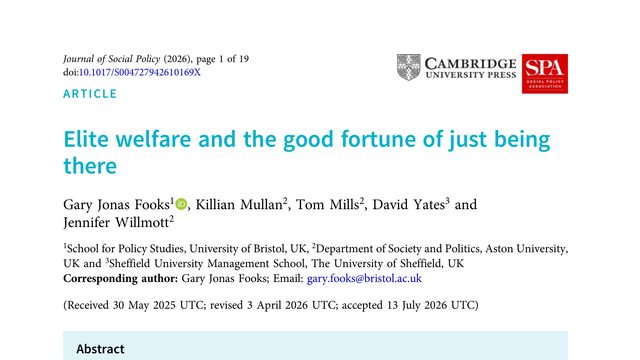
During the pandemic, government support was meant to protect jobs and businesses. But companies receiving that support were also linked to a sharp rise in top executives’ pay soon afterward.Pandemic support was presented as protection for jobs and livelihoods. But in the UK’s biggest listed companies, furlough support was associated with higher executive pay soon afterward.
Z. Dickson, SARA BINZER HOBOLT, Catherine E. De Vries, Simone Cremaschi
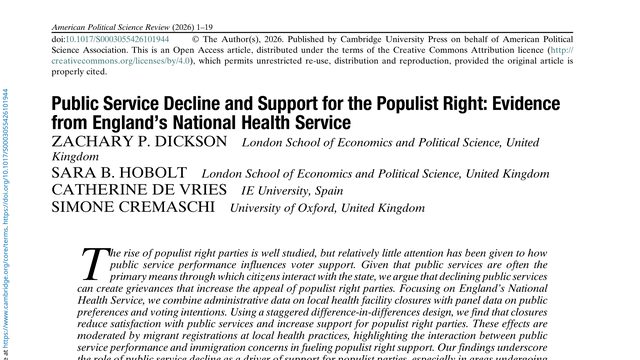
A local doctor’s surgery closes, and years later, people affected by that closure are more likely to support the populist right. The surprising link is not just healthcare; it is trust in the state.What if support for the populist right is shaped not only by culture or the economy, but by something as concrete as losing a local doctor’s practice? This paper finds that GP closures can change both service satisfaction and political support.
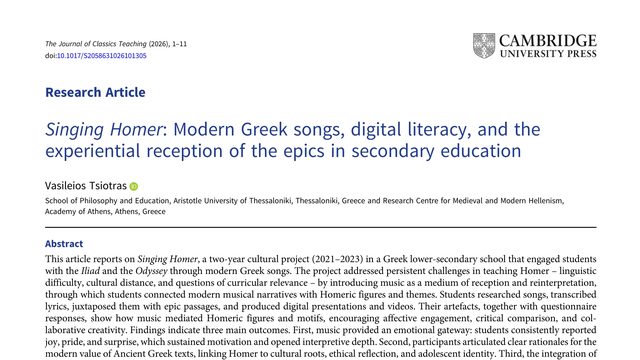
Homer can feel like a locked room: important, famous, and very far away. In one Greek classroom, students found a key in an unexpected place, not another lecture, but modern songs.What if the best way to make Homer feel contemporary is not to simplify the epics, but to let students remake them through songs they already understand? This project turns classical reception into a creative, digital classroom experience.
 5:15