Corporate Accountability by Algorithm: AI and the Interpretation of Human Rights Due Diligence
In depth17:04CCAI
paperi.ai
0:00 / 0:00
Galit A. Sarfaty
AI can make global supply chains more visible and help flag forced-labour risks. But this paper asks a sharper question: when software interprets human rights duties, who is really deciding what counts as a risk?
As companies struggle to conduct human rights due diligence and governments attempt to monitor compliance with supply chain regulations, they are increasingly turning to digital technologies such as artificial intelligence (AI). While AI-based tools can improve supply chain visibility and assess human rights risks, they carry potential risks of marginalizing rightsholders and undermining traditional conceptions of corporate accountability. This article examines the methodologies behind these tools, the role of technology firms in their design and application and the unintended consequences of relying on those firms to interpret the legal norm of human rights due diligence. It draws on a critical analysis of AI-based tools as well as interviews with officials from technology firms, consultants and human rights advocates. I argue that although AI can enhance human rights due diligence, AI-driven corporate accountability delegates interpretive judgment to technology firms, privatizes human rights and deemphasizes stakeholder engagement.
Transcript
AI can make global supply chains more visible and help flag forced-labour risks. But this paper asks a sharper question: when software interprets human rights duties, who is really deciding what counts as a risk? As companies struggle to conduct human rights due diligence and governments attempt to monitor compliance with supply chain regulations, they are increasingly turning to digital technologies such as artificial intelligence.
AI-based tools can improve supply chain visibility and assess human rights risks, but they also carry potential risks of marginalizing rightsholders and undermining traditional conceptions of corporate accountability. The article examines the methodologies behind these tools, the role of technology firms in their design and application, and the unintended consequences of relying on those firms to interpret human rights due diligence.
Its evidence combines a critical analysis of AI-based tools with interviews involving technology firms, consultants, and human rights advocates. The central argument is that AI can enhance human rights due diligence while delegating interpretive judgment to technology firms, privatizing human rights, and deemphasizing stakeholder engagement.
Within business and human rights, there is a growing reliance on artificial intelligence to conduct human rights due diligence. Human rights due diligence is the process by which a company identifies, prevents, mitigates, and accounts for potential adverse human rights impacts within its operations and supply chains.
Introduced in the 2011 United Nations Guiding Principles as part of the corporate responsibility to respect human rights, human rights due diligence is now the cornerstone of the international legal framework on business and human rights. The United Nations Guiding Principles define general parameters, but governments have failed to provide sufficient guidance on how to operationalize the process and have inadequately monitored and enforced compliance with the laws.
Cosmetic compliance includes a box-ticking approach that focuses on process rather than outcomes. It also includes shallow due diligence that does not go beyond the first tier of suppliers and the absence of meaningful engagement with stakeholders.
As companies and states struggle to comply with and enforce supply chain laws, respectively, they are increasingly turning to digital technologies such as artificial intelligence for complex global supply chains. A noteworthy example is the use of AI-enabled tools to implement recent forced labour import bans.
Since 2020, the United States-Mexico-Canada Agreement has committed the three state parties to prohibit imports of goods produced in whole or in part by forced labour. In 2021, the United States passed the Uyghur Forced Labor Prevention Act, which aims to ensure that no product made wholly or partly in China’s Xinjiang Uyghur Autonomous Region is imported into the country.
Companies and government officials rely on technology firms to map complex multi-tiered supply chains and screen public sources, commercially available trade data, and corporate data for forced labour indicators. The use of AI to facilitate compliance with the Uyghur Forced Labor Prevention Act and other supply chain regulations has not been critically examined for its implications for corporate accountability.
The article examines the promise and perils of AI as a technology of governance for interpreting human rights due diligence and implementing supply chain legislation. By enabling supply chain visibility and risk assessment, AI is significantly enhancing companies’ ability to conduct human rights due diligence in compliance with recent laws.
At the same time, AI delegates interpretive judgments to technology firms and their proprietary models, privatizes human rights, and deemphasizes stakeholder engagement. The socio-legal empirical methodology included twelve semi-structured interviews with representatives of technology firms, consultants, and human rights advocates.
Interviewees were selected for professional involvement in developing, advising on, or assessing technologies used to implement global supply chain regulations and human rights due diligence. The interviews were conducted in person or virtually in 2025, recorded, transcribed with informed consent, and analysed for the design and use of AI tools, data sources, analytical methods, supply chain mapping, risk assessment, stakeholder engagement, and corporate accountability.
The study also included participant observation at two conferences featuring presentations and demonstrations by policymakers and practitioners. The conferences also featured technology firm representatives, and these observations provided contextual background and informed the subsequent interviews.
The study analysed reports, product materials, and other publicly available resources issued by technology service providers. These firms offer digital tools for compliance with supply chain regulations, including mapping supply chains and identifying and assessing human rights risks.
The research focuses primarily on two case studies that illustrate distinct approaches to supply chain risk assessment. Sayari uses AI and graph analytics to analyse public and commercial data, map corporate and trade relationships, and identify risk exposure, while Assent uses supplier surveys, AI-powered screening of watchlists and adverse media, and review by subject matter experts.
The cases are not intended to represent all technology service providers; they show how different digital tools and methods shape the interpretation and implementation of human rights due diligence. The first wave of supply chain regulation consisted of disclosure laws addressing conflict minerals and modern slavery.
These laws require companies to report on efforts to address human rights violations in supply chains, but require little concrete action and impose few penalties for non-compliance. A second model comprises mandatory human rights due diligence laws, requiring companies to identify and address human rights risks in their operations and supply chains, sometimes with legal liability for failure to comply.
Despite the proliferation of supply chain regulations, human rights due diligence remains difficult to implement. Corporate Human Rights Benchmark’s 2020 analysis of disclosures from 229 global companies identified human rights due diligence as a key challenge.
Almost half of the companies assessed, forty-six point two percent, failed to score any points under the benchmark’s human rights due diligence indicators. In the benchmark’s 2023 analysis, more than half of companies, fifty-five percent, still failed to include rightsholders in their human rights due diligence processes.
Uneven performance could be explained by the absence of guidance on what constitutes adequate human rights due diligence and a lack of tools to achieve that standard. It could also be explained by the difficulty and cost of mapping complex global supply chains, comprehensively assessing human rights risks, and managing suppliers beyond a company’s first tier.
Companies are increasingly turning to technology firms to help interpret the legal norm of human rights due diligence and implement supply chain legislation. AI is arguably the most critical technology in this context because it enables companies to manage multi-tiered supply chains and mine large datasets for risk intelligence.
The study focuses on AI’s benefits: increasing supply chain visibility, assessing human rights risks, and monitoring corporate compliance. AI can enable the mapping and tracing of suppliers beyond the first tier and down the supply chain, enhancing supply chain visibility.
By applying complex algorithms and synthesizing massive amounts of data from various sources, AI tools can improve supply chain transparency and facilitate product traceability. These capabilities can make human rights due diligence more efficient and scalable.
Sayari applies its algorithms to official public records, commercially available import-export trade data from over seventy countries, and corporate data. Its technology connects data on three billion relationships, including trade, ownership, and control, extracted from seven point one billion records from 245 jurisdictions.
Sayari refreshes data and brings in new data every two to four weeks to account for supply-chain volatility, including tactical name changes and the closing of subsidiaries. It also preserves time-stamped historical snapshots of corporate records, allowing users to identify what changed and when and trace corporate ownership over time.
Sayari’s AI-enabled tool organizes unstructured raw data by standardizing names, reconciling diverse entities, resolving duplicate records, matching suppliers across languages and data formats, and building a unified supply chain map. Sayari maintains data provenance by linking each data point and relationship to the underlying primary source document.
That data provenance can help users provide evidence to authorities investigating a product’s origin, such as when CBP officials review detained shipments for Uyghur Forced Labor Prevention Act compliance. Figure one maps corporate relationships from official Chinese records, with Contemporary Amperex Technology, or CATL, at the top right and Xinjiang Zhicun Lithium farther down the network.
The connected ownership and investment links trace an indirect relationship through several companies, while annotations highlight registration details and changes involving Meishan Chendao Investment. The authors use this visualization to show how supply-chain connections can extend beyond direct suppliers and reveal potential links to Xinjiang-based raw-material entities.
Risk identification and assessment is another important step in human rights due diligence that is being automated using AI. This step is grounded in Principle 18 of the United Nations Guiding Principles, which states that businesses should identify and assess any actual or potential adverse human rights impacts.
After mapping operations and the supply chain, a company needs to identify existing adverse human rights impacts and potential risks of future adverse human rights impacts. Risks should be assessed based on their impact on people, rather than on their financial impact to the company.
AI-powered risk assessment uses sectoral, geographic, and product risk factors, along with human rights indicators such as forced labour, to produce risk scores for suppliers and their factories. Risk rating systems categorize risks at levels such as low, medium, or high, enabling companies to prioritize high-risk sectors and regions.
An AI-enabled platform flags risks for companies, and corporate clients can customize it based on their risk appetite and compliance obligations. By combining supplier screening with direct surveys, Assent produces what it calls a 360-degree view of a company’s sustainability performance across its supply chain.
Its platform combines direct surveys and indirect screening across public sources to produce risk scores for each supplier’s environmental, social, and governance performance. These risk scores appear in corporate clients’ online ESG risk dashboards and help companies identify high-risk suppliers across different ESG risk areas.
The dashboard classifies numerical risk scores under low, medium, and high risk, but Assent does not disclose the scoring scale, weighting system, or risk typology because it considers them proprietary information. The performance summary shows a mixed profile: governance has the largest score at eighty-six, while environment is fifty and marked high risk.
In the detailed rows, Human Rights stands out at seventy-seven, compared with scores of nineteen for Biodiversity and eleven for Product Stewardship. Assent considers information proprietary. The platform may be less able to identify hidden risks deeper in the supply chain.
Assent’s supplier screening process takes a more balanced approach that incorporates human judgment rather than primarily relying on automated analysis. Assent’s platform integrates digital sources with analysis by human rights and subject matter experts, who provide context to the data.
The firm combines automated data analysis with expertise from an in-house team of regulatory specialists. The use of AI is not limited to business: governments are beginning to use AI tools to monitor corporate compliance with supply chain regulations and investigate potential violations.
For the Uyghur Forced Labor Prevention Act, CBP has contracted with several AI firms, including Sayari and Altana AI, to identify companies that may violate import regulations. CBP officials use AI to help screen cargo at ports of entry and efficiently flag high-risk shipments.
By enabling companies to map suppliers beyond the first tier and automate human rights risk assessments, AI offers distinct benefits for optimizing human rights due diligence and facilitating supply chain compliance. Yet AI-based tools also suffer from serious constraints.
Those constraints include data gaps, credibility concerns, and a lack of transparency. AI-driven corporate accountability threatens to privatize the human rights due diligence process and marginalize rightsholders by delegating interpretive judgment to technology firms and their proprietary models.
Beyond missing data, there are credibility concerns associated with the data AI tools rely on to map supply chains and conduct risk assessments. The reliability of AI-powered human rights due diligence depends on trustworthy data, and records can be manipulated if they are falsified.
Companies may change their names in official records to avoid detection of goods made by Uyghur labour, while the Chinese government may delete sensitive data to prevent scrutiny of forced labour practices. AI is not a silver bullet or an all-seeing eye, and the technology cannot identify the actual movement of Uyghur people.
AI is an accelerator in the research process, helping subject matter experts generate leads and query data across hundreds of sources. Not every discovery is a risk-relevant finding, so a determination has to be made about whether the data indicates a connection to forced labor practices, directly or through a related party.
Sometimes AI makes that determination, sometimes an analyst does, and sometimes it is a combination of the two. In every case, an analyst validates the data before publication. The use of AI in human rights due diligence represents a privatization of human rights and supply chain governance that disrupts traditional conceptions of corporate accountability and deemphasizes stakeholder engagement.
Companies remain legally responsible for human rights due diligence, but key interpretive judgments are increasingly delegated to technology firms and embedded in proprietary models. This creates an accountability gap: profit-driven firms influence what counts as a risk, how severity is assessed, and what constitutes adequate due diligence without being legally accountable for those judgments.
The gap between delegated judgment and retained legal responsibility is especially troubling because supply chain regulations are intended to enhance corporate accountability to the public and hold companies responsible for human rights violations in which they are complicit. AI can make human rights due diligence more efficient and scalable, but it also delegates key interpretive judgments to technology firms and proprietary models.
That creates an accountability gap while deemphasizing stakeholder engagement.
A derivative work by Paperi · AI-generated script, voice and captions
· pages and figures unaltered
Made with Paperi.
Drop in a research PDF — get a narrated video walkthrough like this one,
with highlights that follow the narration. Free to start.
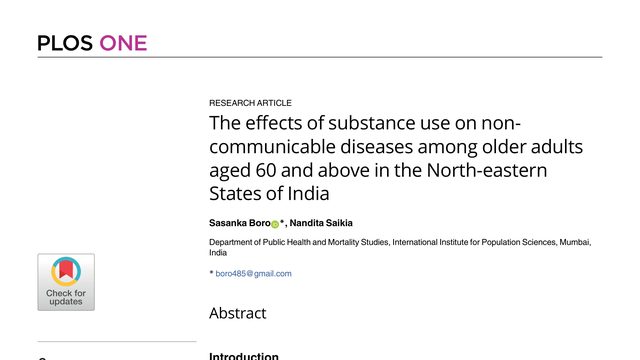
For older adults in North-eastern India, tobacco and alcohol are not just habits carried into later life. This study finds they are closely tied to several chronic illnesses, with one especially striking link to cancer.In Northeast India, older adults who have used tobacco or alcohol show striking associations with chronic diseases, including a nearly twenty-fold higher odds of cancer for people with past smoking behaviour. But this is an association, not proof of causation.
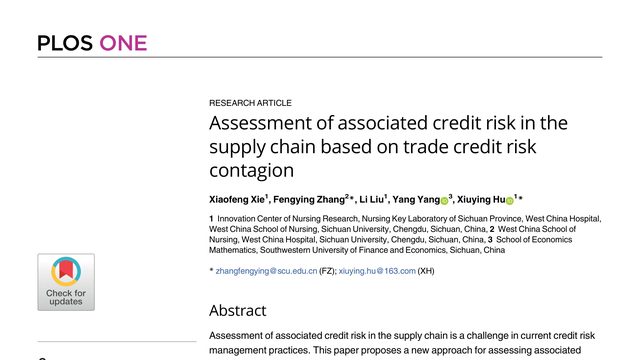
Xiaofeng Xie, Fengying Zhang, Li Liu, Yang Yang, Xiuying Hu
A company can look safe on its own and still become dangerous to a bank when a business partner gets into trouble. This study asks how financial risk travels through the supply chain before the damage is obvious.A firm's credit risk may not stay inside that firm. This paper treats supply chains as contagion networks, separating a company's own risk from the risk transmitted through trade credit relationships.
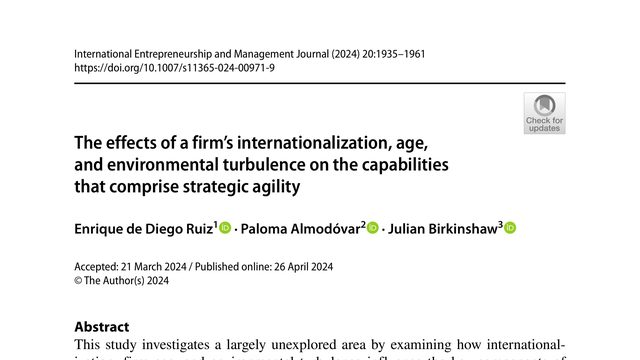
Enrique de Diego Ruiz, Paloma Almodóvar, Julian Birkinshaw
When the business world becomes more chaotic, companies do not always become less capable. This study finds that turbulence can actually make them more alert, more responsive, and better able to adapt.Internationalization does not simply make a firm more agile. In this study, it improves strategic sensitivity but weakens leadership unity, while turbulence strengthens every measured dimension of agility.
 4:23