Corporate Accountability by Algorithm: AI and the Interpretation of Human Rights Due Diligence
Overview4:35CCAI
paperi.ai
0:00 / 0:00
Galit A. Sarfaty
A company may use artificial intelligence to find hidden human-rights risks in its supply chain. But the same system can quietly decide what counts as a risk, and place that judgment in the hands of a private technology firm.
As companies struggle to conduct human rights due diligence and governments attempt to monitor compliance with supply chain regulations, they are increasingly turning to digital technologies such as artificial intelligence (AI). While AI-based tools can improve supply chain visibility and assess human rights risks, they carry potential risks of marginalizing rightsholders and undermining traditional conceptions of corporate accountability. This article examines the methodologies behind these tools, the role of technology firms in their design and application and the unintended consequences of relying on those firms to interpret the legal norm of human rights due diligence. It draws on a critical analysis of AI-based tools as well as interviews with officials from technology firms, consultants and human rights advocates. I argue that although AI can enhance human rights due diligence, AI-driven corporate accountability delegates interpretive judgment to technology firms, privatizes human rights and deemphasizes stakeholder engagement.
Transcript
A company may use artificial intelligence to find hidden human-rights risks in its supply chain. But the same system can quietly decide what counts as a risk—and place that judgment in the hands of a private technology firm. As companies struggle to conduct human rights due diligence and governments attempt to monitor compliance with supply chain regulations, they are increasingly turning to digital technologies such as artificial intelligence.
AI-based tools can improve supply chain visibility and assess human rights risks, but they can also marginalize people affected by business decisions and undermine traditional ideas of corporate accountability. The central argument is that AI can enhance human rights due diligence while delegating judgment about its meaning to technology firms, privatizing human rights and reducing stakeholder engagement.
The use of AI can significantly enhance companies’ ability to conduct human rights due diligence in compliance with recent laws. But the use of AI is also disrupting traditional ideas of corporate accountability by delegating interpretive judgments to technology firms and their proprietary models.
That means a company’s responsibility is increasingly shaped by systems it did not create and may not fully explain. These firms offer digital tools that support compliance with supply chain regulations, including mapping supply chains and identifying and assessing human rights risks.
The tools follow distinct approaches: some analyze public and commercial data to map corporate and trade relationships, while others combine supplier surveys, outside digital sources and review by subject-matter experts. The cases show how different digital tools and methods shape the interpretation and implementation of human rights due diligence.
Here is the everyday picture: AI works like a map that keeps extending past the stores a company buys from, tracing suppliers farther down the chain. By combining large amounts of data from different sources, AI tools can improve the transparency of supply chains and make products easier to trace.
That can make human rights due diligence more efficient and scalable. AI-powered risk assessment produces risk scores for suppliers and their factories using sector, geographic and product factors together with human rights indicators. Risk-rating systems categorize risks at different levels, enabling companies to prioritize high-risk sectors and regions in areas such as forced labour.
The platform flags risks for companies, and corporate clients can customize it based on their risk appetite and compliance obligations. By enabling companies to map suppliers farther down the chain and automate human rights risk assessments, AI offers benefits for improving due diligence and supporting supply chain compliance.
But AI-based tools also suffer from serious constraints. Those constraints include data gaps, concerns about credibility and a lack of transparency. AI-driven corporate accountability threatens to privatize the due diligence process and marginalize affected people by delegating judgment to technology firms and their proprietary models.
Companies remain legally responsible for human rights due diligence, but key judgments are increasingly delegated to technology firms and embedded in their proprietary models. This creates an accountability gap: profit-driven firms influence what counts as a risk, how serious it is and what counts as adequate due diligence without being legally accountable for those judgments.
That gap is especially troubling because supply chain regulations are meant to hold companies responsible for human rights violations in which they are complicit, whether knowingly or unknowingly. As AI maps supply chains and assesses human rights risks, companies should ensure that these tools supplement, rather than replace, meaningful engagement with workers and other affected stakeholders.
Ultimately, companies must remain accountable for how they interpret and implement human rights due diligence and for the human rights impacts of their business activities. These tools can make supply chains easier to see and risks easier to rank, but they must not replace workers and affected communities.
Companies still have to answer for the human consequences of their decisions.
A derivative work by Paperi · AI-generated script, voice and captions
· pages and figures unaltered
Made with Paperi.
Drop in a research PDF — get a narrated video walkthrough like this one,
with highlights that follow the narration. Free to start.
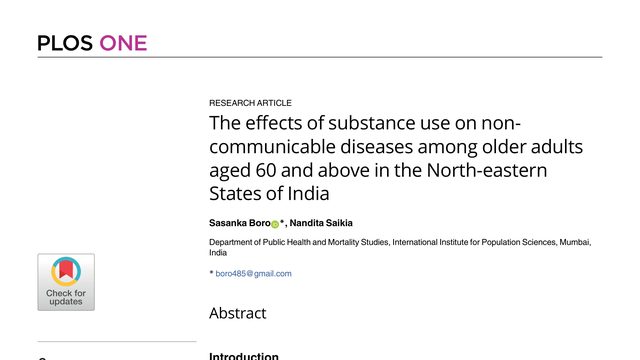
For older adults in North-eastern India, tobacco and alcohol are not just habits carried into later life. This study finds they are closely tied to several chronic illnesses, with one especially striking link to cancer.In Northeast India, older adults who have used tobacco or alcohol show striking associations with chronic diseases, including a nearly twenty-fold higher odds of cancer for people with past smoking behaviour. But this is an association, not proof of causation.
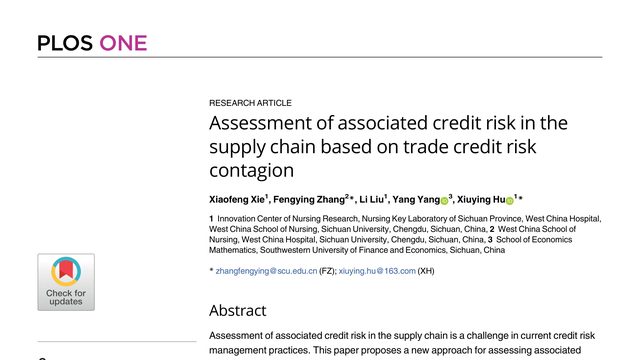
Xiaofeng Xie, Fengying Zhang, Li Liu, Yang Yang, Xiuying Hu
A company can look safe on its own and still become dangerous to a bank when a business partner gets into trouble. This study asks how financial risk travels through the supply chain before the damage is obvious.A firm's credit risk may not stay inside that firm. This paper treats supply chains as contagion networks, separating a company's own risk from the risk transmitted through trade credit relationships.
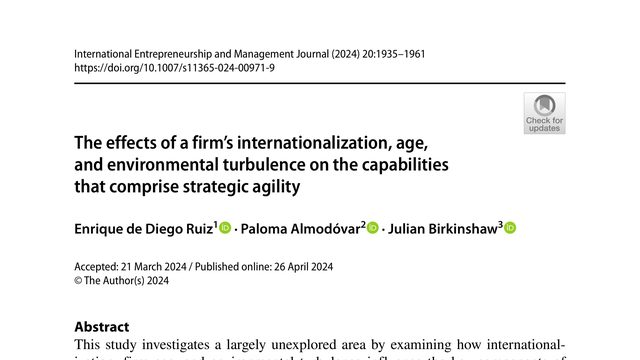
Enrique de Diego Ruiz, Paloma Almodóvar, Julian Birkinshaw
When the business world becomes more chaotic, companies do not always become less capable. This study finds that turbulence can actually make them more alert, more responsive, and better able to adapt.Internationalization does not simply make a firm more agile. In this study, it improves strategic sensitivity but weakens leadership unity, while turbulence strengthens every measured dimension of agility.
 4:23