‘Unprecedented injustice’: Digitalisation and the perceived accessibility of childcare benefits
In depth17:35CCAI
paperi.ai
0:00 / 0:00
Bryn Hummel, Mara A. Yerkes, Michèlle Bal
A benefit designed to make childcare affordable can become harder to reach when the application itself is digital, complex, and treated as the parent’s responsibility. This study asks whether literacy helps explain who feels able to access it.
The Netherlands recently experienced a crisis in childcare benefits, leading to ‘unprecedented injustice’ for many parents falsely accused of defrauding the childcare benefit system. This crisis highlights multiple barriers in parents’ ability to access childcare already evident prior to the crisis, including the far-reaching digitalisation of social policies and childcare benefits in particular. Digitalisation can make parents feel childcare services are less accessible, thereby creating or exacerbating existing inequalities in childcare use. Parents may also lack the skills needed to navigate complex application procedures, which can affect their perceived access to childcare benefits, particularly in market-led systems with greater reliance on government benefits to cover the high costs of childcare. Extending recent research on childcare capabilities, we investigate the extent to which digital and functional literacy affect parents’ perceived access to childcare benefits in the Netherlands. The results from our exploratory quantitative analysis provide a starting point for understanding the understudied relationships between digitalisation, parents’ abilities to navigate complex childcare or other policy systems, and their (perceived) ability to access childcare benefits. We use these findings to develop multiple future research recommendations in the childcare policy literature.
Transcript
A benefit designed to make childcare affordable can become harder to reach when the application itself is digital, complex, and treated as the parent’s responsibility. This study asks whether literacy helps explain who feels able to access it.
The Netherlands recently experienced a crisis in childcare benefits, leading to ‘unprecedented injustice’ for many parents falsely accused of defrauding the childcare benefit system. This crisis highlights multiple barriers in parents’ ability to access childcare, including the far-reaching digitalisation of social policies and childcare benefits in particular.
Digitalisation can make parents feel childcare services are less accessible, thereby creating or exacerbating existing inequalities in childcare use. The study investigates the extent to which digital and functional literacy affect parents’ perceived access to childcare benefits in the Netherlands, using exploratory quantitative analysis.
The Netherlands experienced a government crisis in twenty nineteen, after thousands of parents were unfairly and severely financially sanctioned by the Dutch Tax Authority for their supposed fraudulent receipt of childcare benefits. In some cases, parents were required to pay back upwards of tens of thousands of euros.
Known as the ‘childcare benefit crisis’, it caused the fall of the government and highlighted crucial problems with the accessibility of online government services, particularly childcare benefits. Childcare benefits are financial reimbursement of childcare costs provided to parents to offset the expense of formal childcare, and these benefits are increasingly offered as digitalised services.
Digital provision presumes access to the internet, electronic devices, the ability to use these devices to access and apply for policies and services, and the ability to navigate and understand the online policy environment. These assumptions are problematic because access to electronic devices and digital skills are unequally distributed throughout society.
When digitalisation increases the complexity of service provision, digitally providing social policies and services can reduce rather than increase access. The digital provision of childcare benefits can reduce childcare access if parents perceive the application process to be so complex that they do not even attempt to access policies and services.
Access to childcare services is already unequal, and digitalisation has the potential to exacerbate these inequalities. Structural constraints related to differences in socio-economic position reduce childcare availability and affordability and create ‘Matthew effects’ in usage.
Perceived access is less understood, despite being acknowledged as an important barrier to childcare use. The comparative childcare policy literature has yet to account for the ways digitalisation may affect childcare access via digitally accessible, government-provided childcare benefits.
The study provides an exploratory empirical investigation of the relationship between digitalisation and parents’ perceived access to childcare services in the Netherlands. The Netherlands is a particularly salient case study for investigating this relationship.
The relationship is studied in the Netherlands given high levels of digitalisation, a heavy reliance on market-based childcare services, and the recent government crisis related to childcare benefits. Using data from a cross-sectional survey among parents in the Netherlands, the study investigates parents’ understanding of the childcare system and their digital skills in relation to perceived access, and whether this differs across educational levels.
The study focuses on the accessibility of digitally provided childcare benefits as a crucial component of parents’ perceived access to childcare services. Childcare services in the Netherlands are market-based and expensive, relying on a demand-driven system since the mid-2000s, and parents across all socio-economic positions rely heavily on childcare benefits.
To access the benefit, parents must complete an online form with the Dutch Tax Authority, providing information about their childcare provider, employment, and income. Childcare benefits are income-dependent and intended to cover at least one-third of childcare costs, while parents in the lowest income category can be reimbursed for up to ninety-six percent of childcare costs.
Parents pay childcare costs up front in full, then receive a partial, temporary reimbursement, and payments are audited by the Tax Authority within one to three years. The retroactive audit procedure is considered complicated and demanding for parents, based on a complex and untransparent system.
Thousands of parents had been unfairly required to pay back tens of thousands of euros, and this disproportionately affected low-income families. Parents accused of fraud were also denied access to childcare benefits while awaiting pending decisions or appeals.
The actions of the Tax Authority had severe socioeconomic consequences, including far-reaching debt, job loss and eviction, as well as reduced physical health and mental wellbeing. A parliamentary inquiry concluded that a complicated, market-based system of cash transfers, sensitive to minor changes in employment and income, led to ‘unprecedented injustice’.
The parliamentary report had one glaring omission: reference to the online application procedure for childcare benefits. The crisis reflects a deeply rooted assumption that parents are equally able to shoulder responsibility for an accurate application procedure in a complex digitalised childcare benefit system.
Following the introduction of a market-based system of benefits, the person requesting the benefit is responsible for the accuracy of the application. With a complex application procedure, widespread digitalisation, and an unequal distribution of digital skills, the potential for inequality is great.
Inaccessible childcare benefits could exacerbate gender and class inequality, which childcare benefits were designed to reduce. The study focuses on two key aspects: functional literacy and digital literacy. Functional literacy refers to people’s broader ability to navigate the social policy system, and differs from one’s ability to read and write.
Current conceptualisations recognise that functional literacy relates to societal participation and encompasses the competencies individuals need to function appropriately in society. Someone who is functionally literate has the skills, knowledge, and capacities to be familiar with the system and knows how to navigate it.
Digital literacy is equally necessary to apply for childcare benefits in the Netherlands, and increasingly for many welfare state benefits throughout Europe. Two types of digital literacy skills can be distinguished: operational skills and informational skills.
Operational digital skills include operating a computer, such as typing, whereas informational digital skills refer to solving everyday problems using a computer, such as gathering information online. More than half, fifty-six percent, of twelve- to seventy-four-year-olds has low informational digital skills in the Netherlands, and ten percent also has very low operational digital skills.
Low digital literacy skills are not exclusive to older people: more than thirty-five percent of sixteen- to twenty-four-year-olds possesses low or insufficient digital literacy skills. The study analyses how digital and functional literacy affect perceived parental access to childcare benefits using the capability approach.
Childcare capabilities represent parents’ capabilities to organise childcare in a way that enables them to pursue activities in life they have reason to value. The capability approach is a philosophical and normative framework focused on human wellbeing and people’s opportunities to live a valued life.
From this perspective, social inequalities arise because individual opportunities are embedded in personal situations and broader social structures. Multiple factors shape the extent to which individuals are able to convert means into capabilities, because individuals are embedded in intersecting personal, community, and institutional contexts.
The study focuses on digital and functional literacy as personal-level factors that may shape parents’ perceived access to childcare benefits. A quantitative survey gathered data on functional and digital literacy, parents’ perceived access to childcare benefits, and several sociodemographic characteristics.
The study relied on a convenience sample of parents who were eligible for childcare benefits at the time of the survey. Fielding took place between April and July twenty twenty, at the height of the COVID-19 pandemic and the first lockdown. The survey was intended to be administered online and in paper form to ensure parents with lower functional or digital literacy skills could access the questionnaire, but participant recruitment was ultimately limited to predominantly online surveys.
A limited number of paper surveys, one hundred ten, were distributed via formal childcare organisations in Amsterdam and Utrecht, and response based on the printed surveys was very low: one point eight percent. Perceived access to childcare benefits was measured through the statement, ‘I think applying for childcare benefits is complicated’.
Answer categories used a seven-point Likert scale ranging from ‘completely agree’ to ‘completely disagree’, with a higher value corresponding to higher perceived access. Participants were then asked which factors, if any, complicated the application procedure, such as the income estimation.
Functional literacy was assessed with a measure developed through desk research and two qualitative cognitive pre-testing interviews. The interviews identified competencies necessary to apply for childcare benefits, including working meticulously, anticipating and maintaining changes in personal and financial situations, organisational skills, and the ability to read and write.
These competencies were translated into eight statements measured on ten-point Likert scales. Literacy also emerged as an essential component of functional literacy, so the survey included the DIS-scale to assess respondents’ ability to read and write.
Digital literacy was measured using the digital competence framework, designed to measure people’s ability to critically and responsibly use and engage with digital technology for education, employment, and societal participation. The final measure contained sixteen statements tapping into social, informational, and problem-solving digital skills.
Digital literacy was measured as a continuum, with scores ranging from zero to sixteen, rather than as a threshold. Univariate t-tests tested differences between non-tertiary and tertiary educated participants in perceived access, digital literacy, and functional literacy.
OLS regression was used for the main models, and all models were adjusted for gender, age, ethnicity, and income instability. A parallel mediation model would have been conducted, but given the absence of support for mediation, this analysis was not conducted. Several sensitivity analyses were conducted as a fourth and final step.
In total, one hundred seventy-seven respondents took the survey, and the final analytical sample was one hundred thirty-seven. Thirty-nine respondents were excluded for not fully completing the survey, and one respondent was excluded because they likely did not meet the study inclusion criteria based on age.
The majority, eighty-one point eight percent, of the sample was female, and respondents’ ages ranged from twenty-three to fifty-five. Only two point two percent of the sample was lower educated, while seventy-nine point four percent was higher educated. Due to the overrepresentation of higher-educated parents, descriptive statistics were weighted to the educational levels in the Dutch population.
Nearly two-fifths, thirty-eight percent, of parents in the sample reported feeling that the childcare benefits application procedure was complicated. The majority, eighty-four parents or sixty-one point eight percent, reported that the complication was related to having to estimate their income, and twenty-seven parents said news about supposed fraud scared them.
Parents also identified the amount of information, fear of making mistakes, different terms, the amount of work, the online procedure, and the Dutch language as complications. Despite the perceived complexity, descriptive results suggest that functional and digital literacy were high in the sample.
The mean functional literacy score was seven point eight, and the mean digital literacy score was thirteen point six. Table one summarizes the sample and its weighted composition, alongside descriptive statistics for perceived access, digital and functional literacy, and age.
It reports one hundred thirty-four parents for perceived access, with a weighted mean of four point seven, while total digital literacy has a weighted mean of thirteen point zero. The weighted percentages also show how the sample is distributed by sex, ethnicity, education, contract type, and income, providing essential context for interpreting the paper’s analyses of childcare-benefit access and application complexity.
Higher-educated parents had lower perceived access to childcare benefits than lower-intermediate educated parents, contradicting the first hypothesis. Higher-educated parents were less likely to receive help during the application procedure than lower-intermediate educated parents.
Controlling for receiving help with the application procedure did not nullify the negative relationship between educational level and perceived access. Multivariate linear regression confirmed the negative association between educational level and perceived access, thereby rejecting H one.
Educational level was neither significantly associated with digital literacy nor with functional literacy, leading to rejection of H two and H three. Digital literacy and functional literacy were also not associated with perceived access, leading to rejection of H four and H five.
Because the hypotheses were not confirmed, no mediation effect could be established. Table two reports five multivariate linear regression models. Educational level is negatively associated with perceived access in model M1, with an unstandardized coefficient of minus zero point eight six zero, while its associations with digital literacy in M2 and functional literacy in M3 are not marked as significant.
Models M4 and M5 likewise show no marked association between digital or functional literacy and perceived access, supporting the authors’ rejection of the stated hypotheses. Figure One maps the proposed mediation model: educational level is linked directly to perceived access, and indirectly through digital and functional literacy.
The chart reports a significant direct path from educational level to perceived access, with B equal to negative zero point eight six zero and p equal to zero point zero three zero, while the paths involving the two literacy measures are not statistically significant at the reported p values.
This matters because the model tests whether literacy helps explain educational differences in parents’ access to childcare benefits. The descriptive results suggest that a considerable group of parents considers childcare benefits difficult to access given the complexity of the system.
The necessity of estimating one’s income, and that of the partner, was seen as the most onerous task. Despite most parents being tertiary educated, there was still variation in functional and digital literacy skills, demonstrating that these skills are not ubiquitous even among higher educated parents.
No mediation between educational level, digital and functional literacy, and perceived access could be established. The absence of significant results and the unexpected negative association between education and perceived access may be due to the small sample size and the underrepresentation of lower-educated parents.
The study finds that many parents experienced the application as complicated, but its exploratory data did not support the proposed literacy pathways. The unexpected education pattern points to the need for broader, better-sampled research.
A derivative work by Paperi · AI-generated script, voice and captions
· pages and figures unaltered
Made with Paperi.
Drop in a research PDF — get a narrated video walkthrough like this one,
with highlights that follow the narration. Free to start.
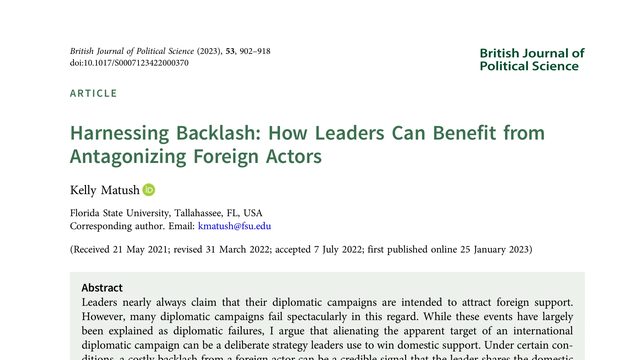
What if a leader angers a powerful foreign partner not by accident, but to prove loyalty to voters back home? This paper argues that a diplomatic backlash can sometimes be politically useful.What if a diplomatic backlash is not a failure, but the point? This paper argues that leaders can trade foreign condemnation for domestic support when the right voters are watching.
Ashley Cleary, Frannie Kaczor, Maisie Finnegan, John Schimek, Abby Egen-Schimek, Erin O’Donnell, Marlene D Melzer-Lange
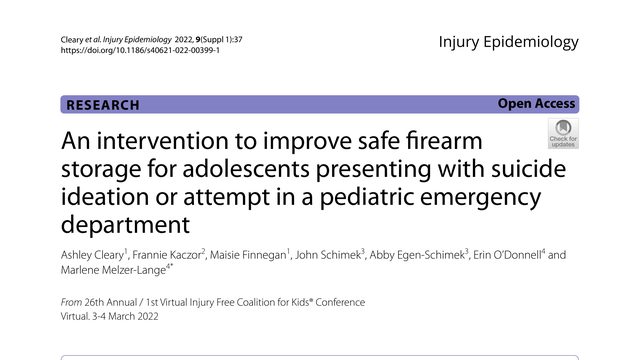
When a young person is in suicidal crisis, a safety conversation may not be enough. This emergency department added something families could take home immediately: a lockbox for a firearm.When a teenager arrives at the emergency department after suicidal thoughts or an attempt, this program does more than offer advice: it puts a firearm lockbox into the family’s hands at that moment.
Bowen Zhang, Chen Zhong, Mingfei Ma, James Golding-Graham
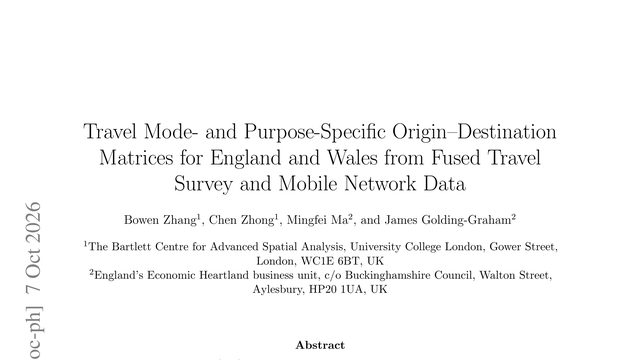
Every transport decision depends on an invisible question: who travels from where to where? This study builds a detailed answer by combining the broad movement picture from mobile phones with the human details surveys can provide.What if the best way to map how a country travels is to combine the reach of mobile networks with the detail of travel surveys? This paper builds that hybrid picture for every small area of England and Wales.
 3:55