Prescriptions of homeopathic remedies at the expense of the German statutory health insurance from 1985 to 2021: scientific, legal and pharmacoeconomic analysis
Curious5:10CCAI
paperi.ai
0:00 / 0:00
Hauke Leemhuis, Roland Seifert
When public health insurance pays for a treatment, the question is not only whether people want it. It is whether the evidence, the price, and the safety information justify using everyone’s shared money.
The prescription of homeopathic remedies at the expense of the statutory health insurance (SHI) system in Germany has been criticized for years due to a lack of evidence. Now, on the planned abolition of the reimbursement of homeopathic medicines in Germany, the debate on this topic has been reignited. The aim of this paper is to show the costs and their development over time incurred by homeopathic remedies in the healthcare system from 1985 to 2021. For this purpose, 15 selected homeopathic medicines were chosen from the drug prescription report (Arzneiverordnungsreport) and analyzed with regard to their development of DDD (Defined Daily Dose) using data from the Wissenschaftliches Institut der Ortskrankenkassen (WidO, Scientific Institute of the General Local Health Insurance Funds) and compared with their respective rational pharmacological alternatives. The price comparison was based on the DDD costs and the pharmacy retail price of the smallest packaging in each case. The clinical study situation for the preparations was also analyzed. For this purpose, the clinical studies provided by the manufacturer and those on PubMed were divided into evidence levels and analyzed. In addition, the presentation of homeopathic remedies on company websites, in online pharmacies, in specialist information and package leaflets was analyzed with regard to side effects, interactions, indication, and information on the alleged effect/ proof of efficacy. In many media, information on homeopathic medicines remained incomplete, and non-compliance with the Therapeutic Product Advertising Act (Heilmittelwerbegesetz) was noted. Naming of the products if often very suggestive, too. Manufacturers’ claims of efficacy go far beyond what can be considered proven in terms of evidence-based medicine and the quality of most clinical studies is poor. Homeopathic remedies are on average significantly more expensive than their rational pharmacological alternatives. Furthermore, DDD costs have continued to rise over the years analyzed. In aggregate, from a pharmacoeconomic, legal, and scientific perspective, abolition of reimbursement of homeopathic medicines in Germany at the expense of the SHI system is well justified.
Transcript
When public health insurance pays for a treatment, the question is not only whether people want it. It is whether the evidence, the price, and the safety information justify using everyone’s shared money. Germany stopped including homeopathic remedies in the regular public health insurance benefits catalogue in 2003.
However, they can still be reimbursed as voluntary additional benefits provided by individual health insurance funds. Although homeopathic remedies left the SHI benefits catalogue, statutory health insurance funds can still reimburse them through voluntary additional benefits provided by those funds.
The analysis uses scientific data to examine Germany’s homeopathic-medicine market, applying stringent pharmacoeconomic and pharmacological criteria to assess the available evidence. The analysis follows the money over time, examining the costs of homeopathic remedies in Germany from 1985 to 2021 and comparing them with ordinary drug alternatives.
It also examines clinical studies and the way these remedies are described on company websites, online pharmacies, package leaflets, and professional information, including claims about effects, side effects, and interactions. The insurance data concern medicines prescribed by registered doctors in outpatient care and dispensed through public pharmacies at the expense of the public insurance system.
Private prescriptions, which could make up a large share of the market, could not be recorded. So the spending picture is limited to the part visible through public insurance prescriptions. The clinical studies found in medical literature and the studies listed by manufacturers were sorted into evidence levels, then compared with the manufacturers’ claims about effectiveness.
The level assigned was the level a study was designed to reach, not necessarily the level it actually achieved. That distinction matters when a claim sounds stronger than the underlying study. The studies listed on manufacturers’ websites were usually observational studies, and they were not sufficient to prove a remedy’s clinical effectiveness beyond doubt.
These studies also often had flaws in how they were carried out. The uneven pattern suggests that manufacturers tend to refer to studies with lower evidence levels because those studies are more often favorable to the remedy. The financial result is clear: homeopathic remedies were, on average, significantly more expensive than their rational pharmacological alternatives.
Their costs also continued to rise over the years analyzed. The study found that in Germany, homeopathic remedies are, on average, significantly more expensive than their rational pharmacological alternatives overall. The evidence behind manufacturers’ efficacy claims is generally weak: those claims exceed what evidence-based medicine can consider proven, and most clinical studies are poor.
The analyzed preparations reached their highest accumulated sales in 1995, at nearly forty-four million euros. The highest recorded amount of use came later, in 2001, mainly because prescriptions of one preparation rose sharply. Spending peaked in 1995, while use peaked in 2001, with the latter driven mainly by a sharp rise in prescriptions of HR1.
Company websites consistently named the company and product, but key safety and transparency details were often missing: only 37.5 percent described unwanted effects, and 12.5 percent specified the price. This leaves patients with important information to find before deciding what to buy.
The overall conclusion is that homeopathic medicines remain important in Germany’s drug market, but use has shifted from public-insurance prescriptions toward non-insurance prescriptions and over-the-counter use, where the available data are very limited. The study also found multiple information problems, suggestive product names, potentially dangerous injectable homeopathic medicines, and poor overall clinical-study quality.
Taken together, the analysis provides economic, legal, and medical arguments for discussing the future of homeopathic remedies at the expense of Germany’s public insurance system. For patients and families, the practical consequence would be that shared insurance money no longer reimburses homeopathic remedies through the statutory health insurance system.
Care decisions would place greater weight on proven medical benefit and cost, since homeopathic medicines are often more expensive than pharmacologically effective alternatives. This analysis found that homeopathic remedies were often more expensive, supported by weak clinical studies, and presented with incomplete information.
It gives scientific, legal, and financial reasons to stop reimbursing them through Germany’s public insurance system.
A derivative work by Paperi · AI-generated script, voice and captions
· pages and figures unaltered
Made with Paperi.
Drop in a research PDF — get a narrated video walkthrough like this one,
with highlights that follow the narration. Free to start.
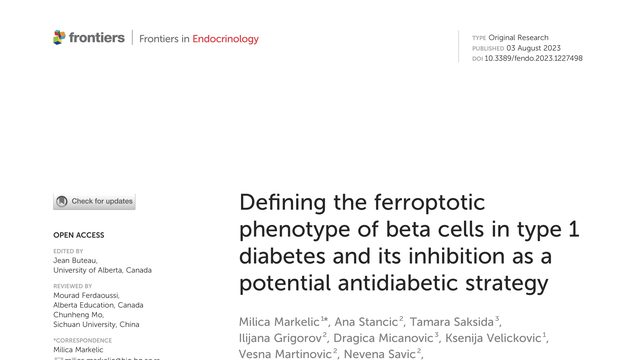
In type 1 diabetes, insulin-making cells may not only be attacked by the immune system—they may also be destroyed by a chain reaction involving iron and damaged fats. Blocking that reaction helped preserve signs of pancreatic health in diabetic mice.What if insulin-producing beta cells in type 1 diabetes are not dying only through the usual pathways, but through an iron-driven process that can be blocked? This study tests that possibility in diabetic mice.
Yang Liu, Yang Liu, Yizhao Wang, Huijin Feng, Lianjun Ma, Yanqing Liu, Yanqing Liu
When cancer cells die, that event may reveal more than the loss of a cell. It may also reflect how the immune system is responding—and help indicate how a colon cancer patient’s disease could unfold.A form of cell death that combines pyroptosis, apoptosis, and necroptosis may also help predict outcomes in colon cancer. This study turns that biological overlap into a two-cluster classification and a six-gene risk score.
Ryan Arlinghaus, Michiyo Iba, Eliezer Masliah, Mark Cookson, Natalie Landeck
A brain signal linked to disease can be easy to see in large clumps, yet nearly impossible to identify when it is quietly doing its normal work. This study found a way to separate that healthy signal from misleading noise.What if the antibody signal researchers use to track alpha-synuclein pathology is noisy in healthy tissue—and the cleaner method works beautifully everywhere except the human Lewy bodies it was meant to reveal?
 3:26
3:26