PANoptosis-related genes function as efficient prognostic biomarkers in colon adenocarcinoma
Curious3:35CCAI
paperi.ai
0:00 / 0:00
Yang Liu, Yang Liu, Yizhao Wang, Huijin Feng, Lianjun Ma, Yanqing Liu, Yanqing Liu
When cancer cells die, that event may reveal more than the loss of a cell. It may also reflect how the immune system is responding—and help indicate how a colon cancer patient’s disease could unfold.
When cancer cells die, that event may reveal more than the loss of a cell. It may also reflect how the immune system is responding—and help indicate how a colon cancer patient’s disease could unfold. PANoptosis is a newly discovered type of cell death that is tightly associated with immune system activities.
But the mechanism, regulation, and application of PANoptosis in tumors remain largely unknown. The study therefore explored whether genes related to it could help predict outcomes in colon adenocarcinoma. PANoptosis may remove damaged cells and promote tissue repair, while CCR and immune checkpoint genes may influence, or be influenced by, apoptotic processes.
More broadly, PANoptosis-related and immune-related gene sets moved together strongly, with a Spearman correlation above zero point seven across four immune feature sets. That strong relationship suggests likely co-regulation or mutual influence between PANoptosis and immune features, although it does not establish a one-way mechanism.
The precise mechanisms behind this relationship remain unexplained, so further investigation is needed to understand how these biological processes interact. The picture links stronger PANoptosis activity with several immune signals, then separates the cases into two immune-pattern groups.
This matters because the groups also differ in thousands of genes, suggesting that immune activity is tied to broad biological differences rather than a single signal. After the clusters were identified, survival analysis tested their prognostic implications, including whether disease progression risk and survival outcomes differed over time.
Cluster B may represent a subtype with lower risk of disease progression and better survival outcomes, suggesting that these patterns could inform clinical decisions and patient management. Those groups also had clearly different overall and progression-free survival, suggesting this pattern may help identify distinct disease courses.
The study then built a prognostic model from the expression levels of six genes related to these patterns, turning a complex biological signal into a risk score. In other words, the model used several gene readings together rather than relying on a single marker.
The risk score gave a reasonably robust forecast for outcomes at one, three, and five years, and every reported accuracy measure surpassed the study’s benchmark of zero point seven. The score also remained a reliable predictor when compared with clinical features, and two separate analyses supported its strength as a predictor.
Taken together, the PANoptosis-related genes were useful for classifying colon cancer patients and may help improve treatment choices. The study also produced an effective prognostic model based on those genes.
For someone facing colon cancer, the possible benefit is more tailored guidance about disease course and treatment—but the model still needs further research and clinical effort before it can be used routinely. The study found that patterns linked to a coordinated form of cell death can separate colon cancers into groups with different outcomes and support a risk estimate.
That could eventually help guide more personal treatment decisions, though clinical testing is still needed.
A derivative work by Paperi · AI-generated script, voice and captions
· pages and figures unaltered
Made with Paperi.
Drop in a research PDF — get a narrated video walkthrough like this one,
with highlights that follow the narration. Free to start.
Ryan Arlinghaus, Michiyo Iba, Eliezer Masliah, Mark Cookson, Natalie Landeck
A brain signal linked to disease can be easy to see in large clumps, yet nearly impossible to identify when it is quietly doing its normal work. This study found a way to separate that healthy signal from misleading noise.What if the antibody signal researchers use to track alpha-synuclein pathology is noisy in healthy tissue—and the cleaner method works beautifully everywhere except the human Lewy bodies it was meant to reveal?
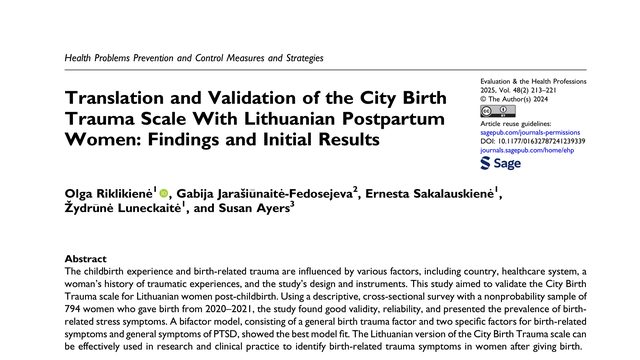
Olga Riklikienė, Gabija Jarašiūnaitė–Fedosejeva, Ernesta Sakalauskienė, Žydrūnė Luneckaitė, Susan Ayers
Childbirth is expected to be one of life’s most meaningful events, yet for some women it becomes psychologically traumatic. This study asks a practical question: can a short questionnaire reliably recognize that hidden distress in Lithuania?Childbirth can be psychologically traumatic for a substantial share of women, yet Lithuania had no validated measure for birth-related PTSD and stress symptoms. This study tests whether one established scale can work in Lithuanian language and culture.
John McDermott, Videha Sharma, Glenda M. Beaman, Jessica Keen, William G. Newman, Paul Wilson, Katherine Payne, Stuart Wright
A genetic test can promise safer, more effective prescribing—but this study found that whether clinicians use it may depend just as much on how the service is built as on the test itself.What if clinicians like the idea of pharmacogenetic testing, but the way results are delivered determines whether they would actually use it? This study tests that question directly with GPs and pharmacists.
 4:06
4:06