Geoheritage research is growing fast, but the marketing part may be more label than theory. This study maps the field to find out what is really connected, and what is only implied.
Research on geoheritage has experienced rapid expansion in recent years. However, the integration of management and marketing perspectives remains conceptually inconsistent. This study employs bibliometric and science-mapping methodologies to characterise the indexed knowledge base on geoheritage management and marketing in the Web of Science and Scopus (1981–2025). Following record-level deduplication, the final dataset comprises N = 1344 documents. The analysis examines publication growth, citation visibility, country productivity and collaboration patterns, source and author concentration, as well as the thematic structure of the field through trend topics, co-occurrence networks, and thematic evolution over time. The findings indicate delayed yet robust consolidation since 2014 and reveal a stable conceptual framework centred on geoheritage, geoconservation, and geotourism. Furthermore, geoparks and UNESCO-related governance serve as the predominant contexts for implementation. Management is primarily operationalised through inventorying, assessment, and decision-making frameworks geared towards conservation. In contrast, explicit marketing constructs exhibit limited structural centrality within keyword and abstract-level networks. Themes related to marketing are primarily manifest through discourses on tourism, interpretation, communication, and digital engagement, rather than through clearly articulated marketing theories or behavioural mechanisms. These results, therefore, suggest a comparatively weak lexical integration of formal marketing theory within the indexed geoheritage corpus. The study identifies opportunities for more precise integration within behavioural and marketing theory, emphasises a more systematic evaluation of management and communication interventions, and advocates for broader empirical coverage beyond geopark-centric research contexts.
Transcript
Geoheritage research is growing fast, but the marketing part may be more label than theory. This study maps the field to find out what is really connected—and what is only implied. Research on geoheritage has experienced rapid expansion in recent years, but the integration of management and marketing perspectives remains conceptually inconsistent.
The study characterises this indexed knowledge base in Web of Science and Scopus from 1981 to 2025, using bibliometric and science-mapping methodologies. After record-level deduplication, the final dataset comprises one thousand three hundred forty-four documents.
The analysis examines publication growth, citation visibility, country productivity and collaboration patterns, source and author concentration, and thematic structure through trend topics, co-occurrence networks, and thematic evolution. Geoheritage research has progressively transitioned from primarily documenting geosites and their geological importance to addressing protection, governance, and societal utilisation.
Within this interdisciplinary space, geoheritage management and marketing have their undisputable place. Geoheritage management is relatively well defined, understood, and discussed among scholars. Geoheritage marketing, in many contexts, is implicitly embedded in geotourism development, interpretation strategies, destination image, and digital communication rather than treated as a distinct theoretical domain with clearly specified constructs, mechanisms, and measurable This creates ambiguity about what the literature actually contributes
to geoheritage marketing knowledge. The ambiguity is whether the literature advances marketing theory and evaluation, or relies on tourism and interpretation as proxies for visitor-facing engagement and dissemination rather than established theory in this field.
Existing bibliometric reviews have extensively mapped the global expansion of geoheritage, geotourism, and geoparks, but they have primarily focused on geoscientific classification and conservation frameworks. No study has systematically examined the management–marketing interface through structural bibliometric modelling, leaving a theoretical disconnect between site-governance methodologies and strategic visitor-engagement constructs.
The study addresses this intersection with co-word and thematic network analysis, bridging geomorphological site assessment with marketing and behavioural science frameworks. The indexed literature is mapped with a merged Web of Science–Scopus corpus from 1981 to 2025 and a reproducible bibliometric workflow.
The analysis covers publication growth, database differences, country productivity and collaboration, citation visibility, source and author structures, co-occurrence, and thematic evolution. Its primary goal is to identify where the knowledge base is conceptually consolidated and where gaps remain, especially in integrating marketing and behavioural mechanisms into geoheritage management research and practical application.
The study applies a bibliometric and science-mapping design to systematically characterise the knowledge base on the management and marketing of geoheritage in indexed scholarly literature. The unit of analysis is a bibliographic record, or document, retrieved from Web of Science and Scopus, which are regarded as leading citation databases containing high-quality, peer-reviewed scientific literature.
The search used the keywords geoheritage management, geological heritage management, geological heritage marketing, and geoheritage marketing across publication titles, abstracts, and keywords. Rather than measuring the practical effectiveness of marketing activities, the study examines marketing as an approach within geoheritage-related academic records and texts.
The methodological focus is therefore publication growth, citation patterns, spatial and collaboration structures, and the thematic architecture of keywords and terms. Web of Science and Scopus counts are reported separately because a single document may be indexed in both databases.
It is methodologically inappropriate to add the two database totals and interpret the sum as unique publications without record-level deduplication and explicitly defined matching criteria. International collaboration is analysed with a merged, record-level deduplicated corpus to prevent double-counting and artificial inflation of tie weights.
Deduplication was made primarily using article digital object identifiers, or DOIs. When a DOI was missing, matching used the normalised title, publication year, and first author name; the co-authorship network was constructed at country level from author affiliations.
Within each publication, the rule unique countries per paper is applied. Records were exported from Scopus, with eight hundred seventy-nine records, and Web of Science, with eight hundred forty records, on 25 January 2026, then merged into one analytical corpus.
The analysed records span 1981 to 2025. Combining Web of Science and Scopus is justified because their coverage differences and indexing delays can create artificial trend breaks and geographic distortions. After importing into R and harmonising the records into a common bibliographic structure, deduplication was performed in two stages.
First, duplicates were removed using DOI as the primary identifier, yielding one thousand three hundred fifty-five records. Second, records without a DOI were matched using normalised title, publication year, and first author, resulting in a final corpus of one thousand three hundred forty-four records.
The final database provenance was eight hundred thirty-nine records from Web of Science and five hundred five from Scopus. Thematic structure was examined through trend topics, a keyword and term co-occurrence network, and a thematic evolution Sankey covering four periods: 1981 to 2014, 2015 to 2018, 2019 to 2021, and 2022 to 2024.
The co-occurrence structure uses a term–document matrix in which each entry denotes the occurrence of a term in a document. The network was interpreted at cluster level to assess whether management-oriented vocabulary is integrated with the geoheritage core of geoheritage, geoconservation, and geotourism, or remains structurally separated.
After 2014, publication output entered a consolidated growth phase, increasing from fifty-five publications in 2014 to one hundred twenty-four in 2024, while remaining cyclical. A marked contraction occurred in 2016, followed by a strong rebound in 2017.
The year 2025 is the final complete calendar year in the dataset, but residual indexing delays cannot be fully excluded, so its values should be interpreted cautiously. Since 2014, growth has been evident in both databases, but with different trajectories.
In Web of Science, annual publications increased from thirty-one in 2014 to ninety-two in 2024, while Scopus publications rose from thirty-seven to eighty-six. The evolution is not monotonous: Web of Science shows a pronounced contraction in 2016 followed by a rebound in 2017, while Scopus shows a milder decline and a marked increase in 2017.
In 2025, Web of Science decreased relative to 2024, whereas Scopus-indexed publication growth continued; this divergence may reflect differences in source coverage and indexing policies. Looking across the rightmost years, the bars and line separate visibly: the Web of Science bar reaches its tallest point in 2024, while the Scopus curve peaks at the far-right 2025 point.
The final bars also show a sharp drop from 2024 to 2025, contrasting with the line’s continued upward movement. Figure six maps deduplicated publication output by country, with darker shading indicating more publications, and overlays international co-authorship links.
The network displays the filtered core of the strongest bilateral ties, based on countries appearing together in publications, rather than the full collaboration structure. This matters because it shows both where research activity is concentrated and how the most substantial cross-border connections are distributed globally.
The country distribution is markedly uneven, separating a persistently productive centre from a later-emerging periphery. Italy and Spain appear to be a stable publication core over the last decade, while China and Brazil show growth that strengthens toward the end of the observation window.
The United Kingdom, Portugal, Australia, and the United States occupy a mid-tier position characterised by long-term stability and sustained output. Greece, Indonesia, Mexico, Morocco, Iran, and Ecuador show higher annual counts primarily after 2016, often as short-lived spikes more consistent with episodic participation than stable national capacity.
Citation impact is not proportional to publication volume: some countries achieve relatively high mean impact through fewer influential outputs, while others produce larger volumes with lower average citation uptake. Term-trend analysis indicates a marked concentration of high-frequency topics in 2019 to 2022, alongside an overall increase in their occurrence.
The most prominent terms—geoheritage, geotourism, and geoconservation—peak in 2021 and 2022, suggesting that the corpus is thematically anchored in the nexus between The corpus is anchored in geoheritage, its conservation, and its tourism-oriented use.
The concurrent rise of geodiversity and management points to a shift from conceptual or descriptive work toward applied questions of site governance, conservation measures, and evaluation of management interventions. In the central rows, the largest markers cluster around twenty twenty and twenty twenty-one, especially for geotourism, geoheritage, geoconservation, and management; the frequency key places these near two hundred to three hundred.
Lower rows show smaller, later markers, with geomorphosites around twenty twenty-one and evolution around twenty twenty-two, indicating more specialized terms with narrower time windows. Research at the interface of management and societal utilisation is organised around three tightly coupled axes: geoheritage as the integrating construct, geoconservation as the protection framework, and geotourism as the dominant utilisation pathway.
This structure is consistent across outputs: the co-word network is centred on geoheritage and managerial vocabulary. After 2015, the thematic trajectory shifted from broad conservation–tourism framings toward an explicit geoheritage focus, followed by consolidation with cultural heritage and geoconservation after 2022.
The field appears predominantly applied, prioritising inventorying and site assessment, geopark governance, UNESCO-related framings, and place-anchored implementation contexts. The marked growth in publications after 2014 supports interpreting this as a recently consolidated subfield rather than a long-standing cumulative research tradition.
Figure thirteen uses an alluvial, or Sankey, diagram to trace how prominent abstract terms shift across four periods, from nineteen eighty-one to twenty fourteen through twenty twenty-four. It shows an early emphasis on conservation and tourism, a later appearance of terms such as management, geological heritage, and cultural heritage, and, by twenty twenty-two to twenty twenty-four, a geoheritage core linked with cultural heritage, geoconservation, heritage, and tourism.
This matters because it visualizes changing thematic connections rather than just isolated word frequencies. The knowledge structure is highly concentrated, creating methodological and interpretive vulnerabilities. The dominance of a narrow set of outlets and uneven author and geographic distributions increases the likelihood of thematic endogeneity, in which the field repeatedly reproduces its own key terms, frameworks, and case-study templates.
The corpus content only partially matches the marketing label. Marketing is largely proxied by tourism and interpretation, while explicit marketing constructs and behavioural mechanisms remain marginal. The field has consolidated around geoheritage, geoconservation, and geotourism, while formal marketing theory remains marginal.
That gap points toward more precise behavioural theory and broader evaluation beyond geopark-centred cases.
A derivative work by Paperi · AI-generated script, voice and captions
· pages and figures unaltered
Made with Paperi.
Drop in a research PDF — get a narrated video walkthrough like this one,
with highlights that follow the narration. Free to start.
Benedikt Bauer, J. Preine, P. Nomikou, Tom Kwasnitschka, María Blanch Jover, Jens Karstens, Félix Gross, Lars Helmuth Rüpke, Heidrun Kopp
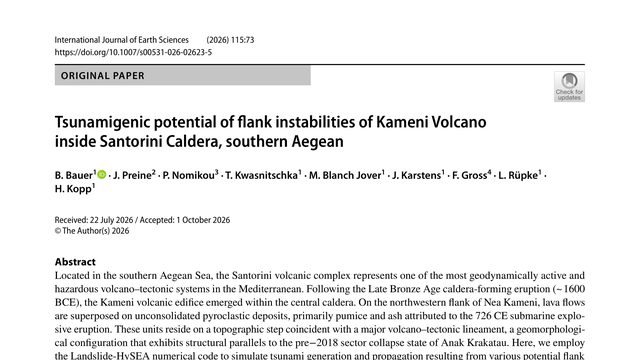
Santorini’s volcano could pose a tsunami threat not only through an eruption, but through a sudden collapse of its own side. The most severe modeled wave could reach thirty-nine meters.Santorini’s famous caldera may hide a different tsunami threat: not an eruption, but a collapse of the volcano’s flank. Simulations suggest even a localized failure could send waves reaching thirty-nine meters.
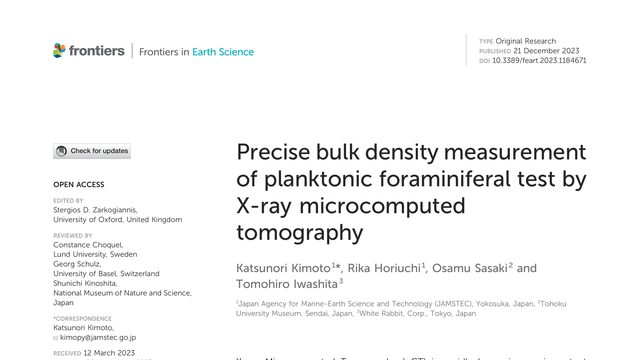
Tiny drifting shells help scientists reconstruct what the ocean was like in the past. Now, a scan can measure not only their shape, but how densely built they are, without breaking them open.A microscopic plankton shell can be weighed without touching it, and potentially with better repeatability than an ultra-microbalance. This study uses X-ray microcomputed tomography to turn imaging into precise bulk-density measurement.
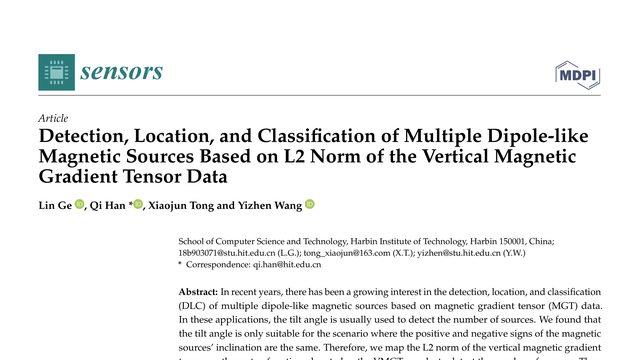
Finding hidden magnetic objects is difficult when their signals overlap. This study offers a way to count, locate, and distinguish several magnetic sources even when one source’s field covers another.What if the usual magnetic tilt angle can mistake interacting sources for extra anomalies? This paper replaces it with a gradient-based angle designed to count sources even when their inclinations have opposite signs.
 3:49