Detection, Location, and Classification of Multiple Dipole-like Magnetic Sources Based on L2 Norm of the Vertical Magnetic Gradient Tensor Data
Student13:21CCAI
paperi.ai
0:00 / 0:00
Lin Ge, Qi Han, Xiaojun Tong, Yizhen Wang
What if the usual magnetic tilt angle can mistake interacting sources for extra anomalies? This paper replaces it with a gradient-based angle designed to count sources even when their inclinations have opposite signs.
In recent years, there has been a growing interest in the detection, location, and classification (DLC) of multiple dipole-like magnetic sources based on magnetic gradient tensor (MGT) data. In these applications, the tilt angle is usually used to detect the number of sources. We found that the tilt angle is only suitable for the scenario where the positive and negative signs of the magnetic sources’ inclination are the same. Therefore, we map the L2 norm of the vertical magnetic gradient tensor on the arctan function, denoted as the VMGT2 angle, to detect the number of sources. Then we use the normalized source strength (NSS) to narrow the parameters’ search space and combine the differential evolution (DE) algorithm with the Levenberg–Marquardt (LM) algorithm to solve the sources’ locations and magnetic moments. Simulation experiments and a field demonstration show that the VMGT2 angle is insensitive to the sign of inclination and more accurate in detecting the number of magnetic sources than the tilt angle. Meanwhile, our method can quickly locate and classify magnetic sources with high precision.
Transcript
What if the usual magnetic tilt angle can mistake interacting sources for extra anomalies? This paper replaces it with a gradient-based angle designed to count sources even when their inclinations have opposite signs. Detection, location, and classification of multiple magnetic sources has important applications in unexploded ordnance detection, exploration of mineral resources, spacecraft characterization, and biological medical engineering.
Multiple magnetic fields overlap and vary nonlinearly with distance, so detecting, locating, and classifying the sources is challenging. When the distance between a magnetic source and the measurement point is 2.5 times larger than the source length, the source can be regarded as dipole-like.
A single dipole-like magnetic source contains six parameters: three position parameters and three magnetic moment parameters. Multiple-source DLC therefore becomes a problem of detecting the number of sources and solving their parameters. Existing methods for solving magnetic-source parameters are either sensitive to the initial parameter values or slow to converge.
The PSO-LM hybrid first uses PSO to approach a global solution, then uses that solution to initialize LM, improving convergence speed while preserving correctness. However, with many magnetic sources, PSO-LM has poor convergence, while DE can reach an optimal solution with high precision but is slow near that solution.
The method first calculates local maxima of the VMGT2 angle to estimate the number of magnetic sources. It then uses NSS to narrow the horizontal search space and combines DE with LM to optimize the source parameters. The overall process is shown in Figure 1.
Figure One summarizes the authors’ process for detecting and locating multiple magnetic sources. It begins by estimating the number of sources through local maxima of the VMGT two angle, then narrows the horizontal-position search space using an NSS-based threshold method, and finally optimizes the source parameters with a combined differential-evolution and Levenberg–Marquardt algorithm.
The visual matters because it shows how detection, search-space reduction, and parameter optimization are connected to improve correctness and convergence. The magnetic gradient tensor is the second-order tensor of the total magnetic field, with nine components arranged as a three by three matrix.
In a passive static magnetic field, Maxwell’s equations impose symmetry and a zero-trace relation on these components. As a result, one measurement point provides five independent components of the magnetic gradient tensor. Multiple dipole-like sources can have different magnetic moments and depths, so their magnetic vectors and gradient tensors can differ greatly in magnitude at one measurement point.
Because of this, the number of sources cannot be estimated directly from magnetic-vector or magnetic-gradient-tensor data. The tilt angle is also unsuitable when sources with positive and negative inclinations occur simultaneously. The proposed VMGT2 angle maps the L2 norm of the vertical gradient tensor through the arctangent function to estimate the number of magnetic sources.
Because magnetic-gradient-tensor data fall off as one over r to the fourth power, VMGT2 has little mutual interference and is larger near a source than elsewhere. VMGT2 can detect sources with small inclination by introducing the Bxz and Byz gradient tensors, and the L2 norm makes it insensitive to positive or negative inclination.
The arctangent mapping limits VMGT2 to zero through ninety degrees, reducing the impact of different magnetic moments and depths on detection. The normalized source strength is isotropic around a magnetic dipole and independent of magnetization direction.
Because NSS falls off as one over r to the fourth power, there is less interference between sources, and increasing NSS indicates a closer approach to a target. The method takes a local NSS maximum as an approximate horizontal source position, but that position cannot be used directly when a source lies between measurement points.
Instead, the approximate position narrows the horizontal search space and helps prevent the optimizer from falling into a local optimum. An NSS local maximum can appear between dipoles, so it can interfere with estimating an approximate horizontal position. The method sets a threshold sigma to divide the detection area into anomaly regions based on the VMGT2 angle, then calculates NSS local maxima in each region.
The threshold starts at the minimum VMGT2 value in the area and increases with the number of divisions until each anomaly region contains only one point from the source set. Using those NSS maxima, the method narrows the horizontal position search spaces around each approximate position by two measurement intervals on either side.
The method combines DE with LM to address initialization sensitivity: DE obtains an approximate global solution, which becomes LM's initial parameter values. It also addresses slow convergence, because the LM algorithm can quickly converge to a global optimal solution that meets the required accuracy.
DE first obtains an approximate global solution close to the real parameter values, and LM uses that solution as its initial parameter values. LM can then quickly converge to a global solution that meets the required accuracy.
DE stops when the cost function does not vary within fifty iterations; the threshold for that variation is zero. The evaluation includes two synthetic examples covering common and extreme numbers of magnetic sources. A separate simulation tests detection when magnetic sources interfere, and a field demonstration tests engineering applicability.
Optimization accuracy is evaluated with position error and orientation error functions. The convergence time ratio compares the convergence speed of different algorithms. Figure 3 compares several tilt measures with the VMGT2 angle for estimating the number of sources; white asterisks mark real sources and rose-red circles mark detected sources.
With negative inclinations, the tilt angle directly above a source becomes negative while nearby regions become positive, producing spurious regions through source interaction. TC and TN remain positive, but they still show outliers between sources.
The VMGT2 angle is insensitive to positive and negative inclinations, is less affected by other sources, and correctly estimates the number of sources in Figure 3f. Figure three compares three tilt-angle maps, two additional indicators labeled T N and T C, and the V M G T two angle across the measurement plane.
White asterisks mark real magnetic sources, rose-red circles show detected sources, and white rectangles identify spurious anomaly regions. The authors use these maps to compare source-count estimation and then initialize the later N S S search using the minimum V M G T two angle in the detection area.
The parameter optimization compares PSO-LM, DE, and DE-LM under different Gaussian-noise levels, using the estimated source number and reduced parameter search space. Without noise, DE and DE-LM reach position error below one millimeter and orientation error below ten to the power of negative three ampere square meters.
In that noise-free case, DE-LM converges 3.0301 times faster than DE, while PSO-LM converges to a locally optimal solution. With ten percent Gaussian noise, DE and DE-LM have similar optimization accuracy, but DE-LM converges 7.105 times faster than DE. Table Three reports estimated positions, orientations, and moments for five magnetic dipoles, under zero noise and ten percent Gaussian noise, using PSO-LM, DE, and DE-LM.
The values in parentheses are the corresponding absolute errors, making the table a direct comparison of parameter estimates and accuracy across methods and noise levels. It matters because the authors use this controlled test to evaluate optimization accuracy before applying the approach to more complex magnetic-source simulations.
To test an extreme source count, the study designs a synthetic example with forty magnetic dipoles. The survey area is fifty meters by fifty meters, with measurement points spaced zero point six two five meters apart. Table 5 reports average errors for forty magnetic-dipole parameters under noise-free conditions and ten percent Gaussian random noise.
It includes position errors along the x, y, and z axes, orientation errors in inclination and declination, and magnetic-moment error. For the noise-free case, the listed values include an x error of seven point six one zero times ten to the power of minus eight meters and an inclination error of eight point seven zero one times ten to the power of minus six degrees; under ten percent noise, the corresponding entries are zero point zero one four meters and one point nine one seven degrees.
The interference experiments consider two cases: two dipole moments differ greatly, or two magnetic dipoles are close together. Two simulation datasets represent these cases, using a detection area of ten meters by ten meters, a measurement-plane height of zero meters, and a point interval of zero point two five meters.
The VMGT2 method retains some detection capability when the field of a larger dipole moment completely covers the field of a smaller dipole moment. However, both VMGT2-based and tilt-angle-based methods have limited detection capability for sources that are closer together.
The field demonstration was conducted in Harbin, China, using a simple magnetic gradient tensor system with a cross structure. The system contains four commercial three-axis fluxgate sensors placed on a carbon-fibre cross-platform. The AK8963 magnetometer has zero point zero six six seven milligauss per least-significant-bit resolution and a measurement range from negative four thousand nine hundred twelve to positive four thousand nine hundred twelve microtesla.
The baseline distance between sensors is zero point one one meters. Figure eight shows the authors’ field-deployment setup in Harbin, China. Panel a presents a cross-shaped magnetic gradient tensor system with four three-axis fluxgate sensors, spaced about zero point one one meters apart, while panel b marks the measurement area as one point nine by one point seven meters, with numbered sampling locations.
This matters because it demonstrates how the proposed detection methods were tested using a real, point-by-point engineering measurement rather than simulation alone. The method combines VMGT2 for source-number detection, NSS for narrowing horizontal search spaces, and DE-LM for locating and identifying magnetic sources.
Experiments and a field demonstration show that VMGT2 addresses the tilt angle’s difficulty with simultaneous positive and negative inclinations. For noise-free cases, DE-LM reaches position error below one millimeter and orientation error below ten to the power of negative three ampere square meters, with convergence speed improved by more than three times over DE.
With ten percent Gaussian noise, DE and DE-LM have similar parameter accuracy, while DE-LM is 7.105 times faster; in the field demonstration, its position error is twenty millimeters. The method has some ability to detect mutually interfering sources, including sources with very different dipole moments or sources that are close together.
As interference increases, correctly estimating the number of sources becomes difficult, and future work will study high-resolution methods for mutually interfering sources. The method combines the VMGT2 angle, NSS, and DE-LM optimization to detect and locate multiple dipole-like sources, improving source counting and convergence speed while still struggling when sources are extremely close.
A derivative work by Paperi · AI-generated script, voice and captions
· pages and figures unaltered
Made with Paperi.
Drop in a research PDF — get a narrated video walkthrough like this one,
with highlights that follow the narration. Free to start.
Tiny drifting shells help scientists reconstruct what the ocean was like in the past. Now, a scan can measure not only their shape, but how densely built they are—without breaking them open.A microscopic plankton shell can be weighed without touching it—and potentially with better repeatability than an ultra-microbalance. This study uses X-ray microcomputed tomography to turn imaging into precise bulk-density measurement.
Michael Mollenhauer, Abdullah Irfan, Xi Cao, Supriya Mandal, Wolfgang Pfaff
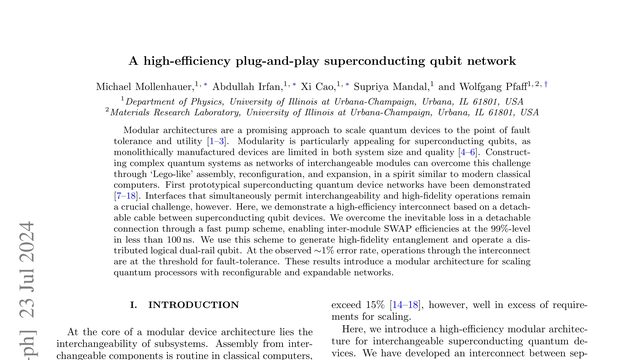
What if a quantum computer did not have to be built as one giant, delicate object? This experiment shows that separate quantum devices can be connected by a cable, unplugged, and still exchange information with about one percent loss.What if scaling a quantum computer looked less like fabricating one enormous chip—and more like plugging together replaceable modules? This paper shows a detachable cable moving quantum information with roughly one-percent loss in under one hundred nanoseconds.
Yan Huang, Yao Deng, Xiaoming Jiang, Yiyuan Chen, Tianxin Mao, Yong Xu, Caihong Jiang, Hengyi Rao
Why can one adult learn a new word almost effortlessly while another struggles? This study suggests the answer may partly lie in how two distant parts of the resting brain keep time together.Some adults learn new words much more easily than others. This study asks whether that difference can already be seen in the resting brain, before the learning task even begins.
 3:43
3:43