Language endangerment: Using analytical methods from conservation biology to illuminate loss of linguistic diversity
Curious4:02CCAI
paperi.ai
0:00 / 0:00
Lindell Bromham
A language can disappear even while its community grows. This paper asks what the science of disappearing species can teach us about protecting the words, stories, and knowledge carried by human languages.
Language diversity is under threat, with between a third to a half of all languages considered endangered, and predicted rates of loss equivalent to one language per month for the rest of the century. Rather than reviewing the extensive body of linguistic research on endangered languages, this review focuses specifically on the interdisciplinary transfer of methods developed in conservation biology, macroecology and macroevolution to the study of language endangerment and loss. While the causes of language endangerment and loss are different to those for species, studying patterns of diversity of species and languages involves similar analytical challenges, associated with testing hypotheses and identifying causal relationships. Solutions developed in biology can be adapted to illuminate patterns in language endangerment, such as statistical methods that explicitly model phylogenetic nonindependence, spatial autocorrelation and covariation between variables, which may otherwise derail the search for meaningful predictors of language endangerment. However, other tools from conservation biology may be much less use in understanding or predicting language endangerment, such as metrics based on International Union for Conservation of Nature (IUCN) criteria, population viability analysis or niche modelling. This review highlights both the similarities and the differences in approaches to understanding the concurrent crises in loss of both linguistic diversity and biodiversity.
Transcript
A language can disappear even while its community grows. This paper asks what the science of disappearing species can teach us about protecting the words, stories, and knowledge carried by human languages. Language diversity is under threat: between a third and a half of all languages are considered endangered, with predicted loss equivalent to one language per month for the rest of the century.
The causes of language loss differ from the causes of species loss, but studying both kinds of diversity creates similar challenges: testing explanations and identifying causes. The review asks how tools developed to study species diversity can be applied to language endangerment and loss.
Many methods from biology can be adapted, as long as the similarities and differences are both recognised. Broad studies cannot capture the local processes behind language loss, but they can reveal general patterns and possible contributors to the decline of linguistic diversity.
For species, one shared system provides a global standard for judging endangerment. Language has no equivalent internationally agreed standard, and measures based on population size and range decline do not fit languages well.
Instead, language scales focus on whether a language passes from one generation to the next and where it is used. Several databases use different scales and cover different sets of languages. The scales broadly agree, but they can rank individual languages differently.
That means a language may receive different warnings depending on which database is consulted. So they tried something clever: before asking whether a condition is linked to language danger, they account for the fact that related languages often resemble one another.
It is like comparing family recipes: several relatives may use the same ingredients because they learned from one another, not because each independently discovered the same recipe. Language relationships can help separate shared history from separate evidence.
Finding factors linked with endangerment can help predict broad future patterns of language loss. Conditions such as climate change or changes in land use can be used to project future pressures on languages. This raises the possibility of identifying languages that are not currently in danger but already face conditions that could place them at risk.
But here's the catch: some forecasting tools from conservation biology have limited use for languages. A method based on birth and death rates works best when population growth can be carried into the future reliably. Language vitality depends on transmission, not human reproduction, so the number of speakers may not follow the size of the population.
In one Australian case, the speaker number declined for over a century while the population grew, and the language became critically endangered. The headline finding is not that biology and language are identical. Their patterns of diversity and loss can look strikingly similar, but biological tools should be used only when they capture processes that matter for language.
Broad analysis cannot tell the whole story of any particular language, yet it can reveal patterns of loss and point toward important interventions. For people trying to keep a language alive, the practical lesson is direct: broad-scale evidence can guide attention, but it cannot replace local understanding of its vitality and future.
One important intervention is education that supports language diversity rather than eroding it, helping communities pass their languages on instead of pushing them aside. Biology offers useful ways to find broad patterns in language loss, but no single measure can replace local knowledge.
The practical goal is education and policy that support, rather than erode, language diversity.
A derivative work by Paperi · AI-generated script, voice and captions
· pages and figures unaltered
Made with Paperi.
Drop in a research PDF — get a narrated video walkthrough like this one,
with highlights that follow the narration. Free to start.
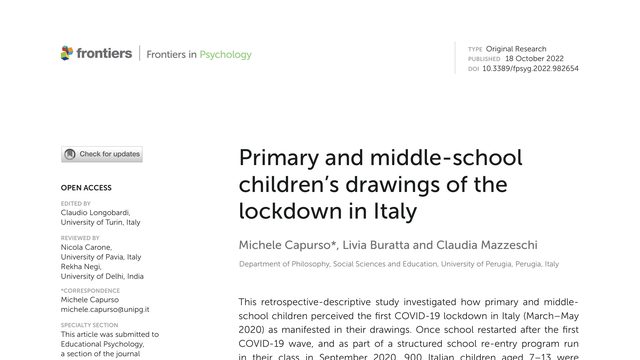
When children were asked to draw their lockdown lives, many did not draw the outside world at all. And among older children, the child in the picture was often missing—or had no face.What happens when children are asked to draw lockdown from memory? These pictures often show cheerful, colorful moments—but older children frequently leave their own faces, or even themselves, out of the scene.
A classroom can be filled with modern technology and still teach in the old way. This review finds that what future teachers believe about technology may shape whether it actually changes learning.Future teachers’ beliefs about technology can shape whether ICT reaches the classroom effectively. Yet this review finds a research landscape concentrated on general ICT attitudes, with limited attention to newer technologies and regional differences.
Social disconnection often becomes visible only after it has taken hold. This study looks earlier, at whether someone can reach people—and whether those encounters actually leave them feeling connected.Social disconnection is usually measured after it has become obvious. This study takes a different approach: use thirteen questions to detect threats to connection earlier, before isolation and loneliness fully take hold.
 5:00
5:00