Water compatible silica supported iron trifluoroacetate and trichloroacetate: as prominent and recyclable Lewis acid catalysts for solvent-free green synthesis of hexahydroquinoline-3-carboxamides
Curious3:12CCAI
paperi.ai
0:00 / 0:00
Dnyaneshwar Purushottam Gholap, Ramdas Huse, Sudarshan S. Dipake, Machhindra K. Lande
Many chemical reactions depend on substances that are difficult to recover and can pollute the process. This study describes a solid helper that works without a solvent, works in water, and can be used again.
Silica supported iron trifluoroacetate and iron trichloroacetate green Lewis acid catalysts were developed by a novel, cheap, environment-friendly approach and utilized in the synthesis of hexahydroquinoline-3-carboxamide derivatives. The structure and morphology of the prepared Lewis acid catalysts were studied by FTIR, PXRD, FE-SEM, HR-TEM, EDX, BET, TGA and NH3-TPD techniques. The present catalysts shows maximum conversion efficiency in hexahydroquinoline-3-carboxamide derivatives synthesis at 70 °C in solvent free reaction condition with best product yield in a short reaction time. Both catalysts are reusable and simple to recover, and perform meritoriously in water as well as in a variety of organic solvents. The key advantages of the current synthetic route are permitting of a variety of functional groups, quick reaction time, high product yield, mild reaction condition, recyclability of catalyst and solvent-free green synthesis. This makes it more convenient, economic and environmentally beneficial.
Transcript
Many chemical reactions depend on substances that are difficult to recover and can pollute the process. This study describes a solid helper that works without a solvent, works in water, and can be used again. Acid catalysts are at the heart of many crucial industrial processes because they accelerate reaction rates at low cost, with excellent conversion and product selectivity.
Heterogeneous lanthanide, rare-earth, and transition-metal trifluoroates may be a more environment-friendly choice when used as Lewis acid catalysts in solvent-free environments. So this one-pot reaction brings four starting materials together to produce hexahydroquinoline-3-carboxamides through a new, efficient, green synthetic process.
The useful twist is that the one-pot condensation happens without a solvent, at 70 degrees Celsius, and gives higher product yield with high catalyst recovery after a simple workup. The target was to evaluate these catalysts and find the most favorable conditions for making the products in one pot from four starting materials.
The model reaction used an aromatic aldehyde, dimedone, acetoacetanilide, and ammonium acetate. The results point to the key design choice: the acid catalyst supported on silica exhibits maximum catalytic efficiency. Spreading the iron compound across silica makes the catalyst well dispersed, rather than leaving it as one concentrated mass.
With the preferred conditions in place, the catalytic system produced a family of hexahydroquinoline-3-carboxamide derivatives with excellent outcomes. The silica-supported iron trifluoroacetate was more active than the silica-supported iron trichloroacetate across the optimization measures.
The stated reason is that fluorine withdraws electronic charge more strongly than chlorine, increasing the catalyst's acidity. Compared with catalysts reported in earlier studies, the silica-supported iron compounds performed better in the amount of catalyst used, reaction time, and product yield.
That makes this route a more economically convenient and environmentally friendly alternative for making these compounds. After recovery, the catalysts showed almost consistent catalytic activity. The study describes them as reusable without a significant reduction in catalytic activity, with recovered catalysts examined after seven cycles.
The catalysts were developed as recyclable, water-compatible helpers, and their performance was assessed in making hexahydroquinoline-3-carboxamides. They retained their catalytic activity in water and organic solvents compared with conventional catalysts, while the reaction also worked without solvent at 70 degrees Celsius.
The route offers superb product yield, a short reaction time, and an easy workup procedure, making it an efficient and favourable synthetic protocol. The study finds that iron compounds spread across silica can help build a family of useful molecules quickly and with less waste, while remaining recoverable for repeated use.
A derivative work by Paperi · AI-generated script, voice and captions
· pages and figures unaltered
Made with Paperi.
Drop in a research PDF — get a narrated video walkthrough like this one,
with highlights that follow the narration. Free to start.
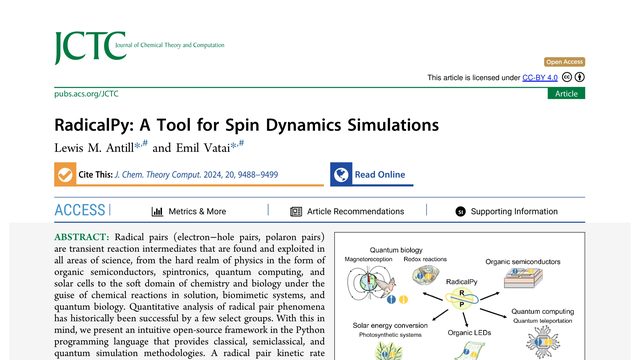
A tiny chemical reaction may help explain how migratory animals sense Earth’s magnetic field. But testing that idea has often required difficult simulations, and some biological results have been hard to reproduce.Spin-dynamics simulations can demand more memory than a practical computer can provide. RadicalPy tackles that bottleneck with a hybrid method that combines chemical kinetics, semiclassical modeling, and quantum techniques—and reproduces experimental magnetic-field effects.
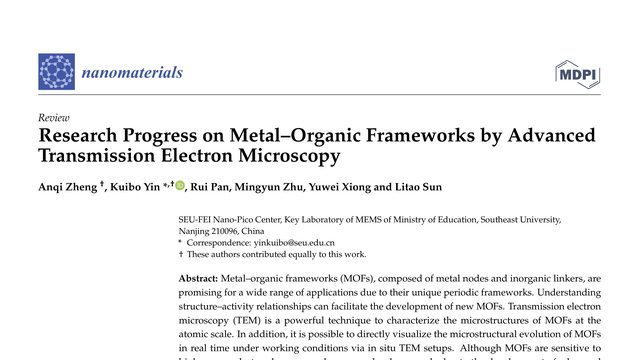
Imagine trying to photograph a soap bubble with a blast of radiation: the picture might be sharp, but the subject vanishes first. That is the problem researchers face with these promising, fragile materials.Metal–organic frameworks can fall apart under the electron beam used to study them. Yet advanced transmission electron microscopy is turning that apparent contradiction into a way to see their atoms, defects, growth, and transformations.
Michael Mollenhauer, Abdullah Irfan, Xi Cao, Supriya Mandal, Wolfgang Pfaff
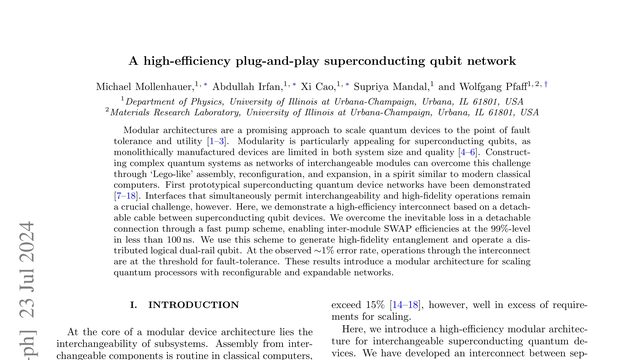
What if a quantum computer did not have to be built as one giant, delicate object? This experiment shows that separate quantum devices can be connected by a cable, unplugged, and still exchange information with about one percent loss.What if scaling a quantum computer looked less like fabricating one enormous chip—and more like plugging together replaceable modules? This paper shows a detachable cable moving quantum information with roughly one-percent loss in under one hundred nanoseconds.
 3:51
3:51