Non-thermal effects and temperature disparities in uniform supersonic flows
Overview4:37CCAI
paperi.ai
0:00 / 0:00
Lok Yiu Wu, Luke Driver, Daniel I. Lucas, Madeleine E. Robertson, Nikil Kapur, Dwayne Ellis Heard, Gregory de Boer, Julia H. Lehman
A gas can be cold in one way and still carry surprising energy in another. That matters because scientists use these cold flows to predict chemistry in space.
Over the last 40 years, low-temperature reaction rate coefficients in astrochemical databases have largely come from CRESU (Cinétique de Réaction en Ecoulement Supersonique Uniforme) experiments, where the flow is described by a single temperature under an assumption of local thermal equilibrium. Here we directly test this assumption using infrared frequency comb spectroscopy, laser-induced fluorescence, Pitot measurements, and computational fluid dynamics in seeded supersonic flows. We observe persistent vibrational excitation in carbonyl sulfide (OCS) and nitrous oxide (N2O) under all conditions examined, despite efficient rotational cooling, demonstrating a breakdown of local thermal equilibrium within the flow. In parallel, we find that conventional Pitot-derived temperatures do not consistently reflect the energetic state of the reacting ensemble. These results show that the reacting ensemble in CRESU flows cannot always be described by a single thermodynamic temperature, particularly for species with low-lying vibrational modes, and that internal-state distributions should be carefully considered when interpreting low-temperature reaction rate coefficients in astrochemical kinetic databases.
Transcript
A gas can be cold in one way and still carry surprising energy in another. That matters because scientists use these cold flows to predict chemistry in space. Chemical reactions at low temperatures play a central role in understanding astronomical phenomena in naturally occurring low-temperature environments, such as the interstellar medium and planetary atmospheres.
But not all reaction systems are well described by the usual temperature-based predictions, and discrepancies often arise between observations and astrochemical models. Laboratory techniques for creating cold environments on Earth have started to address this gap.
For decades, many low-temperature reaction rates in astronomy databases have come from experiments in a uniform, very fast-moving cold gas, where the flow is described by a single temperature. The study directly tests that assumption with several independent ways of reading the gas, including measurements of light absorbed or emitted by molecules and computer calculations of the flow.
The central question is whether cooling the molecules' motion also cools the energy stored inside the molecules. The study compares several ways of measuring temperature in fast-moving flows made from argon or nitrogen, while paying particular attention to how an added reacting substance disrupts the assumed balance.
The everyday picture is a room where people are sitting still but some are still carrying hot objects: the room can look calm while energy remains hidden inside individual occupants. That is what the measurements revealed: an unexpected band showing molecular vibration appeared under every condition, and the same kind of band appeared in a second substance too.
Across the full range of conditions, the vibrational temperature was far higher than the rotational temperature, showing that energy remained disproportionately stored in molecular vibration. That difference is clear evidence that the assumption of one shared temperature was not valid for the tested molecule in the cold flow.
The flow's rotational and vibrational temperatures were still changing with distance, although the differences were greater at the start and began to level off farther along. The most efficient route for turning vibrational energy into motion requires repeated collisions between the same molecules, but those collisions do not happen often enough during the expansion and flow.
Collisions with the surrounding gas provide another route, but it is less efficient, so the amount of vibrational cooling cannot be predicted confidently. A temperature inferred from impact pressure measurements fails to reflect the true energy possessed by the molecules in a range of cases.
In one surrounding gas, adding more of the reacting substance made the pressure-based temperature curve bend downward, even though that decrease was not physically real and likely meant the equation no longer applied. In another surrounding gas, the pressure reading showed no change, but a direct light-based measurement still found that the molecules' rotational temperature increased, showing that the pressure reading was not a true measure of their energy.
When molecules contain low-energy vibrational modes, the true temperature may not be represented well by the usual measurement of rotational or moving energy. The experiments establish this behavior directly for two tested molecules and suggest that similar non-equilibrium may occur more generally when vibration relaxes slowly.
The extra vibrational energy may affect reaction rates by giving reactants a different starting point and changing their ability to overcome barriers. The findings caution against relying on impact-pressure tubes as the sole method of temperature measurement and urge researchers to check whether all forms of molecular energy have truly reached equilibrium.
They do not imply that existing low-temperature reaction rates are broadly invalid; rather, the temperature reported with them may not uniquely describe the reacting molecules' full state. For reactions affected by molecular vibration, direct knowledge of the molecules' internal energy could improve how cold environments in space are modeled and how those reaction rates are used.
The study finds that one reported temperature can hide different kinds of molecular energy. For some reactions, knowing how molecules are internally energized may matter as much as knowing how cold the flow appears.
A derivative work by Paperi · AI-generated script, voice and captions
· pages and figures unaltered
Made with Paperi.
Drop in a research PDF — get a narrated video walkthrough like this one,
with highlights that follow the narration. Free to start.
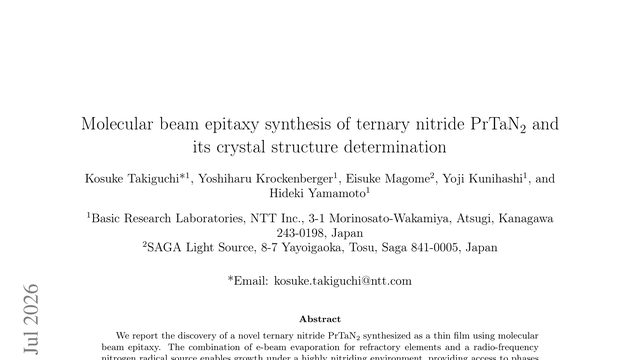
Some materials may exist only when they are built as extremely thin layers. This study creates one such compound and works out its hidden atomic arrangement from limited evidence.A new ternary nitride was not pulled from a bulk material, it was grown as a thin film under highly nitriding conditions, then identified from limited diffraction data. The result is PrTaN2, an unexplored crystal phase.
A tiny chemical reaction may help explain how migratory animals sense Earth’s magnetic field. But testing that idea has often required difficult simulations, and some biological results have been hard to reproduce.Spin-dynamics simulations can demand more memory than a practical computer can provide. RadicalPy tackles that bottleneck with a hybrid method that combines chemical kinetics, semiclassical modeling, and quantum techniques, and reproduces experimental magnetic-field effects.
Imagine trying to photograph a soap bubble with a blast of radiation: the picture might be sharp, but the subject vanishes first. That is the problem researchers face with these promising, fragile materials.Metal–organic frameworks can fall apart under the electron beam used to study them. Yet advanced transmission electron microscopy is turning that apparent contradiction into a way to see their atoms, defects, growth, and transformations.
 3:35