Mineralogy and leaching characteristics of rare earths from the micro-dispersed mineral matter in the organic matrix of Fire Clay coal
Overview3:45CCAI
paperi.ai
0:00 / 0:00
Qi Li, Bin Ji, Wencai Zhang, Rick Q. Honaker, Xinbo Yang, James C. Hower
Coal is usually burned for energy, but it can also hide rare earths, materials needed in many modern technologies. The surprise is that the easiest ones to release are not distributed evenly: acidity changes which rare earths come out.
Previous studies have shown that rare earth elements (REEs) in the micro-dispersed mineral matter of Fire Clay coal exhibit high leachability. To better understand the fundamental mechanisms underlying this behavior, pH-dependent leach ing tests and comprehensive SEM-EDS analyses were conducted. At a pH of 3.3, around 10% of light REEs (LREEs) and 40% of heavy REEs (HREEs) were leached. Reducing the pH to −0.05 significantly increased the leaching efficiency of LREEs relative to HREEs. The leaching efficiencies of the individual REEs at high pH values followed an order similar to that of the binding constants of REEs with organic acids, suggesting that the recoveries at pH 3.3 were primarily due to organically associated REEs in the coal. Numerous REE-bearing particles were identified by SEM-EDS analyses. Most of the particles identified in the raw material had irregular shapes and were formed by the intergrowth of small spheres and/or flakes, indicating that the rare earth minerals were of low-crystallinity. SEM-EDS analyses of the leaching solid residue at pH −0.05 identified fewer LREE-containing particles than HREE-bearing particles. This finding agrees with the higher leaching efficiency of LREEs at pH −0.05 and the greater increase in the leaching efficiency of LREEs as the solution pH decreased. The enhanced leaching of LREEs is primarily attributed to the dissolution of low-crystallinity rare earth phosphate minerals.
Transcript
Coal is usually burned for energy, but it can also hide rare earths—materials needed in many modern technologies. The surprise is that the easiest ones to release are not distributed evenly: acidity changes which rare earths come out. Coal-related materials are being studied as possible sources of rare earths, and many studies have reported encouraging results.
These materials include coal, coal refuse, mine drainage, and coal ash. The attraction is practical: washing solids with an acidic liquid can move rare earths into a solution, where the dissolved material can be purified and turned into a higher-purity product.
The study set out to achieve an in-depth understanding of the rare earths in Fire Clay coal, probing their hidden arrangement. That understanding was then used to connect how the rare earths occur with what happens during acid treatment and to explain their leaching characteristics.
The mineral matter was examined before and after acid treatment so the changes in the rare-earth-bearing particles could be compared directly. The researchers changed the acidity of the liquid surrounding the mineral matter.
At a pH of about three point three, about ten percent of the light rare earths and forty percent of the heavy rare earths entered the liquid. But the pattern changed sharply as the liquid became more acidic. Below a pH of about one point two, recovery of both groups rose dramatically as acidity increased.
The full set of elements separates into distinct paths: some rise steeply with increasing acidity, while others change more gradually and remain partly recoverable across the range. The particles were sorted into two broad groups according to which rare earths they contained.
One group was dominated by heavier rare earths, while the other was dominated by lighter rare earths. That separation matters because the two groups contain different rare-earth profiles: one is dominated by heavier elements, while the other is dominated by lighter elements.
At the strongest acidity tested, recovery of the lighter rare earths was higher than recovery of the heavier group. The increase for the lighter group was about sixty-seven percent, compared with about thirty percent for the heavier group. The changes in the liquid therefore match the changing proportions of the two particle groups left behind after treatment.
At the milder acidity, about nineteen percent of the total rare earths was recovered, including ten percent of the lighter group and forty percent of the heavier group. At the strongest acidity, those recoveries rose to seventy-five, seventy-seven, and seventy percent.
The early recovery was linked to rare earths associated with the coal's organic matter, based on the match with organic-acid binding constants. The later surge, especially for the lighter group, was linked to minerals scattered through that organic material and dissolved as acidity increased.
The particles were extremely small, with most about one micrometre across. Comparing treated and untreated material showed that particles carrying the lighter rare earths were removed more readily than those carrying the heavier group.
The heavier group came out more easily under milder acid, while much stronger acid was needed for what remained. The lighter group stayed low until the pH fell below zero, a contrast linked to the minerals' local origin and poorly formed structure. Fire Clay coal holds rare earths in tiny, poorly formed mineral particles scattered through its organic matter.
Understanding that arrangement shows why stronger acid releases far more of some rare earths, pointing toward recovery from coal-related waste.
A derivative work by Paperi · AI-generated script, voice and captions
· pages and figures unaltered
Made with Paperi.
Drop in a research PDF — get a narrated video walkthrough like this one,
with highlights that follow the narration. Free to start.
Huaiyu Tang, KERRY E. SIEH, Yu‐Ming Lai, Brian R. Jicha, Kwan‐Nang Pang
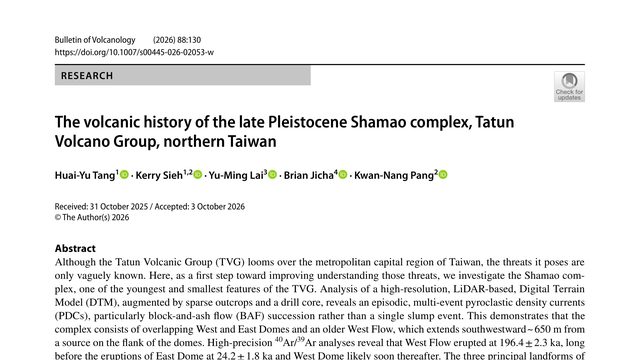
A volcano beside Taiwan’s capital may look like one old mound. This study finds it is a layered record of separate eruptions, separated by roughly 170,000 years.Under Taipei’s skyline sits a volcanic complex that looked, at first glance, like one slump. The evidence instead reveals multiple dome-building episodes, repeated collapses, and eruptions separated by roughly 170,000 years.
A single partial pelvic bone has revealed that one of the earliest large meat-eating dinosaurs survived a major change in its ancient community, and may be the youngest member of its group ever found.A single, fragmentary dinosaur bone from Brazil may show that one of the Triassic’s oldest predators survived a major ecological turnover, and could even be the youngest herrerasaurid ever found.
Protecting a remarkable landscape is only half the challenge. The research on these places has built strong tools for conservation, but the way people discover, understand, and choose to visit them remains much less clearly developed.Geoheritage research is growing fast, but the marketing part may be more label than theory. This study maps the field to find out what is really connected, and what is only implied.
 4:09