Isolating unique variance in mental health outcomes attributable to personality variables and childhood emotional abuse
Curious3:37CCAI
paperi.ai
0:00 / 0:00
Chantal Van Landeghem, Lorna S. Jakobson
Several experiences and personality patterns can travel together, making it hard to tell which ones are linked to depression and anxiety. This study tries to separate those overlapping signals—and the answer is not quite what you might expect.
Introduction: University students are at high risk for anxiety and depression. Our main objective was to tease apart variance in symptom severity that was uniquely attributable to four associated variables that are frequently confounded: exposure to childhood emotional abuse, alexithymia, sensory processing sensitivity (SPS), and anxiety sensitivity (AS). Methods: University students (N = 410) completed an online survey designed to measure our four key study variables along with several other potentially relevant variables including sex, physical activity levels, and perceived COVID-19 impacts. Results: Over half of the participants reported moderate to extremely severe symptoms of anxiety and depression. Females reported stronger signs of SPS and AS and were more likely than males to have increased their moderate/vigorous exercise since the pandemic began. After controlling for the other variables, the best predictors of perceived COVID-19 impacts were SPS, childhood emotional abuse, and current levels of physical activity. Whereas all three personality variables and childhood emotional abuse emerged as significant predictors of both depression and anxiety, neither COVID-19 impacts nor physical activity levels accounted for unique variance in either model. Unexpectedly, male sex emerged as an additional risk factor for depression, raising the possibility that males experience unique stressors and societal pressures that increase their risk of depression. Discussion: These findings help to clarify the links between childhood emotional abuse, personality traits implicated in emotional awareness and self-regulation, and mental health. They may have important implications for the development and implementation of individualized treatments for common mental disorders.
Transcript
Several experiences and personality patterns can travel together, making it hard to tell which ones are linked to depression and anxiety. This study tries to separate those overlapping signals—and the answer is not quite what you might expect.
University students are at high risk for anxiety and depression. The study’s main objective was to separate the part of symptom severity uniquely attributable to childhood emotional abuse and three associated personality-related patterns. Think of several people pulling on the same rope: if they all pull together, it is difficult to tell who added how much force.
The study aimed to tell these overlapping influences apart. The study assessed the unique contributions of personality variables and childhood emotional abuse while taking current physical activity, pandemic impacts, and sex into account. These variables are frequently confounded, meaning that their effects can become mixed together.
Separating each contribution was intended to clarify risk and protective factors affecting university students during a stressful time. Because pandemic restrictions prevented in-person testing, participants completed an online survey covering personality variables, childhood emotional abuse, physical activity, pandemic impacts, depression, and anxiety.
The survey was completed remotely at a time and location of each participant’s choosing, and a check for poor effort was included. All three personality variables, childhood emotional abuse, and male sex emerged as significant predictors of depression. For anxiety, all three personality variables and childhood emotional abuse emerged as significant predictors.
Neither pandemic impacts nor physical activity levels accounted for unique variance in either model after the other variables were controlled. The study considered the four overlapping variables simultaneously rather than looking at one variable at a time, because their overlap may have confounded earlier results.
Each of the four variables accounted for unique variance in both depression and anxiety after several other possible risk and protective factors were controlled. The lack of an association between current physical activity and mental health was unexpected, given previously documented benefits of physical activity on well-being.
It was also surprising that physical activity was not more strongly related to the personality variables or childhood emotional abuse, despite earlier links between exercising less and these factors. The study has limitations. It was carried out during the pandemic, when quarantine, social distancing, and restrictions on in-person testing were in place.
Because the data were collected online, certain things may have been measured less accurately, and participants may have been less attentive than they would have been in person. The study found that childhood emotional abuse and each of the three personality-related patterns made a unique contribution to predicting mental-health outcomes.
That distinction matters because the variables are correlated with one another; treating them separately can make earlier links look less trustworthy than they really are. Childhood emotional abuse and three personality-related patterns each contributed independently to depression and anxiety in university students.
That clearer picture could help mental-health care address more than one source of risk at a time.
A derivative work by Paperi · AI-generated script, voice and captions
· pages and figures unaltered
Made with Paperi.
Drop in a research PDF — get a narrated video walkthrough like this one,
with highlights that follow the narration. Free to start.
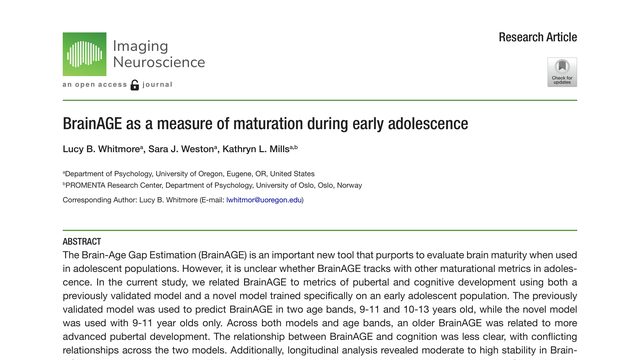
A brain scan can be turned into an estimated age—but does that number really tell us how mature a young person is? This study finds that it tracks puberty, but not reliably the thinking skills people may expect.What if a brain scan could say whether a young adolescent’s brain looks older or younger than their actual age? This study tests whether that brain-age gap really tracks maturation—or only seems to.
Yan Huang, Yao Deng, Xiaoming Jiang, Yiyuan Chen, Tianxin Mao, Yong Xu, Caihong Jiang, Hengyi Rao
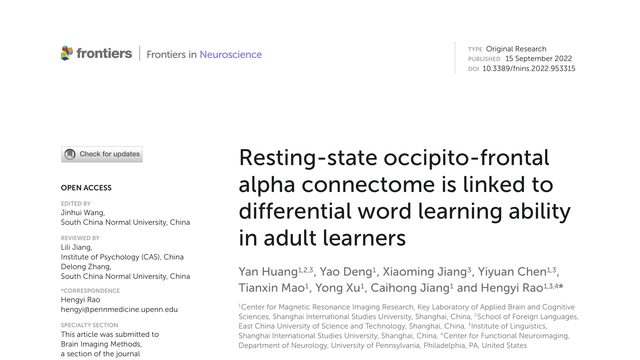
Why can one adult learn a new word almost effortlessly while another struggles? This study suggests the answer may partly lie in how two distant parts of the resting brain keep time together.Some adults learn new words much more easily than others. This study asks whether that difference can already be seen in the resting brain, before the learning task even begins.
Yana Suchy, Michelle Gereau Mora, Libby A. DesRuisseaux, Stacey L. Brothers
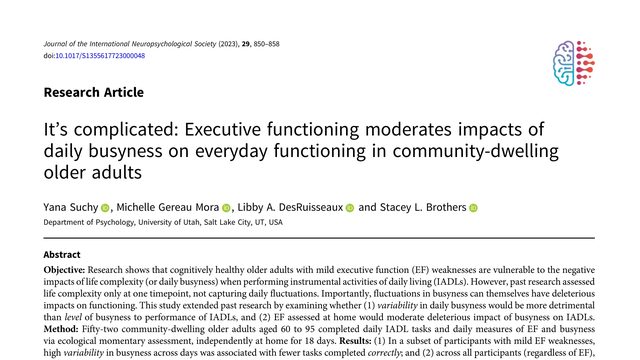
A busy day can make almost anyone late. But for some older adults, the bigger danger may be how sharply life swings from quiet one day to chaotic the next.Being busy is not automatically harmful. This study suggests that day-to-day swings in busyness are especially linked to everyday-functioning errors among older adults with weaker executive functioning, while consistently high busyness can affect task completion more broadly.
 3:27
3:27