Go for zero tolerance: Cultural values, trust, and acceptance of zero-COVID policy in two Chinese societies
Curious3:39CCAI
paperi.ai
0:00 / 0:00
Yi‐Hui Christine Huang, Jun Li, Ruoheng Liu, Yinuo Liu
During the pandemic, some people saw strict controls as a shared shield, while others saw them as a personal burden. This study finds that the difference helped shape whether people accepted zero-COVID rules.
This study seeks to explain the wide acceptance of the stringent zero-COVID policy in two Chinese societies—Mainland China (n = 2,184) and Taiwan (n = 1,128)—from perspectives of cultural values and trust. By employing the efficacy mechanism, this study identifies significant indirect effects of trust in government and key opinion leaders (KOL) on people’s policy acceptance in both societies. Namely, people who interpret the pandemic as a collectivist issue and who trust in government will be more accepting of the zero-COVID policy, whereas those who framed the pandemic as an individual issue tend to refuse the policy. Trust in government and KOLs foster these direct relationships, but trust in government functions as a more important mediator in both societies. The different contexts of the two Chinese societies make the difference when shaping these relationships. These findings provide practical considerations for governmental agencies and public institutions that promote the acceptance of the zero-COVID policy during the pandemic.
Transcript
During the pandemic, some people saw strict controls as a shared shield, while others saw them as a personal burden. This study finds that the difference helped shape whether people accepted zero-COVID rules. The pandemic damaged health, daily life, and the economy worldwide.
Some countries later argued that people should live with the disease by easing distancing, masking, testing, and other strict controls. That meant reducing restrictions and treating COVID nineteen more like other illnesses, including influenza, as countries sought to return to pre pandemic routines.
Mainland China and Taiwan stayed with zero-COVID, a strategy built around lockdowns, required testing, travel bans, and quarantine to crush any sign of an outbreak. Compared with protests against lockdowns in some Western countries, these two societies endured tight public-health controls with almost no public resistance.
That is the puzzle. The study asked whether people’s cultural values predicted support for zero-COVID in Mainland China and Taiwan. It also asked whether trust in government and trusted media figures helped explain that connection.
The key idea is like a neighborhood agreeing to close its road during a flood: people may accept a personal inconvenience when they see the danger as shared, not as something affecting only themselves. To examine these questions, online surveys were conducted in Mainland China and Taiwan from November to December twenty twenty-one.
The recruitment aimed to reflect people’s age, gender, and residential backgrounds. From November to December twenty twenty one, researchers recruited participants in Mainland China and Taiwan, with independent agencies overseeing recruitment in each region.
All participants completed an online survey, using QuestionPro in Mainland China and SurveyCake in Taiwan as the designated platforms for their regions. The results found that people who regarded the pandemic as a collective concern were more likely to endorse zero-COVID.
But people who interpreted the pandemic as an individual issue were less likely to accept the policy. Across both societies, seeing the outbreak as personal pushed acceptance downward. Trust helped connect these views to policy acceptance.
For people who saw the pandemic as a collective concern, trust in government and trust in media figures both helped explain support for zero-COVID. For people who saw the pandemic as an individual issue, trust in government did not explain acceptance, while trust in media figures did.
The two routes were meaningfully different. People who saw the pandemic as a shared concern were more likely to trust the government and accept strict zero-COVID measures; seeing it as a personal concern also related to government trust, but related directly to less acceptance of those measures.
The study concludes that policy acceptance was shaped by both cultural values and trust, and that the relationship differed between Mainland China and Taiwan because their surrounding conditions differed. The practical message is direct: governments should prioritize their own ability and care, build social identity among citizens, and cultivate public trust to promote acceptance of zero COVID.
People who viewed the outbreak as a collective problem were more likely to accept zero-COVID, especially when they trusted government. Public support depended on both shared values and confidence in those enforcing the rules.
A derivative work by Paperi · AI-generated script, voice and captions
· pages and figures unaltered
Made with Paperi.
Drop in a research PDF — get a narrated video walkthrough like this one,
with highlights that follow the narration. Free to start.
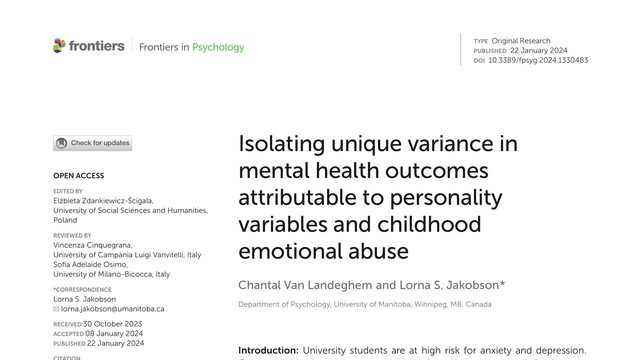
Several experiences and personality patterns can travel together, making it hard to tell which ones are linked to depression and anxiety. This study tries to separate those overlapping signals—and the answer is not quite what you might expect.What if the strongest clues to student anxiety and depression are not the pandemic itself, but personality patterns and childhood emotional abuse that remain important after the variables are separated?
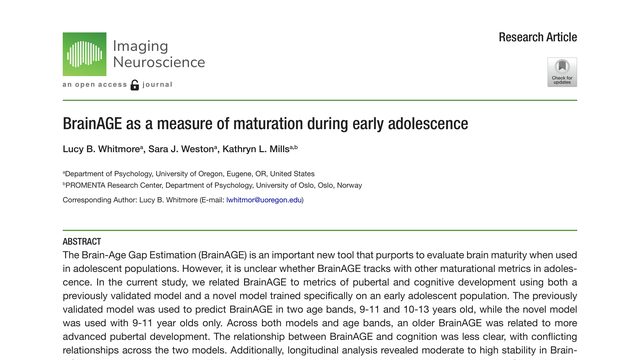
A brain scan can be turned into an estimated age—but does that number really tell us how mature a young person is? This study finds that it tracks puberty, but not reliably the thinking skills people may expect.What if a brain scan could say whether a young adolescent’s brain looks older or younger than their actual age? This study tests whether that brain-age gap really tracks maturation—or only seems to.
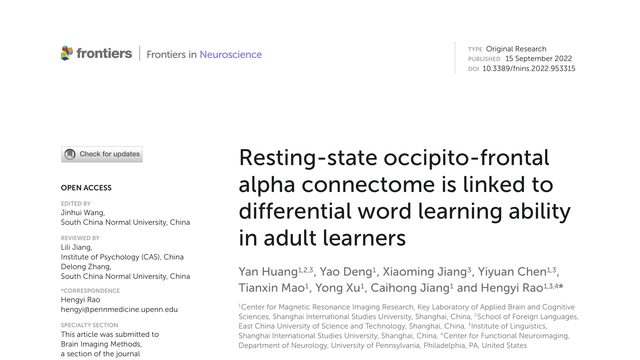
Yan Huang, Yao Deng, Xiaoming Jiang, Yiyuan Chen, Tianxin Mao, Yong Xu, Caihong Jiang, Hengyi Rao
Why can one adult learn a new word almost effortlessly while another struggles? This study suggests the answer may partly lie in how two distant parts of the resting brain keep time together.Some adults learn new words much more easily than others. This study asks whether that difference can already be seen in the resting brain, before the learning task even begins.
 3:37
3:37