Imagine a sheet so thin that its electrons can be made to choose sides: one direction flows like metal, while the other is blocked like a semiconductor. This study predicts a material that can do exactly that.
Two-dimensional antiferromagnetic semiconductors have triggered significant attention due to their unique physical properties and broad application. Based on first-principles calculations, a novel two-dimensional (2D) antiferromagnetic material MnSi2N4 monolayer is predicted. The calculation results show that the two-dimensional MnSi2N4 prefers an antiferromagnetic state with a small band gap of 0.26 eV. MnSi2N4 has strong antiferromagnetic coupling which can be effectively tuned under strain. Interestingly, the MnSi2N4 monolayer exhibits a half-metallic ferromagnetic properties under an external magnetic field, in which the spin-up electronic state displays a metallic property, while the spin-down electronic state exhibits a semiconducting characteristic. Therefore, 100% spin polarization can be achieved. Two-dimensional MnSi2N4 monolayer has potential application in the field of high-density information storage and spintronic devices.
Transcript
Imagine a sheet so thin that its electrons can be made to choose sides: one direction flows like metal, while the other is blocked like a semiconductor. This study predicts a material that can do exactly that. Before a material can matter outside a computer, it has to survive there.
The calculations find no unstable vibration anywhere in the sheet, indicating that its structure is dynamically stable. Consequently, the monolayer has excellent stability and may be experimentally prepared. Think of it like a tightly built bridge: the important point is not merely that it can be drawn, but that it does not shake itself apart.
The material has two possible magnetic arrangements: neighboring magnetic atoms can point in the same direction, or in opposite directions. The energy of the opposite arrangement is lower, so the material has an antiferromagnetic ground state.
In that arrangement, the total magnetic moment is zero, because the magnetic atoms have equal moments pointing in opposite directions. The magnetic atoms carry the strong magnetic signal, while the nitrogen atoms carry only tiny magnetic moments. In its ordinary state, the sheet behaves as a semiconductor: electrons do not move freely across the small energy gap.
The gap is indirect, meaning the easiest starting and ending points for an electron are in different places. The bands are degenerate, and the total electronic states are symmetrical for the two spin directions. No states exist near the Fermi level, leaving a small energy gap.
The magnetic picture explains why the antiferromagnetic arrangement is favored: neighboring manganese atoms point in opposite directions, so their magnetic effects alternate rather than lining up. That lower-energy arrangement is the material’s natural magnetic state.
The results describe the sheet as a stable antiferromagnetic semiconductor, with the antiferromagnetic arrangement as its ground state. A large magnetic exchange parameter indicates strong coupling between the magnetic atoms.
That matters because the antiferromagnetic ground state is stabilized by strong coupling between the magnetic atoms, so this magnetic arrangement is not easily disturbed. But applying an external magnetic field can drive the same material into a half-metal, changing its state from antiferromagnetic to ferromagnetic.
Under an external magnetic field, the ground antiferromagnetic state transitions to a ferromagnetic state. The two spin directions then no longer have the same energy bands. For one spin direction, the material behaves as a metal, while for the other it has a direct energy gap and behaves as a semiconductor.
That is why the sheet behaves as a half-metal in the ferromagnetic state. A magnetic field can turn this material into a metal: near the energy where electrons would begin conducting, one spin direction has available electronic states, while the other follows a different pattern.
That separation could let current carry a preferred spin, not just electric charge. The magnetic behavior is also tunable by stretching the sheet in two directions at once. The magnetic exchange parameter and the magnetocrystalline anisotropy energy increase with tensile strain.
That tunability may support future spintronic devices, because the study identifies potential applications for these adjustable magnetic properties in that field. The predicted monolayer is normally a stable antiferromagnetic semiconductor, but a magnetic field turns it into a perfect spin filter.
That could help control information in smaller storage and sensing devices.
A derivative work by Paperi · AI-generated script, voice and captions
· pages and figures unaltered
Made with Paperi.
Drop in a research PDF — get a narrated video walkthrough like this one,
with highlights that follow the narration. Free to start.
Apolonia Sieprawska, Elżbieta Rudolphi-Szydło, Magdalena Skórka, Anna Telk, Maria Filek
Tiny manganese particles sprayed onto wheat leaves did not simply sit on the surface. They entered the leaves, triggered a stress response, and quietly changed the membranes inside the plant.Manganese is essential to plants in tiny amounts, but manganese nanoparticles applied to wheat leaves increased cellular manganese twenty to forty-five times and activated a clear stress response without obvious leaf chlorosis or necrosis.
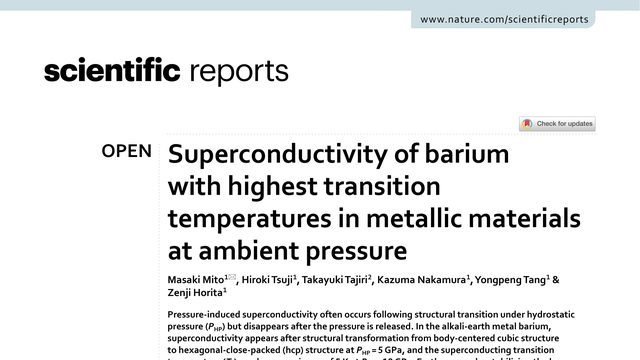
A material that normally needs crushing pressure to become superconducting can keep that special state after the pressure is gone. In barium, the result reaches twenty-four kelvin at ordinary pressure.What if pressure could create a superconductor, but the material could keep the useful high-pressure structure after the pressure vanished? In barium, severe twisting produces an ambient-pressure transition at twenty-four kelvin.
Yuru Ge, Fabian Ganss, Daniel Schmidt, Daniel Hensel, Mike J. Bruckhoff, Bruno Neumann, Mariana Brede, Sakshath Sadashivaiah, Markus E. Gruner, P. Gaal, Klara Lünser, S. Fähler
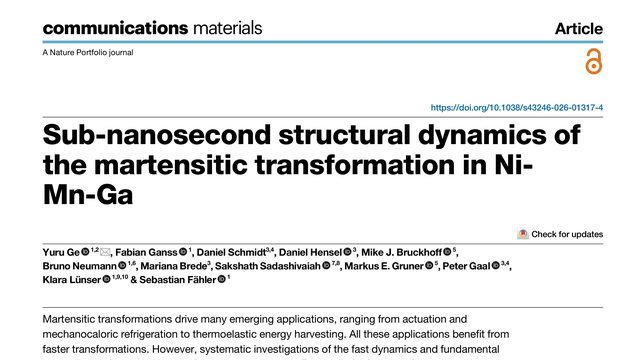
Some metals can change their internal structure almost instantly, and that motion can power tiny machines. This study finds a complete switching cycle in just five nanoseconds.A crystal structure can switch in roughly ninety picoseconds, and the entire switch-back cycle can finish within five nanoseconds. But the surprising part is that temperature alone cannot explain how fast it happens.
 4:08