Considering Autism in Binge-Type Eating Disorders: Broadening Beyond an Anorexia Nervosa-Focused Model
Overview5:06CCAI
paperi.ai
0:00 / 0:00
Lauren Makin, Kate Tchanturia
What if binge eating is being treated with a model built mainly around anorexia? This review suggests that autism can be missed in binge-type eating disorders, leaving important needs unaddressed.
What if binge eating is being treated with a model built mainly around anorexia? This review suggests that autism can be missed in binge-type eating disorders, leaving important needs unaddressed. Research on Autism in eating disorders has historically focused on anorexia nervosa, with comparatively limited attention given to binge-type eating disorders such as bulimia nervosa and binge eating disorder.
Think of treatment like a map: a map drawn mostly for one route can still help, but it may miss the turns that matter on another route. Emerging evidence suggests that Autism is over-represented in binge-type disorders, although prevalence appears lower than in anorexia nervosa.
Recent studies suggest that emotional processes, reward-related processes, and sensory differences may contribute to binge-type presentations, while co-occurring ADHD may complicate recognition, clinical presentation, and treatment. This review summarises emerging research focusing on Autism in binge-type eating disorders.
Because this literature is relatively young and varied, the review highlights key studies and emerging clinical issues rather than providing definitive clinical recommendations. It examines how common Autism may be, possible pathways linking Autism with binge-type disorders, and the clinical presentation, recognition, and support needs of Autistic people with these disorders.
The evidence for binge-type eating disorders remains more limited and methodologically heterogeneous. Two out of three studies reported elevated autistic traits in people with bulimia nervosa and binge eating disorder compared with people without eating disorders, although the studies relied on self-report measures rather than diagnostic assessments.
In a recent clinical study, twenty-seven percent of patients with bulimia nervosa and seventeen percent of patients with binge eating disorder had elevated autistic traits. Evidence from a large population study suggests that emotional processes may play an especially important role in linking Autism to binge-type eating disorders.
When mood and anxiety disorders are taken into account, the association between Autism and bulimia nervosa becomes substantially weaker, suggesting that co-occurring emotional difficulties may explain a significant part of the relationship. In patients with bulimia nervosa, autistic traits are associated with increased psychological distress.
This pattern may be especially important in people with co-occurring ADHD. Developmental samples suggest that Autistic-only children tend to show selective eating linked to sensory sensitivities, whereas ADHD-only children tend to show overeating behaviours.
Children with both Autism and ADHD show a combination of selective eating and overeating behaviours, although not all sensory-driven or reward-driven eating is linked to harmful eating. There is increasing agreement that eating-disorder treatment should be adapted to better meet the needs of Autistic people, but knowledge of treatment options beyond anorexia nervosa remains limited.
Clear communication, predictable structure, and attention to sensory needs can also matter in binge-type eating disorders. But those changes alone are unlikely to be sufficient: binge-type care also needs greater attention to sensory-seeking, heightened emotional distress, and reward-driven eating behaviours.
Current evidence indicates that Autism is over-represented across both restrictive and binge-type eating disorders, although prevalence appears lower in bulimia nervosa and binge eating disorder than in anorexia nervosa. Sensory and body-signal differences may occur across eating disorders, while emotional and reward-related processes, particularly alongside ADHD, may play a more prominent role in binge-type presentations.
These differences affect how people present, how services recognize them, and what treatment they need, so care must move beyond an anorexia-centered model. The current literature on Autism in binge-type eating disorders remains limited, varied, and heavily reliant on measures of traits.
Research needs to turn these possible pathways into treatment adaptations that clinicians can use, because existing approaches remain largely derived from anorexia nervosa models. Without these developments, Autism may remain under-recognized and insufficiently addressed within binge-type eating-disorder services, limiting both engagement and treatment effectiveness.
Binge-type eating disorders may involve different emotional, sensory, and reward-related pathways, especially when attention difficulties also occur. Care has to recognize the person in front of it, not rely on an anorexia-centered template.
A derivative work by Paperi · AI-generated script, voice and captions
· pages and figures unaltered
Made with Paperi.
Drop in a research PDF — get a narrated video walkthrough like this one,
with highlights that follow the narration. Free to start.
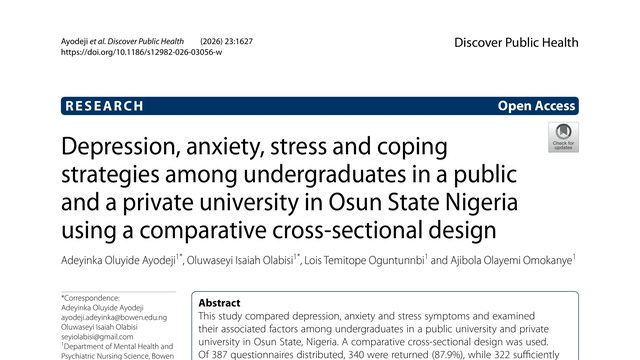
University can open doors to a future, but the pressure of getting there may weigh differently depending on where a student studies. In this study, depression stood out as the clearest difference between two universities.What if the biggest difference between public and private universities is not anxiety, but depression? In this Nigerian comparison, depression was notably more common in the private institution, while anxiety looked almost identical.
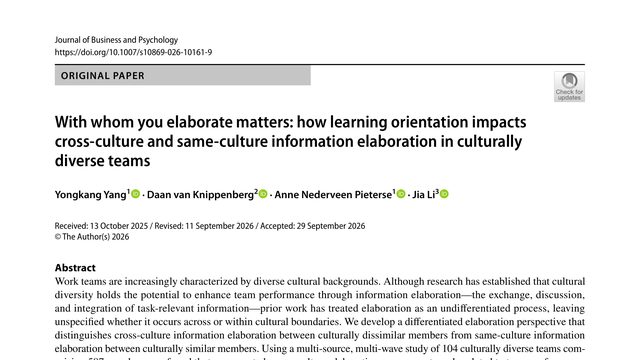
Yongkang Yang, Daan van Knippenberg, Anne Nederveen Pieterse, Jia Li
A culturally diverse team can contain more knowledge and still perform poorly. The missing ingredient may be whether people actually exchange ideas across cultural lines, rather than staying inside familiar circles.Cultural diversity does not automatically improve teamwork. The crucial question is where the team’s information elaboration happens: across cultural boundaries, or mainly among people who already share a culture.
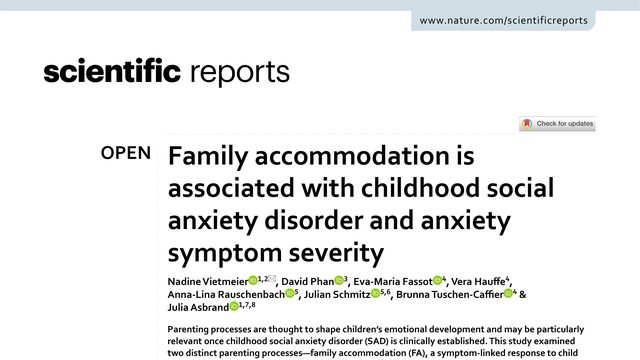
Nadine Vietmeier, David Phan, Eva-Maria Fassot, Vera Hauffe, Anna-Lina Rauschenbach, Julian Schmitz, Brunna Tuschen‐Caffier, Julia Asbrand
When a child is afraid, a parent naturally tries to make things easier. But this study suggests that repeatedly changing family life around that fear may be tied to more severe childhood social anxiety.When a child is anxious, parents often try to make life easier. This study asks whether those symptom-linked accommodations are also connected to more severe childhood social anxiety.
 5:00