Depression, anxiety, stress and coping strategies among undergraduates in a public and a private university in Osun State Nigeria using a comparative cross-sectional design
University can open doors to a future, but the pressure of getting there may weigh differently depending on where a student studies. In this study, depression stood out as the clearest difference between two universities.
This study compared depression, anxiety and stress symptoms and examined their associated factors among undergraduates in a public university and private university in Osun State, Nigeria. A comparative cross-sectional design was used. Of 387 questionnaires distributed, 340 were returned (87.9%), while 322 sufficiently completed questionnaires were analysed, comprising 161 students from each institution. Data were collected using the Depression, Anxiety and Stress Scale-21 and an adapted 15-item Brief COPE questionnaire. Data were analysed using descriptive statistics, chi-square/Fisher–Freeman–Halton tests, Spearman correlation with Benjamini-Hochberg correction, and pooled binary logistic regression. Moderate-or-higher depression occurred among 19.3% of public and 36.0% of private university students. Depression severity differed significantly between institutions, χ² (4) = 19.60, p<0.001, while private university students had higher adjusted odds of depression (AOR = 1.94, 95% CI: 1.08–3.50). Moderate-or-higher anxiety occurred in 49.7% of students in both institutions, with no significant institutional difference (p = 0.298). Moderate-or-higher stress occurred among 9.9% and 19.3%, respectively, with no significant severity difference (p = 0.106). Denial and Self-Critical Disengagement Coping was positively associated with depression, anxiety and stress in both institutions. Academic dissatisfaction was associated with depression and anxiety, while previous course failure was associated with anxiety. The study concludes that depression showed the clearest institutional difference, while coping and academic experiences were important correlates of psychological symptoms. Universities should strengthen accessible mental-health services, academic support and copingskills interventions for undergraduate students.
Transcript
University can open doors to a future, but the pressure of getting there may weigh differently depending on where a student studies. In this study, depression stood out as the clearest difference between two universities. Undergraduate education is an important phase during which students expand their knowledge and develop the critical thinking and professional skills required for their future careers.
But academic workload, financial demands, social adjustment and uncertainty about future employment may negatively affect students’ psychological well-being. Think of a student carrying a backpack: stress may occur when academic, social or personal demands exceed the resources available to carry them.
Persistent exposure to such pressures may contribute to depression, anxiety and stress, affecting academic performance, relationships, physical health and quality of life. The study separately assessed depression, anxiety and stress symptoms among undergraduates in a selected public university and private university within the same state.
Using the same measurements and analyses across both institutions provided evidence about psychological symptoms, coping strategies and associated factors in each setting. The aim was to compare symptoms and examine their relationships with coping and academic factors.
The study used a questionnaire to assess symptoms of depression, anxiety and stress. It measures symptom severity, rather than providing a clinical diagnosis. The questions were grouped equally across the three symptom areas, and the resulting scores were classified from normal through extremely severe.
The private institution recorded higher average depression and stress scores than the public institution. Anxiety scores were more similar across the institutions, with means of 11.57 plus or minus 9.35 in the private institution and 10.87 plus or minus 8.30 in the public institution.
The distribution of depression severity differed significantly between the two institutions. Normal depression levels were more common in the public institution, at 66.5 percent, than in the private institution, at 42.9 percent, while moderate-to-extremely severe depression was more frequent in the private institution.
In the private institution, students dissatisfied with their academic performance had higher odds of moderate-to-extremely severe depression symptoms than students who were satisfied. For anxiety symptoms in the public institution, none of the sociodemographic or academic variables was associated with moderate-to-extremely severe anxiety symptoms.
However, the coping-strategy variable was associated with higher odds of anxiety symptoms. Depression, anxiety and stress symptoms were common among undergraduate students in both institutions, although their severity and associated factors differed across the two settings.
Severe or extremely severe depression symptoms were more frequently reported in the private institution, while severe or extremely severe anxiety symptoms occurred at comparable levels in both institutions. Coping-strategy scores were positively associated with depression, anxiety and stress scores, indicating that students experiencing greater psychological distress also reported greater use of coping responses.
Academic dissatisfaction, drug use for reading, age and previous course failure were associated with selected psychological outcomes. The findings indicate the need for university mental-health services that combine psychological counselling, academic support, early identification of distressed students and substance-use prevention.
Because the study was cross-sectional, its findings indicate associations and do not establish causal relationships. The results therefore point to students who may need support, rather than proving what caused their symptoms. The study compared one public university and one private university, so the findings may not apply to all public and private universities in Osun State or Nigeria.
Because the study purposively selected one public and one private university, differences between them may introduce selection bias, and the findings may not generalize to all universities in Osun State or Nigeria. Future studies should include multiple public and private universities across states and geopolitical zones, using probability sampling to improve representativeness and external validity.
The study found that psychological symptoms were common in both settings, but depression was more severe in the private university, while coping and academic experiences were linked with distress. Students need mental-health care alongside academic support.
A derivative work by Paperi · AI-generated script, voice and captions
· pages and figures unaltered
Made with Paperi.
Drop in a research PDF — get a narrated video walkthrough like this one,
with highlights that follow the narration. Free to start.
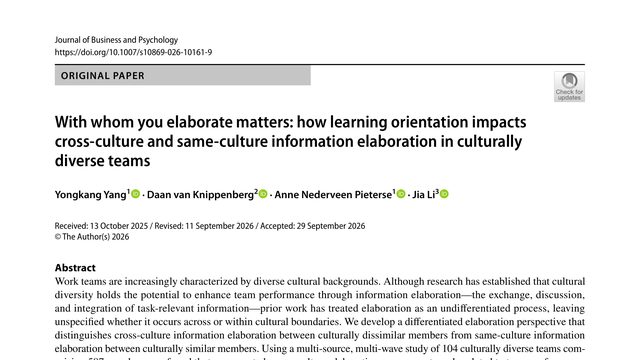
Yongkang Yang, Daan van Knippenberg, Anne Nederveen Pieterse, Jia Li
A culturally diverse team can contain more knowledge and still perform poorly. The missing ingredient may be whether people actually exchange ideas across cultural lines, rather than staying inside familiar circles.Cultural diversity does not automatically improve teamwork. The crucial question is where the team’s information elaboration happens: across cultural boundaries, or mainly among people who already share a culture.
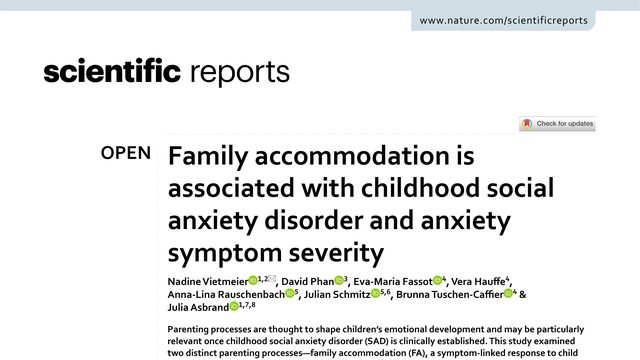
Nadine Vietmeier, David Phan, Eva-Maria Fassot, Vera Hauffe, Anna-Lina Rauschenbach, Julian Schmitz, Brunna Tuschen‐Caffier, Julia Asbrand
When a child is afraid, a parent naturally tries to make things easier. But this study suggests that repeatedly changing family life around that fear may be tied to more severe childhood social anxiety.When a child is anxious, parents often try to make life easier. This study asks whether those symptom-linked accommodations are also connected to more severe childhood social anxiety.
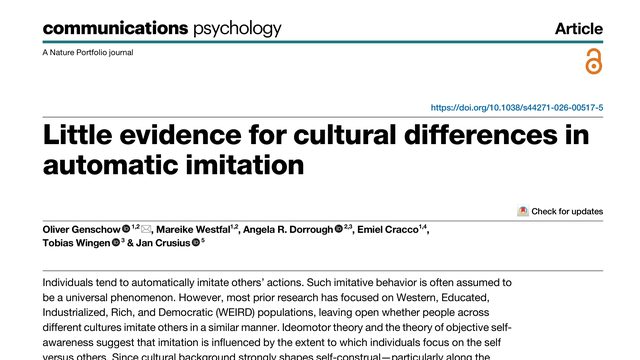
Oliver Genschow, Mareike Westfal, Angela Rachael Dorrough, Emiel Cracco, Tobias Wingen, Jan Crusius
When someone across from you lifts a finger, your own hand may be pulled toward copying them before you decide anything. The surprising question is whether that hidden pull changes with culture.If people automatically imitate each other, does that tendency depend on whether their culture emphasizes the group or the individual? This study tested that question across twenty-two nations, and found little evidence that culture changes the basic effect.
 3:34