Comparing the performance of machine learning and conventional models for predicting atherosclerotic cardiovascular disease in a general Chinese population
Curious3:55CCAI
paperi.ai
0:00 / 0:00
Zihao Fan, Zhi Du, Jinrong Fu, Ying Zhou, Pengyu Zhang, Chuning Shi, Yingxian Sun
Heart disease remains the world's leading cause of illness and death, yet the familiar risk calculators can misjudge some people. A computer trained on many kinds of health information may offer a better warning.
Heart disease remains the world's leading cause of illness and death, yet the familiar risk calculators can misjudge some people. A computer trained on many kinds of health information may offer a better warning. Atherosclerotic cardiovascular disease includes heart attacks, deaths from coronary heart disease, and strokes, and it has become the leading cause of illness and death worldwide.
Finding people at high risk matters because prevention works best before the first event. But personalized cardiovascular risk assessment remains a challenge in clinical practice. Guidelines recommend risk calculators, but widely used tools were built mainly from populations unlike many people in China, and overestimation or underestimation has been reported.
A calculator designed for Chinese adults still needs more evidence across different populations. So the study set out to predict cardiovascular disease in a general community population in Northeast China using demographic, behavioral, psychological, heart-tracing, and heart-imaging information.
It then compared machine-learning approaches with the traditional risk calculations to see which provided better predictions. The information included everyday facts such as age, sex, blood pressure, body size, lifestyle, and blood tests, along with hundreds of measurements from heart tracings and several from heart imaging.
The selection process worked like sorting a crowded toolbox: it repeatedly removed tools that added little and kept the measurements that carried the most useful information. Several machine-learning classifiers were trained on eighty percent of the dataset, with the remaining twenty percent reserved for testing.
The study then evaluated these machine-learning risk models alongside the usual calculators, including PCE and China-PAR, using several performance measures. The comparison asked not only whether the models separated higher-risk from lower-risk people, but also whether their estimated risks matched what actually happened and whether they could support better decisions.
After reducing the information to thirty key predictors, the artificial neural network performed better than the other machine-learning approaches in both separating risk levels and keeping its predictions consistent. Its overall prediction score was higher than the scores of the Chinese and conventional calculators.
The practical question is whether using these risk estimates would help clinicians make better decisions than treating everyone the same. Across likely high-risk cutoffs, the machine-learning approaches and established risk tools provide broadly similar, modest added benefit, so their real-world advantage may be limited.
In this Northeast China population, the established calculators separated higher-risk from lower-risk people reasonably well, but their predicted levels did not match reality closely enough. The artificial-neural-network model using thirty clinical variables performed better than those calculators, even after the calculators were adjusted for this population.
That suggests machine learning could improve risk prediction, although further studies are needed before it can strengthen clinical decisions. The model cannot show the separate effect of each variable or easily identify which treatment would reduce one persons risk, and longer follow-up is needed for a disease that develops over time.
Its accuracy also still needs testing in different populations, and changing blood pressure or blood sugar during follow-up was not taken into account. In this Chinese community population, the strongest machine-learning approach predicted future cardiovascular disease better than the usual calculators, though it still needs testing in other populations before changing care.
A derivative work by Paperi · AI-generated script, voice and captions
· pages and figures unaltered
Made with Paperi.
Drop in a research PDF — get a narrated video walkthrough like this one,
with highlights that follow the narration. Free to start.
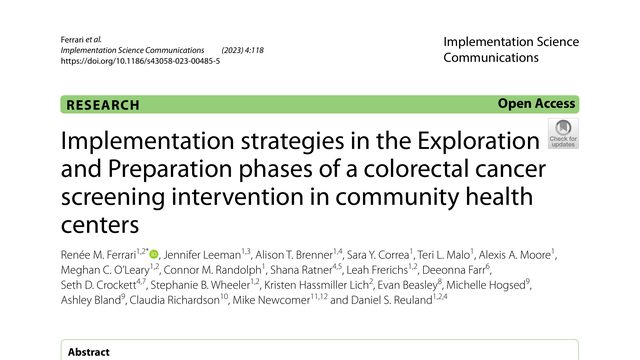
Renée M. Ferrari, Jennifer Leeman, Alison T. Brenner, Sara Y. Correa, Teri L. Malo, Alexis Moore, Meghan C. O’Leary, Connor M. Randolph, Shana Ratner, Leah Frerichs, Deeonna E. Farr, Seth D. Crockett, Stephanie B. Wheeler, Kristen Hassmiller Lich, Evan Beasley, Michelle Hogsed, Ashley Bland, Claudia Richardson, Mike Newcomer, Daniel S. Reuland
Colorectal cancer screening can save lives, yet the people most likely to be missed are often those with lower incomes or no insurance. This study asked how to make screening fit the places serving them.Colorectal cancer screening can save lives, yet it remains especially underused in underserved communities. This project’s surprising solution was not simply a better test—it was redesigning who does the work and how the pieces connect.
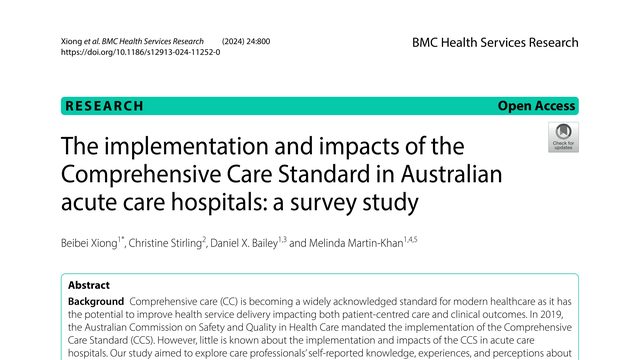
Beibei Xiong, Christine Stirling, Daniel X. Bailey, Melinda Martin‐Khan
A hospital can have skilled professionals, a national care standard, and still fail to give every patient one joined-up plan. This study found that confidence was high—but the support needed to make care consistent was not.Australian hospital professionals generally felt confident delivering comprehensive care—but the weakest point was creating one shared care plan, and nearly one in five reported that none of their unit’s patients had one.
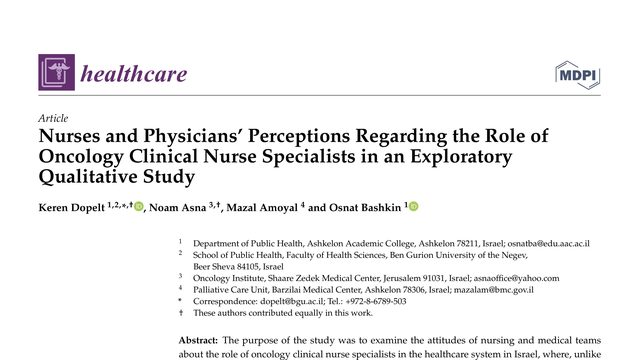
Cancer care is not only about choosing a treatment. Patients and families also need someone to help connect medical decisions, daily problems, and the long stretch after treatment. This study asks whether oncology nurses could fill that missing role in Israel.Israel faces a large cancer burden, yet oncology clinical nurse specialists have not been established there. This study asks what nurses and physicians think such a role could contribute—and where its boundaries should be drawn.
 3:03
3:03