What if a postpartum anti-inflammatory drug could support sow welfare without improving piglet survival at all? This study tests ketoprofen against a conventional treatment—and finds a much more complicated story.
Objective: Inflammation and pain management in postpartum hyperprolific sows is currently an important animal welfare issue in the swine industry. The present study investigates effects of ketoprofen treatment on the incidence of post-parturient disorders, feed intake, colostrum yield, piglet colostrum intake, colostrum immunoglobulin G (IgG) and piglet mortality rate during the first 3 days of postnatal life. Methods: In total, 61 Danish Landrace×Yorkshire crossbred sows and their offspring (n = 833) were included in the experiment. The sows were randomly distributed into two groups: i) control (n = 31), sows were treated with tolfenamic acid 2 mg per kg for 2 days postpartum; ii) ketoprofen (n = 30), sows were treated with ketoprofen 3 mg per kg for 2 days postpartum. The farrowing process of the sows was monitored for 24 h daily, and data associated with farrowing were collected. Piglet colostrum intake, sow colostrum yield and colostrum IgG were determined. Results: During the first 3 days postpartum, the incidence of sows that had fever did not differ between control and ketoprofen groups (51.6% and 56.7%, respectively, p = 0.692). Piglet colostrum intake did not differ between control and ketoprofen groups (p = 0.736). However, the proportions of piglets that had inadequate colostrum intake were 71.3%, 22.6%, and 5.4% in those with birth weights of <1.0 kg, 1.0 to 1.29 kg, and ≥1.30 kg, respectively (p<0.001). The piglet mortality rate did not differ between control and ketoprofen groups (p = 0.808). Conclusion: Administration of ketoprofen in postpartum sows for 2 days can control the evidence of post-parturient disorders in sows as effectively as the use of tolfenamic acid. No deleterious effect of ketoprofen was detected on sow colostrum yield, piglet colostrum intake and piglet mortality. Therefore, ketoprofen can be recommended as an alternative anti-inflammatory drug used in postpartum sows. Keywords: Colostrum; Inflammation; Ketoprofen; Lactational Pig
Transcript
What if a postpartum anti-inflammatory drug could support sow welfare without improving piglet survival at all? This study tests ketoprofen against a conventional treatment—and finds a much more complicated story. Inflammation and pain management in postpartum hyperprolific sows is currently an important animal welfare issue in the swine industry.
The study investigates effects of ketoprofen treatment on post-parturient disorders, feed intake, colostrum yield, piglet colostrum intake, colostrum immunoglobulin G, and piglet mortality rate during the first 3 days of postnatal life. Ketoprofen is an NSAIDs that has analgesic, anti-inflammatory and antipyretic properties.
A previous study demonstrated that a single injection of ketoprofen within 1.5 hours after farrowing can improve piglet survival during the lactation period. However, there were no clinical studies on ketoprofen in post-parturient sows in a tropical environment in relation to farrowing duration, sow parity number, colostrum yield and piglet survival.
The study therefore investigated postpartum ketoprofen treatment and post-parturient disorders, feed intake, sow colostrum yield, piglet colostrum intake, colostrum immunoglobulin G, and piglet mortality during the first 3 days of postnatal life. The study was a case-control study including 61 Danish Landrace×Yorkshire crossbred multiparous sows and their offspring, totaling 833 newborn piglets.
It was conducted in a commercial swine herd in the western region of The study took place in Thailand between July and August 2020. The sows were randomly distributed into a control group treated with tolfenamic acid at 2 milligrams per kilogram for 2 days postpartum, or a ketoprofen group treated with ketoprofen at 3 milligrams per kilogram for 2 days postpartum.
The farrowing process was monitored from start to end for 24 hours daily, and all records associated with farrowing were carefully collected. Postpartum sow characteristics were determined for 4 days postpartum, while piglet birth weight, body weight at 24 hours postpartum, and mortality during the first 3 days were collected.
Piglet parameters included birth order, birth interval, birth weight and day of mortality, and all piglets were individually identified by a pen marker on their back. Body weight was determined immediately after birth, again at 18 to 24 hours, and at day 3 of postnatal life using a digital bench scale.
Piglets were classified by birth weight as low, below 1.0 kilogram; moderate, 1.0 to 1.29 kilograms; or high, above 1.3 kilograms. A colostrum intake of less than 300 grams was considered inadequate, and sow colostrum yield was calculated by summing the colostrum intake of each individual piglet within the litter.
The statistical analyses were performed using SAS version 9.4. The data were classified into sow data, with 61 sows, and piglet data, with 833 piglets. The statistical models included treatment groups, parity group, and their two-way interaction, with the sow considered the experimental unit.
Least-square means were obtained from each class of the factors and compared using the least significant difference test. Table three reports the percentage of multiparous sows with a rectal temperature of at least thirty-nine point five degrees Celsius during the first three days after farrowing.
On day one, the incidence was sixteen point one percent for controls and three point three percent with ketoprofen, while days two and three were thirty-two point three versus thirty-six point seven, and nineteen point four versus thirty-three point three percent, respectively.
None of the p-values—zero point zero nine three, zero point seven one seven, or zero point two one five—indicates a statistically significant difference. Of all 61 sows, fever was detected in 33 sows, or 54.1 percent, during the first 3 days postpartum.
During the first 3 days postpartum, fever did not differ between ketoprofen and control groups: 56.7 percent versus 51.6 percent, with a p-value of 0.692. Across groups, fever on day 2 was higher in sows with prolonged farrowing duration, above 300 minutes, than in sows with normal farrowing duration: 22.2 percent versus 4.7 percent.
Abnormal vaginal discharge was detected in 50.8 percent of sows, and prolonged farrowing duration was associated with a higher incidence than normal farrowing duration: 77.8 percent versus 39.5 percent. Table two compares thirty-one control sows with thirty sows treated with ketoprofen postpartum across reproduction, farrowing, colostrum, post-parturient disorders, and piglet outcomes.
The reported p-values range from zero point three zero nine to zero point nine eight four for these comparisons, including colostrum yield, immunoglobulin G concentration, piglet colostrum intake, and mortality during the first three days. This matters because the table assesses whether the postpartum protocol was associated with measurable differences in sow or early-life piglet performance.
Colostrum intake varied from 5.5 to 991.4 grams, and 20.8 percent of all piglets had inadequate colostrum intake. Inadequate colostrum intake occurred in 71.3 percent of low-birth-weight piglets, 22.6 percent of moderate-birth-weight piglets, and 5.4 percent of high-birth-weight piglets.
The mortality rate during the first 3 days was lower in piglets with adequate colostrum intake than in piglets with inadequate colostrum intake: 3.2 percent versus 15.2 percent. Across groups, piglet mortality rates were 24.8 percent in low-birth-weight piglets, 7.2 percent in moderate-birth-weight piglets, and 4.7 percent in high-birth-weight piglets.
Table five compares colostrum yield in Danish Landrace-by-Yorkshire sows receiving ketoprofen postpartum or the conventional herd protocol. For parity numbers three to five, yields were five point six five plus or minus zero point two six kilograms under control and five point eight one plus or minus zero point two seven with ketoprofen, with a p-value of zero point six five four.
For parity numbers six to nine, the corresponding values were five point zero six plus or minus zero point two seven and five point zero two plus or minus zero point two seven, with a p-value of zero point nine one nine, while the superscripts indicate significant differences within a column.
Across groups, sow colostrum immunoglobulin G averaged 41.6 grams per liter, with a range from 15.7 to 98.7 grams per liter. The Brix value averaged 26.6 percent, and colostrum immunoglobulin G was significantly correlated with the Brix value. Colostrum immunoglobulin G did not differ significantly between control and ketoprofen groups: 41.5 versus 41.7 grams per liter, with a p-value of 0.956.
Brix values also did not differ between control and ketoprofen groups: 26.3 percent versus 26.8 percent, with a p-value of 0.520. Administration of ketoprofen in postpartum sows for 2 days can control the evidence of post-parturient disorders as effectively as tolfenamic acid.
No negative impacts of ketoprofen on sow colostrum yield, piglet colostrum intake and piglet mortality were detected. Therefore, ketoprofen can be recommended as an alternative NSAIDs used in postpartum sows. Ketoprofen performed similarly to tolfenamic acid for the measured postpartum outcomes, with no detected negative effects on colostrum or piglet mortality.
But birth weight and colostrum intake mattered far more for piglet risk.
A derivative work by Paperi · AI-generated script, voice and captions
· pages and figures unaltered
Made with Paperi.
Drop in a research PDF — get a narrated video walkthrough like this one,
with highlights that follow the narration. Free to start.
Cancer treatment can attack healthy tissue while attacking a tumor. This review asks whether proteins from colostrum, the first milk after birth, could help protect the body without weakening treatment.Cancer treatments can attack healthy tissues while attacking tumors. This review asks whether colostrum proteins, especially lactoferrin, could reduce those injuries while preserving or even improving treatment effects.
Michael Mollenhauer, Abdullah Irfan, Xi Cao, Supriya Mandal, Wolfgang Pfaff
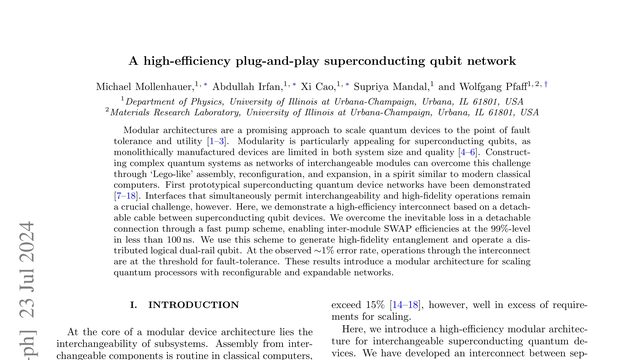
What if a quantum computer did not have to be built as one giant, delicate object? This experiment shows that separate quantum devices can be connected by a cable, unplugged, and still exchange information with about one percent loss.What if scaling a quantum computer looked less like fabricating one enormous chip—and more like plugging together replaceable modules? This paper shows a detachable cable moving quantum information with roughly one-percent loss in under one hundred nanoseconds.
Yan Huang, Yao Deng, Xiaoming Jiang, Yiyuan Chen, Tianxin Mao, Yong Xu, Caihong Jiang, Hengyi Rao
Why can one adult learn a new word almost effortlessly while another struggles? This study suggests the answer may partly lie in how two distant parts of the resting brain keep time together.Some adults learn new words much more easily than others. This study asks whether that difference can already be seen in the resting brain, before the learning task even begins.
 4:15
4:15