Non-invasive investigation of Polychromophilus parasite infections in bat populations in Serbia using bat flies
Curious3:37CCAI
paperi.ai
0:00 / 0:00
Branka Bajić, Oskar Werb, Ivana Budinski, Jelena Blagojević, Juliane Schaer, Jaap van Schaik
A bat can carry a hidden infection without giving researchers an easy way to check. This study finds that the bat fly riding on its body can act like a tiny, non-invasive warning signal.
Background Haemosporidian parasites of the genus Polychromophilus infect bats worldwide. They are vectored by obligate ectoparasitic bat flies of the family Nycteribiidae. Despite their global distribution, only five Polychromophilus morphospecies have been described to date. The two predominant species, Polychromophilus melanipherus and Polychromophilus murinus, are broadly distributed and mainly infect miniopterid and vespertilionid bats, respectively. In areas where species from different bat families aggregate together, the infection dynamics and ability of either Polychromophilus species to infect other host families is poorly characterized. Methods We collected 215 bat flies from two bat species, Miniopterus schreibersii and Rhinolophus ferrumequinum, which sometimes form mixed clusters in Serbia. Miniopterus schreibersii is known to be frequently infected with P. melanipherus, whereas R. ferrumequinum has been observed to be incidentally infected with both Polychromophilus species. All flies were screened for Polychromophilus infections using a PCR targeting the haemosporidian cytb gene. Positive samples were subsequently sequenced for 579 bp of cytochrome b (cytb) and 945 bp of cytochrome oxidase subunit 1 (cox1). Results Polychromophilus melanipherus DNA was detected at six out of nine sampling locations and in all three examined bat fly species collected from M. schreibersii (Nycteribia schmidlii, n = 21; Penicillidia conspicua, n = 8; Penicillidia dufourii, n = 3). Four and five haplotypes were found for cytb and cox1, respectively. Evidence for multiple Polychromophilus haplotypes was found in 15 individual flies. These results point to a high diversity of P. melanipherus parasites in Miniopterus hosts and efficient transmission throughout the study area. A single Phthiridium biarticulatum bat fly collected from R. ferrumequinum screened positive for P. melanipherus, but only yielded a partial cox1 sequence fragment. Nevertheless, this result suggests that secondary hosts (both bat and fly species) are regularly confronted with this parasite. Conclusions The results of this study provide new insights into the prevalence and distribution of Polychromophilus parasites in European bats and their nycteribiid vectors. The use of bat flies for the non-invasive investigation of Polychromophilus infections in bat populations has proven to be efficient and thus represents an alternative for large-scale studies of infections in bat populations without the need to invasively collect blood from bats.
Transcript
A bat can carry a hidden infection without giving researchers an easy way to check. This study finds that the bat fly riding on its body can act like a tiny, non-invasive warning signal. Parasites related to Polychromophilus infect bats worldwide, including temperate regions.
In Europe, two main kinds are usually linked to different bat groups, but both have also been found in other bat families. The unresolved question is how often those parasites move beyond their usual bat hosts, especially where different bat families gather together.
The investigation used bat flies to look for these infections instead of taking blood from bats. That works like checking a coat for traces left by its wearer: the fly can carry evidence of what it encountered. The researchers focused on shared roosts, asking whether infections would occur in flies from R.
ferrumequinum alongside Miniopterus, or independently in that host. They also hypothesized that even accidental spillover could introduce both parasite species into each host-and-fly system and let them persist when both bat species were present. The study covered roosting sites in Serbia and Bosnia and Herzegovina, including places shared by the two bat species and places used by only one of them.
The bats were released after processing, while their flies were collected and identified before being checked for parasite DNA. The main parasite was found at six of the nine locations and in all three kinds of bat flies taken from one bat species. The flies also carried several genetic forms of the parasite.
Some individual flies carried evidence of more than one form, pointing to high parasite diversity and efficient spread across the study area. The parasite’s genetic patterns are shared across different bat-fly species rather than sorting neatly by host, suggesting these flies may exchange the same parasite lineages instead of carrying strictly separate ones.
Infection was much more common in the two Penicillidia fly species than in the third fly species, although fewer flies of those kinds were examined. The researchers suggest that larger blood meals or more frequent feeding could help explain the difference.
Together with their ability to carry both European parasite species and their broad range of bat hosts, these flies show how mixed cave communities could allow infections to spill over. A single fly from the second bat species tested positive, but that result has two possible explanations: the fly may have been infected, or it may simply have carried blood from a recently infected bat.
The study therefore cannot confirm either where that infection came from or whether this fly species can pass the parasite on. The researchers also suggest that barriers may limit the parasite's persistence in R. ferrumequinum and in its associated bat flies.
The study adds information about where these parasites occur and how genetically varied they are in European bats and their flies. It also records one possible spillover into a fly associated with a different bat species. Most importantly, collecting bat flies offers an efficient alternative to taking blood from bats, making wider monitoring of bat infections possible with less disturbance to the animals.
Bat flies revealed widespread and genetically varied parasite infections, plus a possible jump into a different bat setting. That gives researchers a practical way to monitor bat health without drawing blood.
A derivative work by Paperi · AI-generated script, voice and captions
· pages and figures unaltered
Made with Paperi.
Drop in a research PDF — get a narrated video walkthrough like this one,
with highlights that follow the narration. Free to start.
When standard leukemia treatments fall short, the body may already have another weapon: immune cells that can recognize and attack cancer without needing the same target as other immune therapies.CLL treatments have improved, but high-risk disease and drug resistance remain serious problems. This review asks whether natural killer cells can provide a more flexible way to attack leukemia.
Luke C. Cooksey, Derek C. Friesen, Enrique D. Mangan, Porunelloor A. Mathew
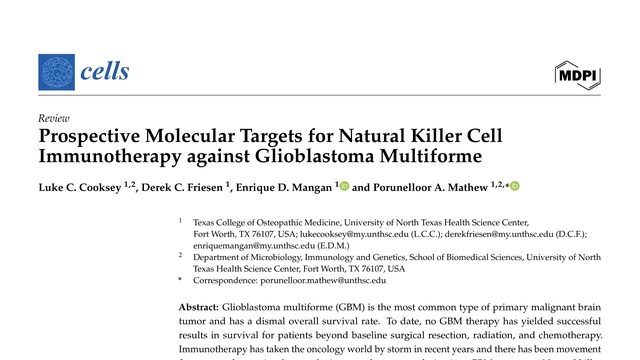
Glioblastoma is a devastating brain cancer, and standard treatment has not produced lasting survival gains. This review asks whether the body’s natural killer cells can be directed toward the tumor in several different ways.Glioblastoma is notoriously difficult to treat, but this review points to a different strategy: instead of asking NK cells to recognize one perfect tumor antigen, block the molecular brakes that keep them from attacking.
Nabanita Mukherjee, Elizabeth Katsnelson, Tonya M. Brunetti, Kylie Michel, Kasey L. Couts, Karoline A. Lambert, William A. Robinson, Martin D. McCarter, David A. Norris, Richard P. Tobin, Yiqun G. Shellman
What if a melanoma drug works not by attacking the cancer directly, but by removing the cells that stop the immune system from attacking it? This study points to that unexpected possibility.What if an MCL1 inhibitor fights melanoma not mainly by killing tumor cells, but by removing the immune-suppressing cells that help tumors evade treatment? This study tests that idea and combines the inhibitor with anti-PD-1.
 5:22
5:22