Expression patterns of CD24 and CD27 resolve the origins and gradual differentiation of CD11c+ atypical memory B-cells after malaria infection
Overview3:53CCAI
paperi.ai
0:00 / 0:00
Alan‐Dine Courey‐Ghaouzi, Linn Kleberg, Zaynab Mousavian, Maximilian Julius Lautenbach, Marta Pirronello, Ganesh E. Phad, Mattias N.E. Forsell, Anna Färnert, Christopher Sundling
After malaria, some immune cells long treated as exhausted may actually be moving through a carefully ordered life cycle. The surprising part is that cells from different beginnings can end up in the same late state.
Atypical B-cells (ABCs) are observed across infections, yet their ontogeny and differentiation remain unclear. Using highdimensional flow cytometry, single-cell transcriptomics, V(D)J sequencing, and functional assays in samples from individuals with malaria and healthy donors, we identify markers of cellular origin while tracking ABC differentiation. Early ABCs express CD11c and arise predominantly from memory B-cells. Two intermediate states originate from germinal center-derived and marginal zone-like Bcells. Pseudotime and lineage analyses reveal trajectories marked by progressive loss of CD24 and CD27, which is recapitulated in vitro, defining bona fide differentiation programs. Differentiation culminates in late ABCs lacking CD24, CD27, and CD21, while expressing CD11c, T-bet, and NKG7 at high levels, exhibiting partial overlap with double-negative-2 B-cells. Early and intermediate stages show greater plasma-cell differentiation potential and cytokine production capacity, whereas later stages acquire transcriptomic signatures of antigen presentation and association with microbial particles, defining stage-dependent functions that reconcile conflicting ABC roles. Comparable ABC populations occur in healthy blood and tonsils, with tissue-associated class switching and CD86 expression consistent with recent T-cell interaction. This framework consolidates ABC definitions along a single differentiation axis and clarifies their cellular origins.
Transcript
After malaria, some immune cells long treated as exhausted may actually be moving through a carefully ordered life cycle. The surprising part is that cells from different beginnings can end up in the same late state. B cells help make antibodies, remember past threats, and regulate immune responses.
A group called atypical B cells became associated with disease and was first described as exhausted because of altered features and reduced responsiveness. Atypical B cells are now recognized as a dynamic population with marker expression and functions that vary depending on context.
Evidence indicates that atypical B cells are varied, which may explain their different functions. Their origins, relationships, and paths of change have remained poorly defined, causing conflicting interpretations. The study found that atypical B cells form one gradual continuum, with distinct memory and outside-the-usual tissue origins converging on a shared late state and changing functions along the way.
One route moved from inexperienced B cells through ordinary memory stages and intermediate atypical cells toward late atypical cells, reflecting progressively later stages. A second route passed through switched memory cells and ended in early atypical cells, especially influenced by one antibody class.
These routes may reflect different immune jobs or origins, but they do not prove a single straight chain of direct changes. Here is the everyday picture: think of a workplace with employees moving through early, middle, and late roles. These immune cells also occupied early, late, and two intermediate stages, identified by changing surface signals and internal activity.
The balance shifted with infection status: early cells were more common in healthy donors, while late cells were more common in people with malaria. The intermediate groups were transition states from different beginnings.
One came from memory cells formed in organized immune tissues, while the other came from memory cells resembling those found at the edges of immune tissues. Both of these routes eventually converged into the late atypical state.
The cells also changed jobs as they moved along the path. Early stages retained the ability to become antibody-producing cells and release immune signals, while late stages gained features linked to handling particles and displaying targets to other immune cells. These functional results supported the broader framework linking the cells' changing surface signals with their stage of development.
Across people with malaria and healthy donors, the stages showed gradual changes in internal activity, surface features, and function. The cells came from switched and unswitched memory cells formed in organized immune tissues, and from memory cells resembling those at immune-tissue edges.
Two surface signals helped separate the intermediate stages and connected stage with the ability to become antibody-secreting cells. That ability diminished in later groups under one type of immune stimulation. Malaria served as a model of inflammation that begins and then resolves, but the conclusions are meant to describe broader principles of atypical B-cell change, not malaria alone.
The analysis covered the wider pool of responding B cells rather than cells directly identified as targeting malaria, so the paths and functions describe the overall activated immune-cell group during infection. These cells are not one mysterious, fixed group: they form a gradual path, with different origins and changing jobs.
That map could help researchers interpret immune responses more clearly across infections.
A derivative work by Paperi · AI-generated script, voice and captions
· pages and figures unaltered
Made with Paperi.
Drop in a research PDF — get a narrated video walkthrough like this one,
with highlights that follow the narration. Free to start.
Gehad A. Basuony, Alshaimaa Hamed, Amal M. Mahfoz, Abdel Wahab M. Mahmoud, Hala Ramadan, Magda Said Ahmed Abdeltawab
A common gut parasite may be vulnerable not only to its usual medicine, but also to a diabetes drug and onion extract. The surprise is that killing it may involve changing its energy system and its chemical surroundings.What happens when a common antiparasitic drug, a diabetes medicine, and onion extract meet Blastocystis? This study finds that all three can suppress the parasite, but they do not shift its biochemical environment in the same way.
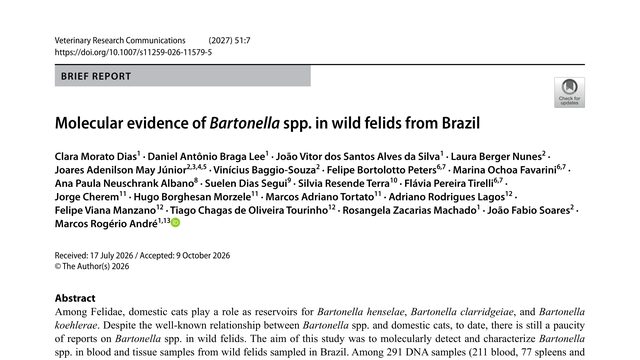
Clara Morato Dias, Daniel Antônio Braga Lee, João Vitor dos Santos Alves da Silva, Laura Berger Nunes, Joares Adenilson May Júnior, Vinícius Baggio-Souza, Felipe Bortolotto Peters, Marina Ochoa Favarini, Ana Paula Neuschrank Albano, Suelen Dias Segui, Sílvia Resende Terra, Flávia Pereira Tirelli, Jorge Cherém, Hugo Borghesan Morzele, Marcos Adriano Tortato, Adriano Rodrigues Lagos, Felipe Viana Manzano, Tiago Chagas de Oliveira Tourinho, Rosângela Zacarias Machado, João Fábio Soares, Marcos Rogério André
Wild cats may be carrying bacteria linked not only to domestic cats, but also to the rodents and fleas they hunt. That changes how scientists think about disease moving through Brazil’s wildlife.Wild felids are not just possible carriers of the Bartonella associated with domestic cats. In Brazil, their sequences also clustered with Bartonella linked to wild rodents and fleas.
Sylvia Rofael, Clara Leboreiro-Babe, Mehmet Davrandi, Alexandra L Kondratiuk, Leanne Cleaver, Naseem Ahmed, Claire Atkinson, Timothy D. McHugh, David M. Lowe
For people whose immune defenses are already weakened, antibiotics can be lifesaving. But this study finds that the bacteria living in their airways may already resist many of those drugs, and may even pass resistance between patients.Patients with antibody deficiency face frequent respiratory infections, but the antibiotics intended to protect them may also help select widespread resistance. This study traces that resistance and tests a possible way to guide treatment.
 4:47